Lowrider
November 4, 2008 by cgilde
What is an American? If a person is not an American, how do they become an American? Why would they want to be one? Land of opportunity? You don’t need to be American to be successful, do you? There seems to be a lot of foreign interests in this country. But hasn’t there always been? My great-grandfather came to New Amsterdam, New York, at the turn of the last century and bought a little American grocery store with dirt floors. He wanted to be an American more than anything else, even though he knew little English and was ashamed for a long time of his German background, especially during WWI, and it was that store that made him an American (even though 50 percent of New Amsterdam’s population at that time was of German descent).
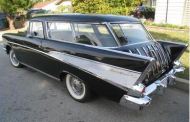 Here’s a thought. What if I wanted to buy an All-American automobile today? I’m afraid there wouldn’t be any guarantees there, not like that first American car I bought right out of high school in ’66: a 1957 Chevy Nomad. Now, that was an American automobile. One hundred percent American made. Need a distributor? Delco products American made. Spark plugs? AC Delco, American made. Steel? Bethlehem Steel Works, USA, naturally. Body by Fischer. Well, if it’s made in America, then, by God, it must be American. Of course, a person could modify their American-made car, to give it a little personality, a little cultural identity.
For example, “Lowrider” culture of the late 60’s and early 70’s sought to codify California Car culture, making it uniquely Mexican (most popular were the Chevy Impalas because the suspension could be cheaply modified). In fact, pachucos have cruised Sunset Strip bajito y suavecito (low and slow) since the 1940’s. In fact, my friends and I used to watch with amazement the “dances” of these radically modified or Mexicanized cars. The hydraulics in the suspension would allow the car to jump up and down in this crazy dance. This is a good example of a distinctly American medium becoming assimilated into the Mexican culture. Chicanos of the L.A. Barrio, children of immigrants, struggling with poverty and discrimination, took this icon of the American Dream ( Chevys and Cadillacs often salvaged from wrecking yards) and created a distinctly new form of Mexican (or American?) culture.
You can’t buy distinctly American cars anymore anyway. They’re assembled in factories owned by foreign companies employing American workers using parts manufactured in other countries. But they’re still called American cars. Unlike many people, I suppose, this doesn’t bother me. When I was young and naïve, I wanted to buy American only because I was an American, and, of course, I knew what being American was all about (although, regrettably, that included for a short time being a republican). Being American meant I didn’t buy stuff “Made in Japan.” And now, ironically, my prized possession (next to my dog, Roscoe, who was born in America, so that makes him an American, even though he is a Jack Russell, and they’re from England) is my Toyota pick up truck! No matter though; by God, it’s made in America too, and besides, Americans invented the pick up (I think).

 Call and Response
Lowrider
November 4, 2008 by cgilde
What is an American? If a person is not an American, how do they become an American? Why would they want to be one? Land of opportunity? You don’t need to be American to be successful, do you? There seems to be a lot of foreign interests in this country. But hasn’t there always been? My great-grandfather came to New Amsterdam, New York, at the turn of the last century and bought a little American grocery store with dirt floors. He wanted to be an American more than anything else, even though he knew little English and was ashamed for a long time of his German background, especially during WWI, and it was that store that made him an American (even though 50 percent of New Amsterdam’s population at that time was of German descent).
For example, “Lowrider” culture of the late 60’s and early 70’s sought to codify California Car culture, making it uniquely Mexican (most popular were the Chevy Impalas because the suspension could be cheaply modified). In fact, pachucos have cruised Sunset Strip bajito y suavecito (low and slow) since the 1940’s. In fact, my friends and I used to watch with amazement the “dances” of these radically modified or Mexicanized cars. The hydraulics in the suspension would allow the car to jump up and down in this crazy dance. This is a good example of a distinctly American medium becoming assimilated into the Mexican culture. Chicanos of the L.A. Barrio, children of immigrants, struggling with poverty and discrimination, took this icon of the American Dream ( Chevys and Cadillacs often salvaged from wrecking yards) and created a distinctly new form of Mexican (or American?) culture.
You can’t buy distinctly American cars anymore anyway. They’re assembled in factories owned by foreign companies employing American workers using parts manufactured in other countries. But they’re still called American cars. Unlike many people, I suppose, this doesn’t bother me. When I was young and naïve, I wanted to buy American only because I was an American, and, of course, I knew what being American was all about (although, regrettably, that included for a short time being a republican). Being American meant I didn’t buy stuff “Made in Japan.” And now, ironically, my prized possession (next to my dog, Roscoe, who was born in America, so that makes him an American, even though he is a Jack Russell, and they’re from England) is my Toyota pick up truck! No matter though; by God, it’s made in America too, and besides, Americans invented the pick up (I think).
Share this:
Related
Posted in Memoir, Social Commentary | Leave a Comment
Comments RSS