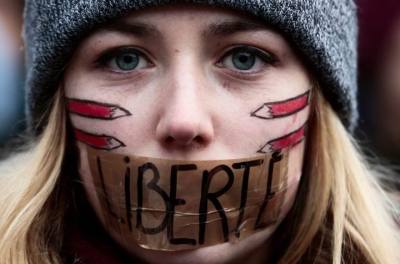
Woman protests outside the French embassy. Free speech?
In a healthy democracy we should be encouraged by the fact that we continue to debate what counts as protected free speech and whether or not how we choose to personally exercise our right to free speech can be limited or censored in any way.
The recent terrorist massacre at the offices of the French satirical newspaper Charlie Hebdo last month has got us talking about free speech again. Since the tragedy, world reaction to the massacre has slowly evolved from initial reactions of horror, shock, and sympathy to reactions of condemnation, criticism, and cries for censorship, all directed at Hebdo’s satiric cartoons. And now a kind of “they had it coming” blame reversal is surfacing. One New York Post blogger, Nicole Gelinas, described the blame shifting as “blaming the victim.” It’s Hebdo’s fault. If they weren’t making fun of one of the world’s great religions, then the massacre wouldn’t have happened. Ah, they had it coming.
As a side note, Iran has now stepped into the free speech debate by launching a global cartoon competition based on the theme of holocaust denial. This is their second such contest, the first was held in 2006, the year after Danish newspaper published a cartoon depicting the Muslim prophet Muhammad wearing a bomb with a lit fuse for a turban. What a holocaust denial cartoon would look like, I’m not at all sure, but the first prize winner in 2006 was a drawing of a construction crane with a Star of David on the side setting concrete barriers around Temple Mount. The outside of these barriers pictured a black and white photograph of Auschwitz. First prize for the best cartoon is a modest $12,000. The contest is organized by the Tehran-based House of Cartoons and the Sarcheshmeh Cultural Complex, and claims to celebrate free speech.
So those making the argument against Hebdo’s right to satirize religion would restrict their ability to do so by censoring what they can say about religion. Their argument is that as long as the speech you create doesn’t insult somebody’s religion, you are free to say anything you want. This reasoning reminds me of what George Orwell wrote in his 1945 preface to his novel Animal Farm:
If liberty means anything at all, it means the right to tell people what they do not want to hear.
To those who have been insulted by Hebdo’s satiric cartoons, I would think the Orwellian question to ask is What is it that these cartoons are “saying” about their (or anyone’s) religion that they themselves “do not want to hear”? Maybe what they don’t want to hear is that murder in the name of Islam is in some situations acceptable to some followers. Who can say? I’m certain it’s a divisive issue among Muslims; all followers of Islam do not support murder as a way of silencing critics of their religion, but some do.
If the debate is over free speech is framed by the question of whether or not there should be limits on speech, limits on what we can write, on what we can say in public, and, in the case of Charlie Hebdo, limits on what we can draw, then what are the justifications for these limits? In the case of religion, justifications for limiting free speech are on shaky ground. Let’s consider Pope Francis’ arguments in response to the massacres. He, of course, condemned the murders, but he also suggested that maybe Charlie Hebdo “had it coming,” that they had gone too far by using religion as a target of their satire. He defended free speech but made it clear that there should be limits. “You cannot provoke,” he said. “You cannot insult the faith of others. You cannot make fun of the faith of others.” If you do go “too far,” if you satirize someone’s religion and they are insulted by that satire, Pope Francis suggests that it’s not unreasonable to believe that some sort of reaction, even a potentially deadly one, will follow. The Pope’s argument here suggests free speech should be limited, not only to prevent insulting someone’s religion, but also to prevent any violence that might follow as a result of those insults. So is his argument that limiting free speech is acceptable if that speech will provoke violence reasonable?
On the surface the idea of limiting free speech is troubling to me. To my progressive and idealistic way of thinking, the very nature of free speech is that it be free, unrestricted, without limits. Absolute. Yet, defined this way, absolute free speech is like a loaded gun. Yet, I understand that if not used responsibly, that gun could cause great violence.
If I say something ugly to someone, I may face some sort of consequence. I also know if I choose to be ugly to someone, I’m free to do so. Calling someone an ugly name is not against any law. And I am sure there are folks who will say cruel and ugly things to people if for no other reason than to provoke them in some way, bullies, for example.
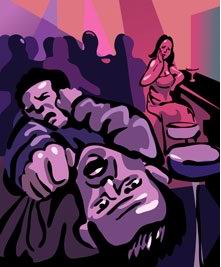
All-American Bar Fight
Also, some people, I’m certain, really enjoy going into a bar, getting shit-faced, and then provoking a total stranger into a fist fight by calling his girlfriend an ugly name. Some enjoy doing that. It’s not the right thing to do, but for some people, it’s a meaningful experience. Their motivations are not complicated. They just want to get drunk and kick the shit out of someone, and the best way to get that fight started is with ugly words. Should we, then, in the name of avoiding bar-fight violence, limit the ugly-word free speech of patrons in a bar? I don’t think so. Limiting free speech in a bar, even if it was possible, is not going to deter bar-fight lovers from engaging in their meaningful experience.
The point is there are different reasons, different motivations for exercising free speech, some good, and some bad. What of Charlie Hebdo’s motivation or the purpose for publishing their satiric cartoons? Do they want to provoke a good “bar fight”? Do they want to commit suicide? They knew in advance their cartoons would invite the hatred of religious zealots and eventually provoke some kind of extreme, violent reaction, and despite this fact, they continued publishing their cartoons. They knew the risks—they had already been the victim of a terrorist bombing in 2011—but they were willing to accept them. Obviously, exercising free speech to provoke bar fights is different from Hebdo satirizing religion to provoke violence. But I think it’s important to examine for a moment how we could characterize Hebdo’s mission as a news publication.
First, from Hebdo’s point of view, the only difference between them and any other news publication is
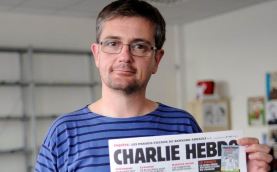
Stephane (Charb) Charbonnier, editor of Charlie Hebdo and murdered by terrorists Jan. 2015. Did he have it coming?
that they use drawings. The targets of their satire are all kinds of institutions, not just Islam. Stephane Charbonnier, the editor of Charlie Hebdo and one of the murdered victims, stated in a 2012 interview with Al Jazeera, that he felt that the Muslim response to his publication was normal and to be expected. The cartoons weren’t published to “please believers.” He understood, though, that many Muslims would be seriously offended by these cartoons. If that was the case Charbonnier hoped Muslim believers would not buy the newspaper to avoid doing themselves “harm.” If you don’t want to be offended by this material, don’t buy the newspaper.
Something else to consider is that Hebdo is part of a very long French tradition of mocking humor—referred to by the French as gouaille—that respects nothing about social, or political (the publication was once forced out of business for making fun of former President Charles de Gaulle’s death), or religious institutions.
They are in the business of offending everyone equally. Their goal is to undermine all that is held sacred by societal institutions. Nothing is sacred is their motto. The essence of Charlie Hebdo, according to Arthur Goldhammer, is to “express the inexpressible in images with the power to shock and offend.” Their belief is that as long the cultural and religious “tensions and turmoil” that exist between democracy and Islam remain unseen, nothing will be reconciled. Hebdo has a responsibility and the right, as Orwell states above, to “tell people what they do not want to hear.” This requires confrontation.
American media reaction suggests much of the press is confusing confrontation with provocation. Hebdo very much believes that free speech is in danger and that the only way to defend it is by testing the limits of free speech, by being as offensive as possible. Lyrr Descy believes that Hebdo is not in the business of deliberately provoking acts of violence; instead, through its cartoons, Hebdo “confront(s) its readers with unpalatable truths,” forces people to recognize the “hypocrisy, dogmatism, sexism, chauvinism, corruption and idiocy in all spheres of life.”
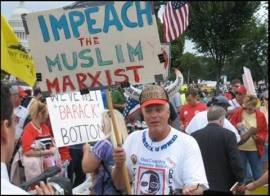
“Redneck” sign carrier. At the core of 1st Amendment Freedom of Speech language lies the fundamental dictum that we allow this man to express his views, despite how repugnant.
To protect our free speech, it is a necessary requirement to sometimes be tolerant of ugly expressions of speech in the world. Charbonnier and the editors of Charlie Hebdo would be quick to defend the right of the Islamic community to protest these cartoons, and they would condemn any attempt by the French government to restrict these protests, even for fear they would erupt in violence. A powerful irony is at work here. Even the ugliest kinds of speech need to be vigorously defended to ensure the continuation of our own right to free speech. Free speech must apply to everyone, even to those hateful, homophobic, and holier-than-thou Westboro Baptist Church “God Hates Fags” sign carriers. There’s no room for hypocrisy in the defense of free speech. Free speech for one requires the acknowledgement of free speech for all. Like it or not, “God Hates Fags” signs are as much an exercise of free speech as “Marriage Equality Now” signs, or “Impeach the Muslim Marxist!” signs. All of us has the right to express our political opinions, no matter how repugnant those opinions may be.
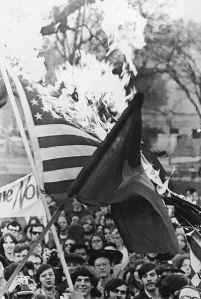
Students look on as US flag burns during an anti-Vietnam war protest.
I am also old enough to remember the anti-Vietnam war flag burning incidents in the 1960s. Setting the American flag, that sacred symbol and source of patriotic ideology, ablaze in public became an effective strategy for inciting the wrath of the war supporters. Flag burnings had a polarizing effect on America’s conscience. On one side, stood those who burned the flag in protest of the war in Vietnam, and on the other, those who defended the flag from being desecrated. To prevent the rash of anti-war flag burnings, states began to enforce laws against flag desecration that had been in effect since the late 1800s. By 1968, Congress had passed the Federal Flag Desecration Law, which made it a federal crime to “knowingly cast contempt upon any flag of the United States by publicly mutilating, defacing, defiling, burning, or trampling upon it.” But do citizens have a right to burn the flag as an expression of free speech? Is the act of flag burning a form of speech in the same way as speaking or writing or drawing political cartoons? The U.S. Supreme Court ruled in 1989 that it is. The decision was based upon the reasoning that flag burning constitutes a form of “symbolic speech” that is protected by the First Amendment. The majority clearly stated that freedom of speech does protect actions society may find very offensive, such as flag
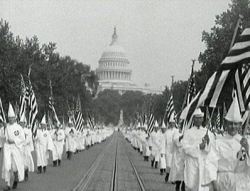
The KKK marches down Pennsylvania Avenue in Washington, D.C. in 1927. Free speech or Freedom of Speech? The irony in the image is powerful.
burning, Westboro Baptist Church anti-gay protests, KKK street marches, and so on, but the outrage alone is not justification enough for suppressing free speech.
But, in fact, does the First Amendment protect our right to free speech without limits? Is our right to speech absolute? Alexander Meiklejohn points to what he calls a “strangely paradoxical” meaning of the phrase “Congress shall make no law . . . abridging the freedom of speech . . .” The idea that under no circumstances shall the freedom of speech be abridged is an absolute. Yet as a part of any well-governed society, the legislature has the right and the duty to prohibit certain forms of speech, such as libel, slander, any words which “incite men to crime,” sedition and treason, must be outlawed for the sake of the “general welfare.” Here’s the paradox: Speech related to self-governing must have absolute First Amendment protection; “incidental speech (any speech not related to self-government such as gossip, sports, politics, etc.) is not protected speech and may be regulated in some way. In other words there are two ways in which we can understand the First Amendment concepts of speech: the idea of freedom of speech and the idea of speech itself. The former must never be abridged by Congress as it is an absolute; the latter, can be limited if it poses a threat to the general welfare of the state.

 Call and Response
In Defense of Free Speech
February 16, 2015 by cgilde
Woman protests outside the French embassy. Free speech?
In a healthy democracy we should be encouraged by the fact that we continue to debate what counts as protected free speech and whether or not how we choose to personally exercise our right to free speech can be limited or censored in any way.
The recent terrorist massacre at the offices of the French satirical newspaper Charlie Hebdo last month has got us talking about free speech again. Since the tragedy, world reaction to the massacre has slowly evolved from initial reactions of horror, shock, and sympathy to reactions of condemnation, criticism, and cries for censorship, all directed at Hebdo’s satiric cartoons. And now a kind of “they had it coming” blame reversal is surfacing. One New York Post blogger, Nicole Gelinas, described the blame shifting as “blaming the victim.” It’s Hebdo’s fault. If they weren’t making fun of one of the world’s great religions, then the massacre wouldn’t have happened. Ah, they had it coming.
As a side note, Iran has now stepped into the free speech debate by launching a global cartoon competition based on the theme of holocaust denial. This is their second such contest, the first was held in 2006, the year after Danish newspaper published a cartoon depicting the Muslim prophet Muhammad wearing a bomb with a lit fuse for a turban. What a holocaust denial cartoon would look like, I’m not at all sure, but the first prize winner in 2006 was a drawing of a construction crane with a Star of David on the side setting concrete barriers around Temple Mount. The outside of these barriers pictured a black and white photograph of Auschwitz. First prize for the best cartoon is a modest $12,000. The contest is organized by the Tehran-based House of Cartoons and the Sarcheshmeh Cultural Complex, and claims to celebrate free speech.
So those making the argument against Hebdo’s right to satirize religion would restrict their ability to do so by censoring what they can say about religion. Their argument is that as long as the speech you create doesn’t insult somebody’s religion, you are free to say anything you want. This reasoning reminds me of what George Orwell wrote in his 1945 preface to his novel Animal Farm:
If liberty means anything at all, it means the right to tell people what they do not want to hear.
To those who have been insulted by Hebdo’s satiric cartoons, I would think the Orwellian question to ask is What is it that these cartoons are “saying” about their (or anyone’s) religion that they themselves “do not want to hear”? Maybe what they don’t want to hear is that murder in the name of Islam is in some situations acceptable to some followers. Who can say? I’m certain it’s a divisive issue among Muslims; all followers of Islam do not support murder as a way of silencing critics of their religion, but some do.
If the debate is over free speech is framed by the question of whether or not there should be limits on speech, limits on what we can write, on what we can say in public, and, in the case of Charlie Hebdo, limits on what we can draw, then what are the justifications for these limits? In the case of religion, justifications for limiting free speech are on shaky ground. Let’s consider Pope Francis’ arguments in response to the massacres. He, of course, condemned the murders, but he also suggested that maybe Charlie Hebdo “had it coming,” that they had gone too far by using religion as a target of their satire. He defended free speech but made it clear that there should be limits. “You cannot provoke,” he said. “You cannot insult the faith of others. You cannot make fun of the faith of others.” If you do go “too far,” if you satirize someone’s religion and they are insulted by that satire, Pope Francis suggests that it’s not unreasonable to believe that some sort of reaction, even a potentially deadly one, will follow. The Pope’s argument here suggests free speech should be limited, not only to prevent insulting someone’s religion, but also to prevent any violence that might follow as a result of those insults. So is his argument that limiting free speech is acceptable if that speech will provoke violence reasonable?
On the surface the idea of limiting free speech is troubling to me. To my progressive and idealistic way of thinking, the very nature of free speech is that it be free, unrestricted, without limits. Absolute. Yet, defined this way, absolute free speech is like a loaded gun. Yet, I understand that if not used responsibly, that gun could cause great violence.
If I say something ugly to someone, I may face some sort of consequence. I also know if I choose to be ugly to someone, I’m free to do so. Calling someone an ugly name is not against any law. And I am sure there are folks who will say cruel and ugly things to people if for no other reason than to provoke them in some way, bullies, for example.
All-American Bar Fight
Also, some people, I’m certain, really enjoy going into a bar, getting shit-faced, and then provoking a total stranger into a fist fight by calling his girlfriend an ugly name. Some enjoy doing that. It’s not the right thing to do, but for some people, it’s a meaningful experience. Their motivations are not complicated. They just want to get drunk and kick the shit out of someone, and the best way to get that fight started is with ugly words. Should we, then, in the name of avoiding bar-fight violence, limit the ugly-word free speech of patrons in a bar? I don’t think so. Limiting free speech in a bar, even if it was possible, is not going to deter bar-fight lovers from engaging in their meaningful experience.
The point is there are different reasons, different motivations for exercising free speech, some good, and some bad. What of Charlie Hebdo’s motivation or the purpose for publishing their satiric cartoons? Do they want to provoke a good “bar fight”? Do they want to commit suicide? They knew in advance their cartoons would invite the hatred of religious zealots and eventually provoke some kind of extreme, violent reaction, and despite this fact, they continued publishing their cartoons. They knew the risks—they had already been the victim of a terrorist bombing in 2011—but they were willing to accept them. Obviously, exercising free speech to provoke bar fights is different from Hebdo satirizing religion to provoke violence. But I think it’s important to examine for a moment how we could characterize Hebdo’s mission as a news publication.
First, from Hebdo’s point of view, the only difference between them and any other news publication is
Stephane (Charb) Charbonnier, editor of Charlie Hebdo and murdered by terrorists Jan. 2015. Did he have it coming?
that they use drawings. The targets of their satire are all kinds of institutions, not just Islam. Stephane Charbonnier, the editor of Charlie Hebdo and one of the murdered victims, stated in a 2012 interview with Al Jazeera, that he felt that the Muslim response to his publication was normal and to be expected. The cartoons weren’t published to “please believers.” He understood, though, that many Muslims would be seriously offended by these cartoons. If that was the case Charbonnier hoped Muslim believers would not buy the newspaper to avoid doing themselves “harm.” If you don’t want to be offended by this material, don’t buy the newspaper.
Something else to consider is that Hebdo is part of a very long French tradition of mocking humor—referred to by the French as gouaille—that respects nothing about social, or political (the publication was once forced out of business for making fun of former President Charles de Gaulle’s death), or religious institutions.
They are in the business of offending everyone equally. Their goal is to undermine all that is held sacred by societal institutions. Nothing is sacred is their motto. The essence of Charlie Hebdo, according to Arthur Goldhammer, is to “express the inexpressible in images with the power to shock and offend.” Their belief is that as long the cultural and religious “tensions and turmoil” that exist between democracy and Islam remain unseen, nothing will be reconciled. Hebdo has a responsibility and the right, as Orwell states above, to “tell people what they do not want to hear.” This requires confrontation.
American media reaction suggests much of the press is confusing confrontation with provocation. Hebdo very much believes that free speech is in danger and that the only way to defend it is by testing the limits of free speech, by being as offensive as possible. Lyrr Descy believes that Hebdo is not in the business of deliberately provoking acts of violence; instead, through its cartoons, Hebdo “confront(s) its readers with unpalatable truths,” forces people to recognize the “hypocrisy, dogmatism, sexism, chauvinism, corruption and idiocy in all spheres of life.”
“Redneck” sign carrier. At the core of 1st Amendment Freedom of Speech language lies the fundamental dictum that we allow this man to express his views, despite how repugnant.
To protect our free speech, it is a necessary requirement to sometimes be tolerant of ugly expressions of speech in the world. Charbonnier and the editors of Charlie Hebdo would be quick to defend the right of the Islamic community to protest these cartoons, and they would condemn any attempt by the French government to restrict these protests, even for fear they would erupt in violence. A powerful irony is at work here. Even the ugliest kinds of speech need to be vigorously defended to ensure the continuation of our own right to free speech. Free speech must apply to everyone, even to those hateful, homophobic, and holier-than-thou Westboro Baptist Church “God Hates Fags” sign carriers. There’s no room for hypocrisy in the defense of free speech. Free speech for one requires the acknowledgement of free speech for all. Like it or not, “God Hates Fags” signs are as much an exercise of free speech as “Marriage Equality Now” signs, or “Impeach the Muslim Marxist!” signs. All of us has the right to express our political opinions, no matter how repugnant those opinions may be.
Students look on as US flag burns during an anti-Vietnam war protest.
I am also old enough to remember the anti-Vietnam war flag burning incidents in the 1960s. Setting the American flag, that sacred symbol and source of patriotic ideology, ablaze in public became an effective strategy for inciting the wrath of the war supporters. Flag burnings had a polarizing effect on America’s conscience. On one side, stood those who burned the flag in protest of the war in Vietnam, and on the other, those who defended the flag from being desecrated. To prevent the rash of anti-war flag burnings, states began to enforce laws against flag desecration that had been in effect since the late 1800s. By 1968, Congress had passed the Federal Flag Desecration Law, which made it a federal crime to “knowingly cast contempt upon any flag of the United States by publicly mutilating, defacing, defiling, burning, or trampling upon it.” But do citizens have a right to burn the flag as an expression of free speech? Is the act of flag burning a form of speech in the same way as speaking or writing or drawing political cartoons? The U.S. Supreme Court ruled in 1989 that it is. The decision was based upon the reasoning that flag burning constitutes a form of “symbolic speech” that is protected by the First Amendment. The majority clearly stated that freedom of speech does protect actions society may find very offensive, such as flag
The KKK marches down Pennsylvania Avenue in Washington, D.C. in 1927. Free speech or Freedom of Speech? The irony in the image is powerful.
burning, Westboro Baptist Church anti-gay protests, KKK street marches, and so on, but the outrage alone is not justification enough for suppressing free speech.
But, in fact, does the First Amendment protect our right to free speech without limits? Is our right to speech absolute? Alexander Meiklejohn points to what he calls a “strangely paradoxical” meaning of the phrase “Congress shall make no law . . . abridging the freedom of speech . . .” The idea that under no circumstances shall the freedom of speech be abridged is an absolute. Yet as a part of any well-governed society, the legislature has the right and the duty to prohibit certain forms of speech, such as libel, slander, any words which “incite men to crime,” sedition and treason, must be outlawed for the sake of the “general welfare.” Here’s the paradox: Speech related to self-governing must have absolute First Amendment protection; “incidental speech (any speech not related to self-government such as gossip, sports, politics, etc.) is not protected speech and may be regulated in some way. In other words there are two ways in which we can understand the First Amendment concepts of speech: the idea of freedom of speech and the idea of speech itself. The former must never be abridged by Congress as it is an absolute; the latter, can be limited if it poses a threat to the general welfare of the state.
Share this:
Related
Posted in Politics, Social Commentary | Tagged 1st Amendment, Charlie Hebdo, flag burning, free speech, French, George Orwell, gouaille, Islam, limiting free speech, Pope Francis, religion, satiric cartoons, Stephane Charbonnier | Leave a Comment
Comments RSS