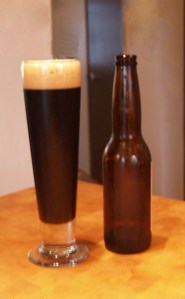
Methods of brewing beer at home can vary from the primitive (picture brewing in a 20-gallon plastic garbage can hidden in the closet of a college dorm room) to the  complex (all-grain brewing with a HERMS—Heat Exchanger Recirculating Mash System). But when I was in college, the principal aim was to make a highly alcoholic beer as fast and as cheap as possible regardless of taste: hence the BIAGC method.
Times have changed. Thanks to the popularity of extract brewing kits and the availability of inexpensive equipment, brewing high quality ales is now within reach of even the most casual of home brewers. Most home brewers, such as myself, start with extract brewing. As I started to learn more about the actual science behind brewing beer, I realized that by moving from extract to all-grain brewing, it was possible to brew even better beer less expensively and without having to spend the exorbitant amounts of money on equipment upgrades that you would expect.
Much of the satisfaction I get from brewing my own beer comes from the satisfaction of coming up with alternatives to the high costs associated with both ingredients and equipment. Why spend more money on extract when I can mash my own grains? Why spend $7.00 on liquid yeast when I can culture my own strain? Specialty malts? Why not save a little money and roast my own? Equipment? Why spend all that money on expensive boil kettles fitted with ball valves, thermometers, and sight glasses when it’s possible to buy a good quality stainless steel pot and just install the valves yourself?
That brings me to the point of this post. To save money on liquid yeast, I decided to culture my own. But I had to spend money on some “lab” equipment: Erlenmeyer flask, stir plate, and a stir-bar. I needed high-quality glassware, so I had to spend money on a flask, and there’s no alternative to the magnetic stir bar. The most expensive piece of equipment is the stir plate itself which could cost anywhere from $100 to $200, depending on quality. So like a lot of home brewers, I built my own, with help from online sources (of which there are many).
The Hanna Magnetic Stir Plate runs about $99 from morebeer.com, and shipping is free. My goal was to make something at least as functional as the Hanna plate at a significantly lower cost. Functional means: it had to handle at least one liter or more of liquid yeast starter; it had to have some way of controlling speed; it had to, of course, “stir” the contents of the flask adequately; and it had to be contained somehow in a box.
Here’s what I came up with, thanks to internet “hacks”.
I purchased a Thermaltake external USB powered computer cooling fan for $12.38 with free shipping from Amazon. It comes with a VR that allows you to manually adjust fan speed and USB power cable.

The fan is designed to stand on its own once it’s plugged in to a computer’s USB port. The VR knob is in the upper-left corner. Legs and front cage of fan will be removed.
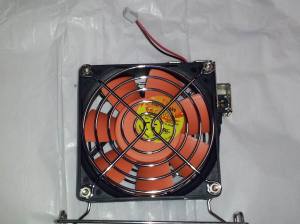
This is the reverse side of the fan showing the cage and the bottom of the VR. Note how simply the cage and legs are mounted to the fan body. The screws were long enough to use for mounting the fan body to a piece of thin, wood hard board.
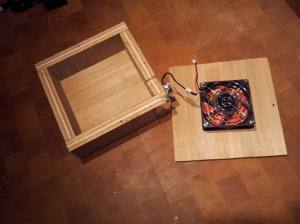
I built a very basic box using woods scraps I had lying around. I used 3/4″ plywood for the sides and 1/8″ hardwood for the top and bottom. I built the top so that it could easily be removed. Image shows fan body without the front cage and legs mounted to the top.
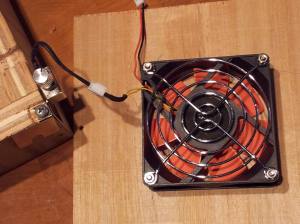
Close up of fan body mounted to the top using the same fasteners. I mounted the VR by crudely notching out the box corner then screwing it to the corner. Simple connection from fan body to VR, but I had to drill an opening for the wiring.
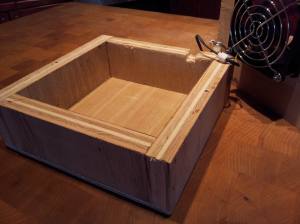
Image shows the passage for the wiring, allowing the fan to be easily mounted to the top of the box.
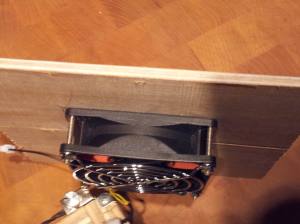
Fan body mounts easily to the top using the same small bolts and nuts. I countersunk the bolt holes through the top outside surface so the flask would sit flat on the surface.

Looking down at the top of the stir plate. Using a hole saw, I drilled a hole large enough to expose the center hub of the computer fan, which is necessary so the fan can spin freely. Reflecting light in the center is the rare earth magnet from a computer hard drive I had lying around. I was surprised how easy it was to remove. The magnet must be exactly centered in the middle of the hub to balance the spinning of the fan. I used epoxy to glue the magnet to the fan hub. The four screws are countersunk below the surface so the flask rests directly on wood surface. The hard board is thick enough to prevent the magnet from coming into contact with the bottom surface of the glass flask. Removable screws allow me to access the wiring inside. VR is on the lower right of the stir plate.
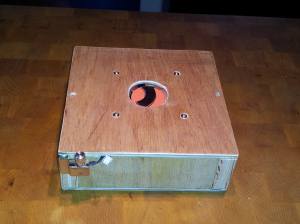
Another view of the completed box. Note VR pigtail and connector.

Fan comes with a retractable power cable; one end has the USB connector and the other the connector for the VR pigtail. I used a cell phone power adapter plug to directly power the stir plate. One end of the adapter plugs into a 120v wall outlet, the USB plugs into the adapter, and the connector plugs into the VR. Simple and it works.
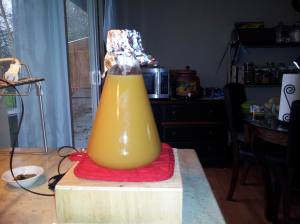
A full liter of yeast starter stirring with an 1 1/8″ stir bar spinning at the bottom. I had to use a pot holder between stir plate surface and the bottom of the glass flask because even on the lowest VR setting, the stir bar was “spinning out.” The pot holder in between seemed to give me more control over the spinning action of the stir bar.
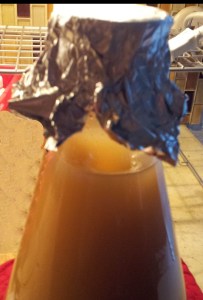
Vortex clearly visible in the center of the flask. I let this spin 36 hours with no spin out. Once the wort was cooled, I pitched the whole thing without decanting, and within eight hours, I had serious fermentation action. The yeast I used in this starter came from spent yeast at the bottom of the primary fermentation bucket for a batch of Belgian Wit I brewed. I recovered about a gallon of slurry that I washed and separated into four pint jars and stored them in the fridge for later yeast starters.
Liquid yeast I used, normally expensive, was free. Total cost for my stir plate hack was $12.38. After a few uses, There were a few changes I had to make. Obviously the VR was not designed for this kind of use, especially the disassembly and reassembly it had to go through. I did have to re-solder the VR power connections, but I already had a cheap soldering gun lying around.
I still have the occasional magnetic stir bar spin out; I still working on a solution (I’m thinking scientific method again here) to better control the spin action. Maybe replace pot holder method with attaching rubber washers to raise the flask. I was also concerned about air circulation around the fan to avoid overheating, so I drilled holes in the box for air, top and sides, and now there is plenty of air circulation.
Brewing beer is all about experimentation. It is science after all: ask a question, research the problem, develop a hypothesis, test the hypothesis with experiments, analyze results and form conclusions, drink a beer.
Oh, by the way, the beer is delicious!
 Call and Response
Leave a comment