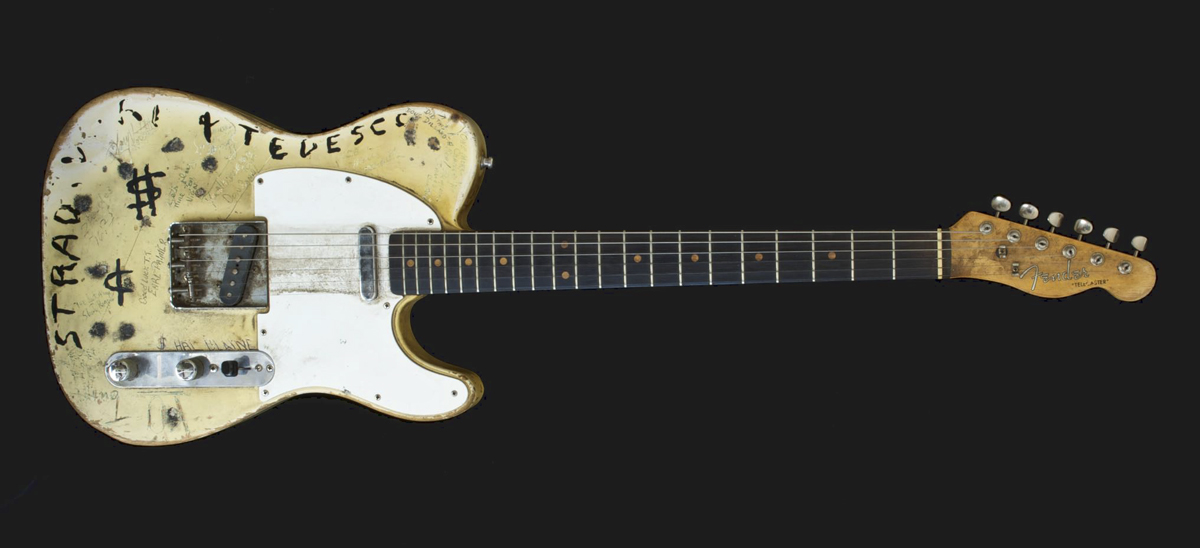
Tommy Tedesco’s 1960s Fender Telecaster, signed by fellow musicians
One of the great things about doing a weekly public radio jazz show is that, every once in a while, I come across jazz musicians I’ve never heard of. Then when I hear their music for the first time, I can’t believe these people are not better 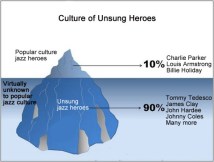 known. But that’s the nature of popular culture; that’s the nature of jazz culture. It’s the “iceberg metaphor” in action, illustrating that the real finds, the real treasures are beneath the surface.
What this really means is that the most influential musicians are not always the ones we know about, not always the ones we instantly recognize, and certainly not the ones who are commercially successful, though it may seem they should be. Most of these musicians are content to remain behind the scenes, recording when they can find studio sessions, and always performing live somewhere. These are the musicians whose names are unfamiliar to us, and as a consequence, sadly, they often receive little if any credit for the important work they do. They are truly unsung heroes who help create the music that launches others into stardom.
For the most part, these musicians see themselves as regular working people, just trying to make a living to support their families, not looking for fame or to make music history. They look only for their next gig, whether live on stage or in the studio. These are the musicians the recording studios and producers go to because they are dependable, loyal, have an encyclopedic knowledge of music, and who are, simply put, damn good musicians.
Tommy Tedesco is a good example of this. Anyone familiar with the 2008 documentary The Wrecking Crew, produced and directed by Tommy Tedesco’s son Denny, will recognize the name of Tommy Tedesco. He along with many other local LA Local 47 Musician’s Union members who were a part of the Crew became the studio musicians of choice for the likes of The Beach Boys, Phil Spector’s Wall of Sound Orchestra, Frank Sinatra, Nancy Sinatra, Sonny & Cher, Elvis, The Monkees, The Byrds, and even Frank Zappa (cf. Lumpy Gravy).
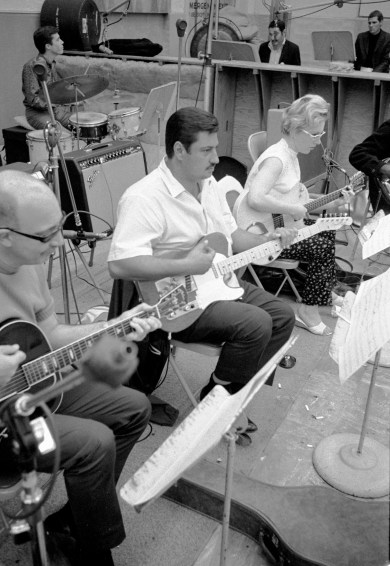
Tommy Tedesco and Carol Kaye
The idea of the Wrecking Crew, according to bassist Carol Kaye (she has been quoted saying she has come to dislike the name), came from drummer Hal Blaine. The name describes the kind of attitude music business executives had about these young studio musicians who they feared would “wreck” the music industry with their new “pop” music sounds and often unconventional style of playing. In reality, nothing could be further from the truth. These musicians were a part of a larger collective of musicians in the L.A. area who were highly skilled (many were conservatory trained musicians) and highly experienced in a variety of musical genres (Tedesco, for example, began his career as a jazz studio musician). I like to think of these musicians as working class heroes, regular “working stiffs” with extraordinary musical abilities and instincts who work hard at their jobs with low pay, little recognition, and erratic job security who loved what they did. They were never interested in “stardom,” as Kaye explains it. They “were part of the process in business to make people into ‘stars.’”
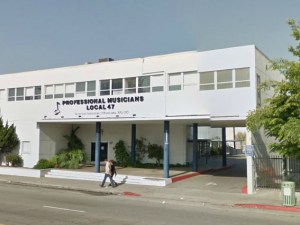
Local 47 Musician’s Union Hall in Hollywood
Tommy Tedesco was known as “the most recorded musician in history,” a “studio monster” as Marc Myers describes him. Tedesco had a huge work ethic. He was just your basic “working stiff,” though an extraordinarily talented one, who never turned down a recording date, no matter what. As a member of LA’s Local 47 Musician’s Union, Tedesco and other union members were basically “independent contractors,” getting their bookings from answering services and, of course, through word of mouth. Big-name recording artists wanted Tedesco on their records. Even though it created tremendous pressures on his personal life, Tedesco prided himself on making himself available for any gig offered to him. His reputation was based on his not only “monster” chops as a guitar player, but also on the message that he was a “stand-up-guy,” willing to drop everything, rush cross town for a recording session that took six hours for a ten-minute guitar piece, and play his heart out. He was session call number one!
Despite his enormous knowledge of music and the music business, Tedesco was a very down-to-earth, unassuming guy. Talking to him, according to jazz guitarist Jimmy Bruno, “was like talking to a truck driver. Everything was Bb to him. There was nothing special or far out.” Even though Tedesco had massive sight-righting skills—as this was during an era when very few session guitarists could read music, many had to learn their parts by ear—he always downplayed his skills. He was the kind of guitarist that never presented his skills as being out of reach of young, up-and-coming guitar players, and this was something Bruno particularly admired about Tedesco. He was always willing to help the talented newcomers.
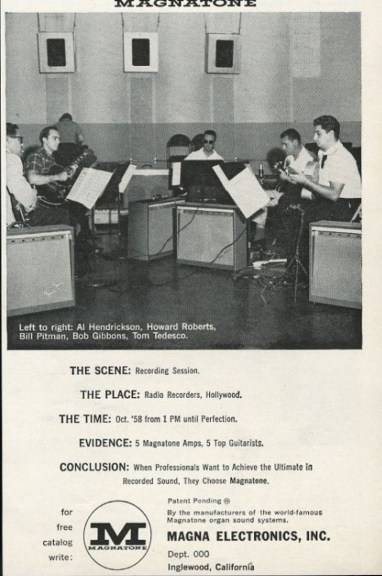
Even before Tommy Tedesco’s prolific session recording career during the sixties, Tedesco’s studio work included recording jazz albums with sax player Dave Pell. During this period he also played on Anita O’Day’s Cole Porter album arranged by Billy May (unaccredited member of May’s orchestra) in 1959 and the Four Freshman and Five Guitars album that same year. At his heart, he was an improvisor who felt equally comfortable with both Joe Pass and Frank Zappa. This comes from his early experience coming into the jazz guitar scene in the early 50’s. Prior to that time, jazz guitar just was not popular, not “hip.” But that’s what initially attracted him: it became hip to be a jazz guitar player in Hollywood, doing all kinds of studio work:
Okay, in the’50s I found it was kind of hip playing jazz, like when Barney Kessel, Howard Roberts, and a few of the guys came in. They were featured, like when Bob [Bain] started playing on the Peter Gunn show with Henry Mancini. That was a big turnaround for jazz-type guitarists in this town. All of a sudden there was jazz work and jazz sounds. “Tommy Tedesco and Friends on the Golden Age of Studio Guitar.”
In addition to his studio session, Tedesco also recorded several fine albums in his career. One in particular is quite good: The Guitars of Tommy Tedesco on Imperial Records, 1965, featuring Pete Jolly on piano, Emil Richards on vibes, Jimmy Bond on bass, and Hal Blaine on drums. Additionally, Laurindo Almeida plays rhythm guitar on three songs. Here is the album in its entirety:
Here’s an interesting side note about Tommy Tedesco: Tommy Tedesco was born in Niagara Falls, NY, in 1930, but there was another Tommy Tedesco also born in Niagara Falls, born in 1916, who was a professional boxer, known as “the fighting alter boy.” Never found success as a boxer.
 Call and Response
Leave a comment