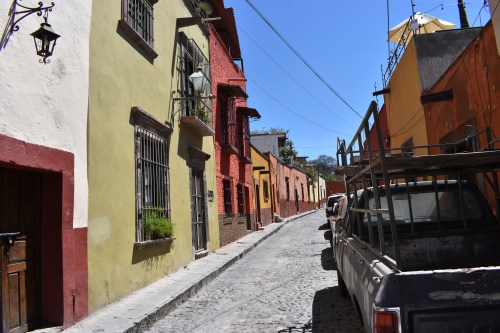
The narrow sidewalk on Calle Tenerías.
Walking down the sidewalks of San Miguel is a lot like dancing in a ballet.
Though I am not a dancer by any stretch of the imagination, if I was I’m certain that what ballet dancers do on a stage is what I see San Miguel “walkers” do on sidewalks. So maybe I am a “dancer” after all; just a different kind.
To appreciate how this “dance” plays out—for example on a walk down Ancha de San Antonio up to el centro—forget all of your preconceived sidewalk notions. In the states standard residential sidewalk widths are at least four feet from street curb to sidewalk edge, allowing two people to walk comfortably side by side. Sidewalk widths could even be wider, especially along city streets.
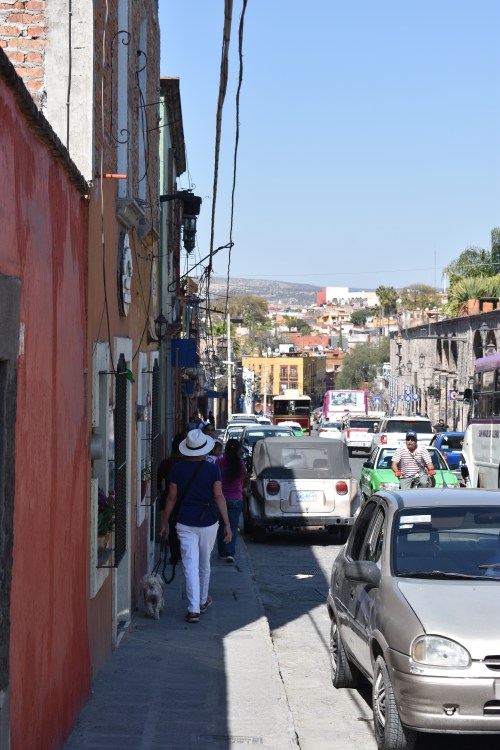
Jackie and Louie walking north toward El Centro on the narrow sidewalk of the Ancha with little room to spare.
In San Miguel, however, the majority of sidewalks are nothing like that. It’s rare that two people can walk comfortably side by side on a San Miguel sidewalk. As a rule (but wait, there are no rules here) they are just barely wide enough for one person to walk safely (maybe) between the walls of buildings that line the Ancha and the street that’s most of the time clogged with traffic. In fact the sidewalk is crowded when Jackie walks Louie.
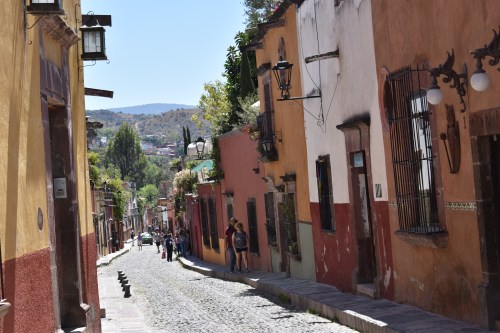
Looking south on Calle Aldama. Typical narrow sidewalk with pedestrians walking in single file.
The “dance” begins the moment the side walker steps foot into the stone-paved streets and sidewalks. Then a kind of organic sidewalk choreography comes immediately into play.
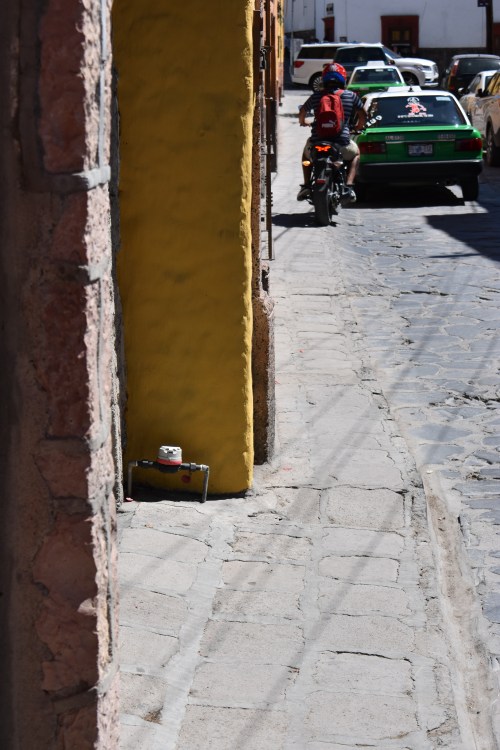
Callejon San Antonio just outside the entrance to our campsite in the middle of Colonia San Antonio. This is a one-way street that empties onto the busy two-way Ancha. Even motorcyclists use a kind of choreography: note how he squeezes into the space between sidewalk and the green taxi. Motorcyclists typically maneuver in between and around the flow of traffic with impunity because…well, because they can!
Choreography is necessary because San Miguel sidewalk pedestrians, have to decide on a moment’s notice whether or not there’s going to be enough room for two people to pass each other on the sidewalk without collision. Obviously, pedestrian collisions are to be avoided at all times, whether collisions between passers-by or collisions with the cars in the street. In fact “collision avoidance” is one of the major side walker dance moves.
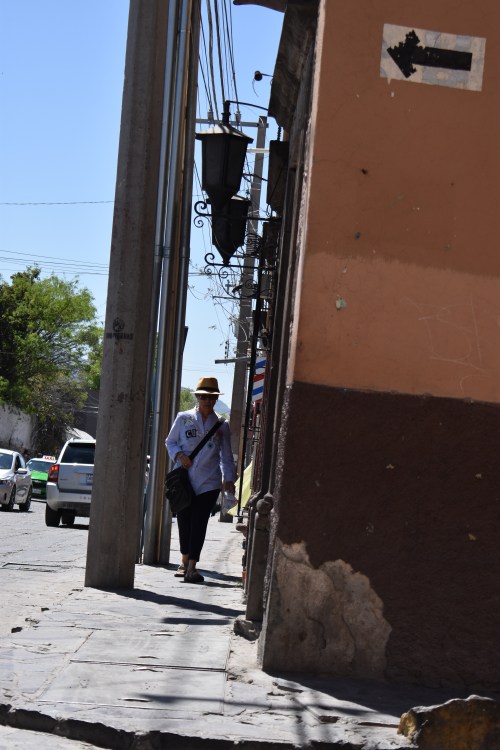
Decision time: a pedestrian approaching very narrow section of the sidewalk on Ancha. Note two power poles embedded into the sidewalk.
To successfully accomplish a smooth, collision-free pedestrian pass by, each person has to perform an upper-body twisting motion, bringing shoulders parallel, so that each person can pass without contact (even though slight contact does sometimes occurs—harmless though).
But each pedestrian pass by situation is different, requiring different kinds of pase movements. If there are little kids ahead of you, for example, it’s always advisable to go for the “step-off” movement. As the kids approach, the pedestrian can quickly step off the curb into the street, allow the pass-by, then quickly step back up onto the sidewalk. As you can imagine, stepping off into the street can be a risky move.
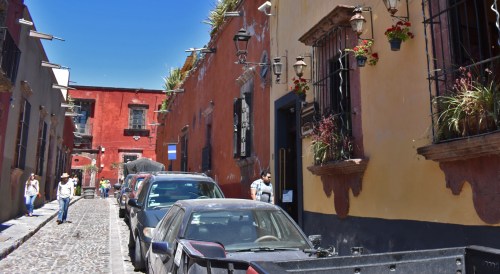
Pair of sidewalkers on Calle Jesus, one off, one on. One way street presents slight risk if the pedestrian is not paying attention to traffic behind him.
When there is a group of three or more people ahead of you, walking at different speeds, there’s a lot of stepping-off and on going on. It’s all very spontaneous with people hopping off and on the curb in a kind of rhythmic dance. Not surprisingly, all this passing and hopping is performed flawlessly.
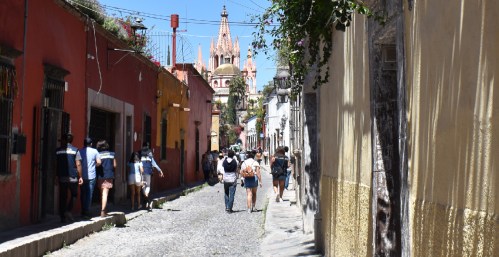
Very narrow one-way street on Aldama with groups of people both in the street and on the sidewalks. Organic choreography in action.
An unwritten rule for SMA side walking requires yielding the sidewalk to women, older citizens, and anyone who may have mobility issues. And because of the narrowness of these sidewalks, it is rare that you see anyone in a wheelchair; I have seen one person try to use an electric wheelchair like the ones you see in a super market in the states. And I have seen folks use walkers with wheels on the front legs. It’s a remarkable sight to see an elderly Mexican man manipulate his walker on and off these sidewalks and cobble stone streets.
Shall we dance? Sometimes the “choreography” of the sidewalk fails. If someone approaches you on one of these narrow sidewalks, often the preferred move is the “step off” into the street, and after the pass by, a quick jump up back to the curb. However, there is no rule, other than the unwritten one mentioned above, that states who steps off first and who stays on the sidewalk. What can occur is the awkward double step off and jump up, which can result in the curious picture of both walkers jumping up and down a couple of times until someone holds her ground or a street pass by happens in the street with cars whizzing by.
Navigating these narrow sidewalks also requires a minimal level of vigilance; there are dangers lurking everywhere. Think loose wires popping out of the sides of stone and concrete building and drooping down the wall, sometimes creating a kind of small animal snare. Or coils of insulating wiring lying in the middle of the sidewalk. I can see someone snagging their foot in one of those wire snares.
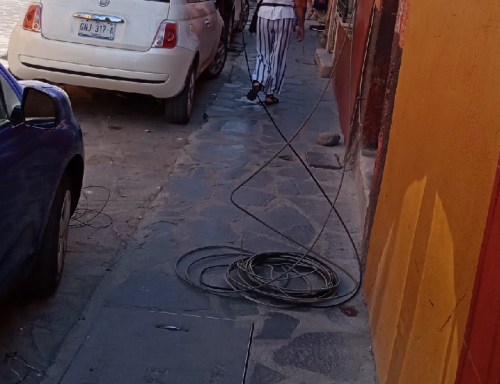
Coil of wires in the middle of the sidewalk—the perfect snare for unsuspecting sidewalkers. I’ve seen pedestrians leap over them at the last second. These are telephone, television, and internet cables, not 110 volt wiring—I hope.
Quite often, springing up from the middle of the sidewalk are concrete (yes concrete) power poles, sometimes leaning precariously into the walkway to such a degree that the side walker is required to perform a dip move in order to pass under the thing. Doubly precarious is the combination of leaning power pole and loose wires, requiring the kind of moves construction workers use when walking through a construction site. I’ve seen agile pedestrians perform a kind of grand jeté, leaping over all kinds of sidewalk barriers.
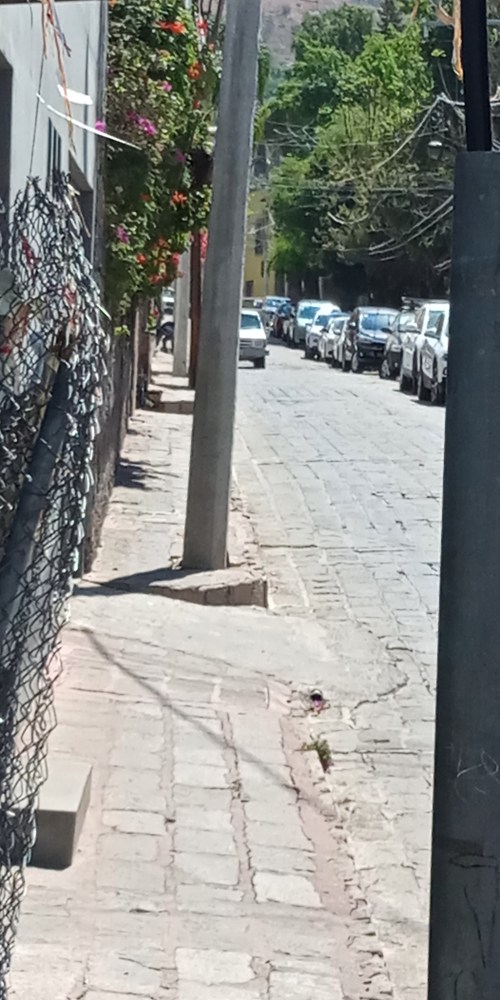
Concrete power pole leaning, in this case, slightly into the street. Pedestrian choice is to either squeeze between the pole and the chain link fence or to step off into the street. The street is Privada Guadiana, a typically very busy street because of El Parque Guadiana off to the right.
Once in a while, the San Miguel side walker will encounter odd street-side colonial architectural structures like this beautiful fountain that suddenly appears out of nowhere jutting out into the sidewalk. The sidewalk ends and the pedestrian has to do a kind of high wire act to negotiate a step up from the sidewalk to the fountain, as you can see in the photograph below.
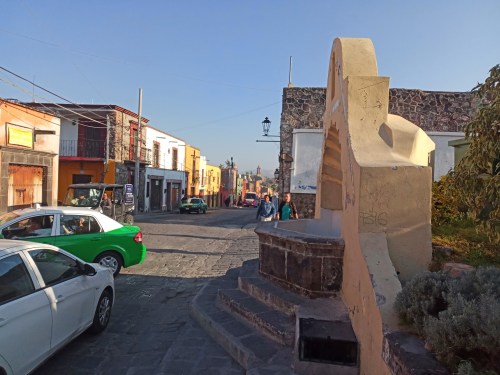
Sidewalk in the right foreground abruptly ends at the beginning of one of three fountain steps. To avoid stepping off into the traffic coming from behind, pedestrians have to cautiously walk the first step to the other side which then drops off into the street. Note green taxis that just turned into traffic. Not also the two approaching pedestrians.

Beautiful portale or doorway with rough granite surround and elaborate transom above. Two very narrow steps lead to portale. The steps are dangerous on a narrow sidewalk like the one shown. Constant vigilance is really necessary to avoid tripping and falling over the step
Traffic flow: The flow of traffic through the streets of San Miguel is a kind of “dance” in itself. San Miguel traffic has been compared to the movements and flow of ant colonies. Picture this: in the states, for pedestrian and traffic flow to function efficiently, there are countless “stop and go” control systems in place: traffic lights, left turn lanes, bike lanes, stop signs, yield signs, divided lanes, and painted pedestrian crosswalks. And much more.
None of that is necessary in San Miguel.
There’s a different organizing system at work that controls pedestrian and traffic. Unlike in the states, San Miguel drivers seem to possess an innate understanding of the natural ebb and flow of traffic—both human and mechanical—without having to rely on traffic signals. Actually, I haven’t come across a single traffic signal or stop sign in San Miguel.
Even so, San Miguel drivers possess a unique awareness of what’s going on around them all of time. If a pedestrian or two needs to cross a crowded two- or one-way street, all they need do to cross is to slowly ease their way out into traffic, trusting that drivers, if they see them, will automatically slow to allow them to cross. Fundamentally, this “trust” comes from a mutual sense of respect for both pedestrian and driver.
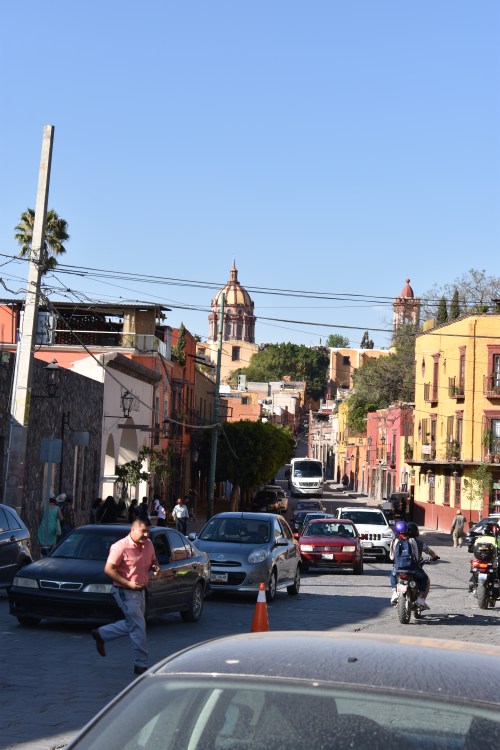
Pedestrian making a run for it through busy street traffic. Such a crossing is somewhat safe, although, there are better places to cross such as at topes (speed bumps) where traffic slows considerably.
Traffic flow is founded on the principle of “keep moving”; hence, the ant colony comparison. Whether the pace of traffic flow is fast or slow doesn’t matter— just keep moving; eventually you will get there. The use of mechanical stop signals doesn’t match up with this idea. Like everything else in Mexico having to do with human interactions, it’s all about Mexican time (see Tony Cohen great book On Mexican Time for a further discussion on the pace of Mexican life in San Miguel).
Instead of traffic lights and stop signs, traffic is controlled in other ways. Roundabouts or glorietas as they’re called in SMA are located in crucial traffic areas to direct (rather than control) traffic flow into and outside of the inner city areas. Major glorietas are so large they are impossible for pedestrians to cross. At the Glorieta Pipila (seen below), at the very south part of San Miguel, the only way for pedestrians to get from Pollo Feliz on one side of the busy divided highway to the supermercado grande La Comer on the other, is by crossing on the insanely high (and in some places rickety) pedestrian bridge.
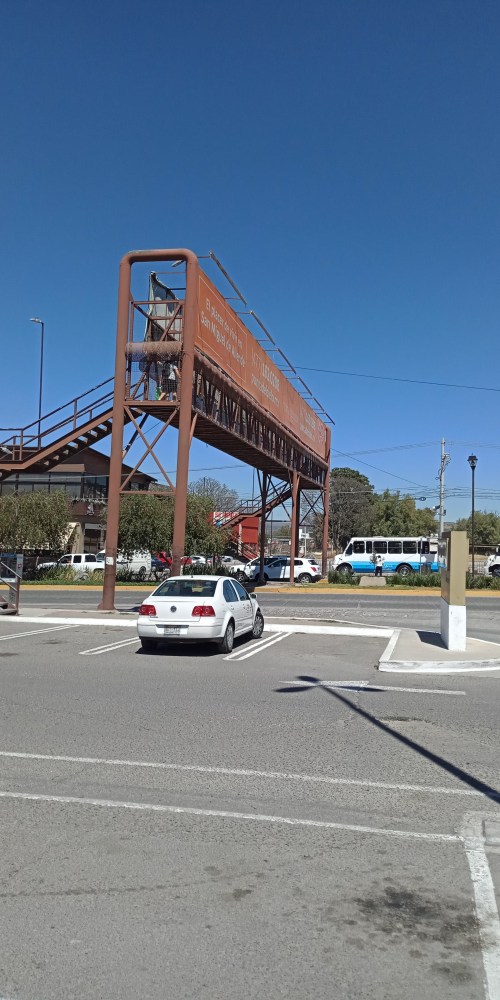
Pedestrian bridge crossing. Supermercado La Comer on the other side. I have to admit crossing this bridge is more than a bit nerve wracking. The actual bridge structure is very narrow and rickety.
Despite the apparent insanity that accompanies trying to navigate through the Glorieta Pipila, the roundabout, as well as others in SMA, the Glorietas are surprisingly effective at directing the flow of traffic around and away from the inner city areas.
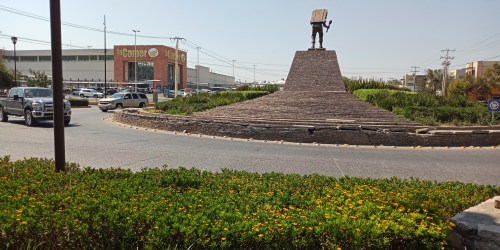
Glorieta Pipila with La Comer on the left.
But once traffic gets into the inner city areas, areas without traffic control, the principle of give and take applies. San Miguel drivers are not aggressive. At the same time they are also not overly cautious. For example, when a left turn into busy, flowing traffic is necessary, all a driver need do is edge their way slowly into traffic and cars will automatically slow down. If a car is trying to merge into traffic and a hole opens up in the traffic flow, rather than speeding up to fill that hole, drivers will leave it for merging traffic to fill.
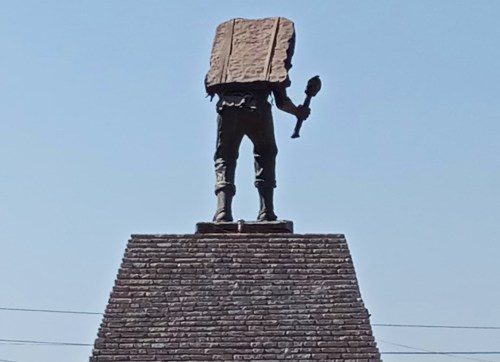
Pipila with stone slab on his back and a torch in his hand stands atop stone pedestal in the center of the glorieta. Pipila is an iconic historic figure who played a role in the Mexican Revolution of 1810 in Guanajuato. A much larger, modernistic version of the statue of Pipila stands on a hill overlooking Guanajuato.
Practically no one who lives full time in San Miguel wants to own a car. There’s really no need for one. Residents either walk, flag a taxi, or take the bus. But people mostly walk. But whether walking or driving the reigning principle is always mutual respect, kindness, and consideration—a truly Mexican state of mind.
 Call and Response
Leave a comment