
Came across this mural on the wall of a small tienda, a perfect example of street art combining both magical and the realistic elements. The side streets of Ajijic are a virtual gallery of stunning street art.
Daily life in Mexico is full of unexpected moments—occasionally frustrating, sometimes stressful, but often infused with a sense of the magical. It’s not that life here is so different from anywhere else; it’s that Mexico seems to incorporate a sense coincidence and irony into everyday experiences. There’s a feeling that whatever happens around you holds a deeper significance—if you take the time to notice.
These moments, taken together, are like episodes that tell the story of our new life in Mexico. Some stand alone, self-contained and seemingly unconnected to anything else. Others form part of a larger narrative of events that, at first glance, might appear unrelated but on reflection reveal themselves to be intricately connected. It’s these episodes, both the isolated and the interconnected, that capture the magic of what it truly means to live in Mexico.
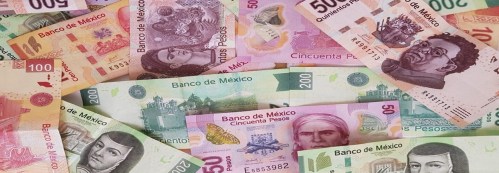
Mexican peso banknotes are renowned for their colorful and intricate designs, featuring historical figures like Sor Juana Inés de la Cruz, Frida Kahlo, Diego Rivera, and Benito Juárez, along with cultural landmarks and Aztec imagery. The new polymer-based notes are also highly resistant to counterfeiting.
In Ajijic, cash—pesos—is king, especially in small denominations. Twenties and hundreds are ideal. While debit cards work in restaurants and larger super mercados, particularly those popular with the expat community, cash is essential for shopping at the multitudinous vendors lining the carretera, selling everything from birria tacos to coffee beans out of the back of a truck. It’s also a must for the local tianguis (Mexican-style flea markets) and the weekly farmer’s markets that dot the Lake Chapala area,where breaking a larger bill is often more compli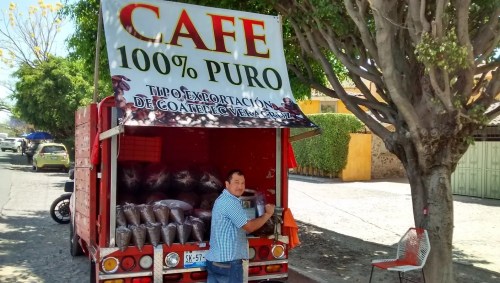 cated than it should be. The same holds true for small specialty shops like fruterías and carnicerías. And let’s not forget the all-important propinas (tips), which are a cornerstone of income for grocery baggers, gas station attendants, and many others. In Ajijic, keeping a supply of cash—always—is non-negotiable.
Like anywhere else in the world, the go-to source for cash in Ajijic is the trusty ATM. While some might tell you they’re “everywhere,” my experience suggests otherwise. These machines have a knack for hiding in plain sight—or, more accurately, in completely random places: barberías, super mercados, farmacías, you name it. But the holy grail of ATMs—the one expats and tourists alike dream of finding—is tucked away inside the foyer of the Banca BBVA, the closest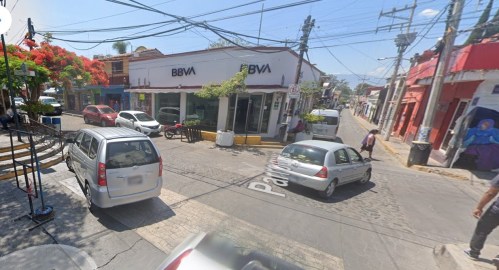 thing to a sure bet in this treasure hunt for pesos. What’s more, it’s easily spotted on the corner of Hildago and Colón, right across the street from the Plaza Principal in the center of Ajijic.
When entering the bank’s foyer, three ATMs line the wall, each promising an adventure—or a headache. At peak times, long lines often stretch outside the building, and by the time it’s finally someone’s turn, there’s always the chance the chosen machine has run out of pesos, while the people next to you seem to have tapped into an infinite peso reserve.
Once the process becomes familiar, using a Mexican ATM isn’t terribly complicated—unless, of course, the on-screen instructions appear only in Spanish. Translating banking terms on the fly, with a line of people watching, can be a uniquely stressful experience. The BBVA machines do offer instructions in English, though the translations can be hilariously unhelpful, turning a simple withdrawal into a game of guess-the-meaning. Even when everything seems to be working, it’s all too easy to make a mistake, often eliciting amusement (or exasperation) from those waiting.
Fortunately, Mexican people are renowned for their patience and understanding with Gringos. In fact, they’ll sometimes step in to help—albeit cautiously, so you don’t feel like they’re intruding. It’s a refreshing twist: the cautious paranoia many Gringos carry dissolves in the face of such genuine kindness. But that’s Mexico.
Which leads me to the episode.
During one of our ATM visits at the Banca BBVA, Jackie got flustered. (To be fair, she was multitasking—trying to help me and handle her own transaction simultaneously.) In the chaos, she left her debit card in the ATM.
Realizing her mistake, Jackie immediately called the number on the back of the card to report it lost. The bank promptly blocked it. Crisis averted—or so we thought. The next day, Jackie received an unexpected Facebook message from an old friend who lives Portland, Oregon, and visits Ajijic during the winter. The friend, while scrolling through Facebook, stumbled upon a photo of Jackie’s missing debit card posted in one of those ubiquitous Gringo Facebook groups in Mexico. Unfortunately, the friend couldn’t remember which group it was.
Determined to track it down, Jackie dove into the rabbit hole of Gringo FB sites, scrolling through dozens of posts until, finally, she spotted her card’s photo on a group called Friendly Gringos Ajijic and Chapala.
Here’s where things get ironic—Mexican style. The person who posted the photo was also named Jackie. My Jackie messaged Facebook Jackie (who was not the actual finder, just the helpful poster) and discovered the good Samaritan behind the recovery was a Mexican man named Diego. Diego had found the card still in the ATM slot and, noting the obviously Gringo name, asked his friend Jackie to post a photo of it in one of the groups she followed, hoping the owner would see it.
That’s exactly what happened. My Jackie thanked the other Jackie for posting the picture, though with a touch of regret—her card was already blocked and useless by then. Both Jackies shared a brief moment of mutual apology: my Jackie for not acting fast enough, and Facebook Jackie for not connecting sooner.
Looking back on this episode, I realized the story wasn’t really about ATM machines, lost debit cards, or even the two Jackies. It was about Diego—a kind-hearted Mexican man who found a card left in an ATM slot and took the time to ensure it got back to its rightful owner. It made me pause and ask myself: Would I have expected an unknown Mexican man to go out of his way like this? Would I have assumed the same of a stranger in the U.S.? I’d like to think so—but I’m not entirely sure.
What struck me most was the quiet generosity and moral decency Diego demonstrated, not as a grand gesture but as something instinctive. Over the years, I’ve noticed how often acts of kindness like this happen in Mexico, shaping my view of the people here. Admittedly, my reactions are often emotional, shaped by personal experiences rather than detached realism. And yet, I can’t shake the belief—perhaps biased, perhaps naive—that there’s something inherently compassionate and ethically grounded in the Mexican way of life, something that feels increasingly rare in the U.S.
 Call and Response
Leave a comment