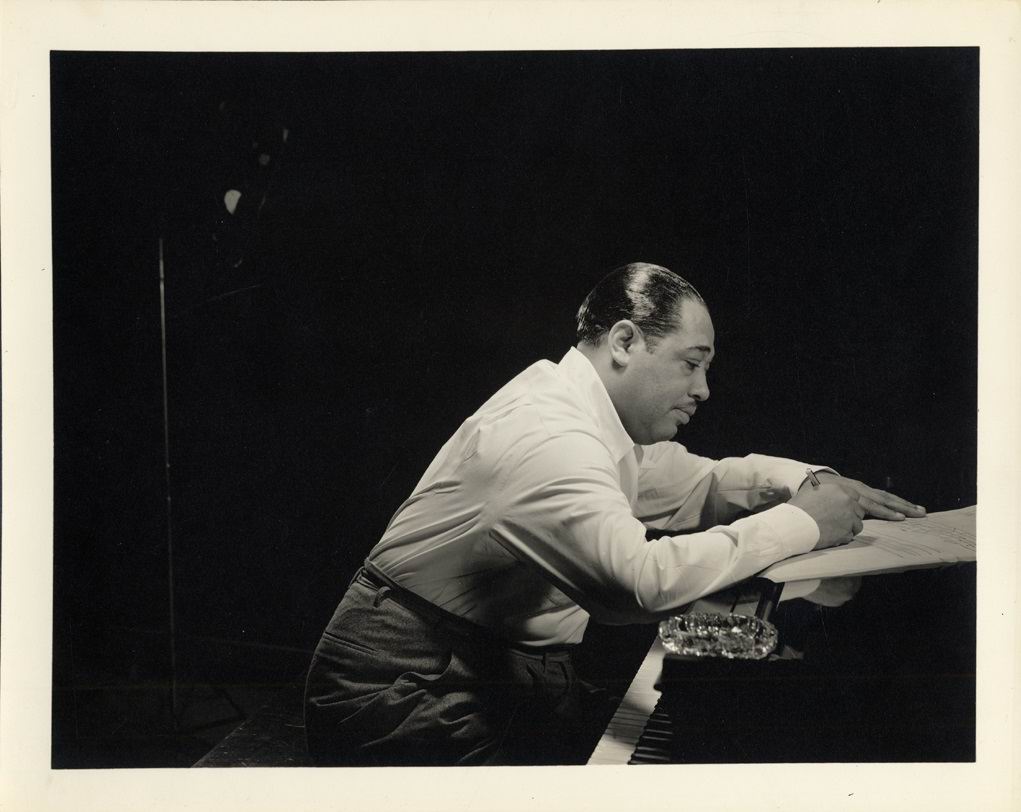
There are plenty of reasons to celebrate Duke Ellington’s 116th birthday. He is arguably the most prolific composer of the 20th century, both in terms of the sheer number of compositions he has written and also in terms of the incredible variety of musical forms within which he experimented musically.
It’s also worthy to celebrate the fact that Ellington’s development over fifty years into a world class jazz composer is one of the most spectacular narratives in the history of American music. It is a narrative of a musician who, in spite of waning popularity as rock & roll, television, and changing musical tastes began to siphon commercial interest and mass-market record deals (see Marc Myers superb essays on the death of jazz: “Who Killed Jazz and When?” and the follow up essay “What Killed Jazz? The Plot Thickens” on his jazzwax.com website) would prevail and continue to sustain his achievements as an artist and an entertainer worldwide.
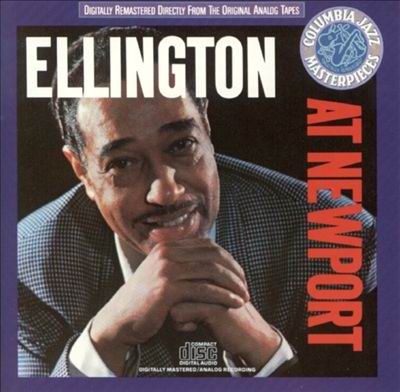 The most famous example of Ellington’s ability to succeed in a record market that forced him to perform at ice-skating rinks to keep his musicians employed is his orchestra’s performance at the Newport Jazz Festival in July of 1956. According to George Wein, long-time festival promoter and organizer, at the time, Ellington did not have a record contract (see Wein’s book Myself Among Others: A Life in Music). Columbia records recorded the historic performance, notable in particular for Paul Gonsalves’ twenty-seven chorus tenor solo on “Diminuendo in Blue and Crescendo in Blue,” and released it as a hap-hazard, cut and paste job with only about 40% of the original recording actually live. C. Michael Bailey implies in his essay “Duke Ellington: The Complete Live At Newport 1956” that the performance captured on record was less-than-perfect (he describes Gonsalves as “modestly talented” and reviewers of the performance as frothing—he uses the word froths—over the twenty-seven chorus tenor solo. Columbia/Legacy released Duke Ellington: The Complete Live at Newport 1956 in 1999, as a two-CD set which includes the original historic recording with the studio-produced recording. It’s only after hearing the original that it becomes apparent how badly produced the 1956 version was. Bailey describes the differences as “startling.” The two versions are worth listening to back-to-back, if for no other reason than to understand, at least in part, the extent to which the recording industry—Columbia records in this case—their production and marketing practices contributed, unnecessarily, to the decline in Ellington’s popularity in particular and in jazz in general.
Both the actual performance and the Columbia record, as commercially contrived as it was, rejuvenated Ellington’s popularity and career. In August Ellington appeared on the cover of Time magazine, accompanied by the simple sobriquet “Jazzman.” This is significant because the cover story is one of only five Time has ever done about a jazz musician.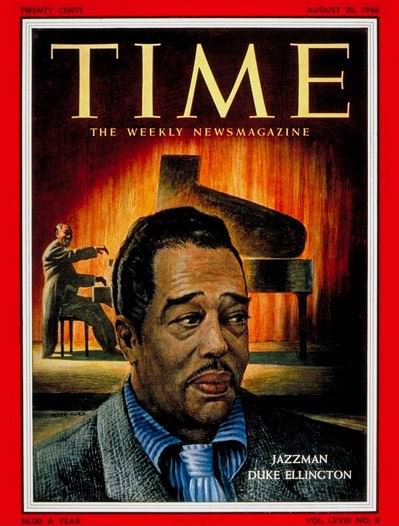
One only needs to consider the hundreds of books—both critical and biographical—about Ellington the man and the musician, the thousands of magazine and newspaper articles, album liner notes, reviews, and countless websites, both good and bad, to understand why many consider him to be America’s greatest composer, bandleader, and recording artist. The number of biographies and autobiographies by Duke and friends and fellow musicians is staggering. The most recent book is The Cambridge Companion to Duke Ellington (Cambridge Companions to Music) edited by Edward Green, published just this year on February 9. The book is a collection of essays that survey Ellington’s career, music, and place in popular culture in depth and are authored by renowned scholars, critics, composers, and jazz musicians. It’s worth noting that Terry Teachout’s biography of Ellington Duke: A Life of Duke Ellington, published on October 17, 2013, has gotten rave reviews and continues to be very popular on amazon.com.
My playlist for the Ellington Birthday All That Jazz show follows with few commentaries. Any Ellington playlist is at risk of being inadequate, especially one that pretends to be a “greatest hits” kind of list. The problem with any type of Ellington playlist is more about what you don’t play than about what you actually do play. For every choice I make, even while I’m listening to it, I automatically think of something else I could have played instead or in addition. But this is live radio with listeners who just want to hear the music and not have to wonder whether or not what they’re listening to is a particularly good example of musical Ellingtonia.

What I did decide to do was include some of the Ellington orchestra musicians who recorded as leaders of their own bands, and who were able to form their own groups because they were in fact distinguished alumni of the Ellington School of Jazz. That list follows:
Duke Ellington “When Music Is Your Kick” from When Music Is Your Kick
Duke Ellington “Black Beauty” composed by Duke Ellington from The Okeh Ellington (1928) on Columbia — Duke Ellington solo piano
Duke Ellington “I Have a Band” from I Have a Band
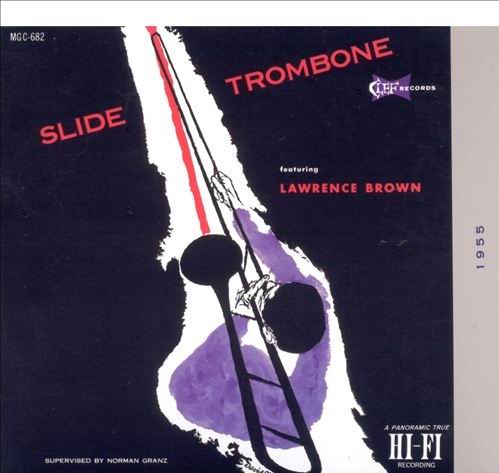 Lawrence Brown “Blues For Duke” composed by Brown from Slide Trombone (1955) on Clef — With Hank Jones on piano and Al Cohn on tenor. Lawrence Brown was a key member of Duke Ellington’s band, but he was never a breakout star. During the 1950’s, Brown did lead his own band for a number of years and recorded this 1955 album, arranged by Ralph Burns. Highly recommended.
Duke Ellington “Echoes of Harlem” composed by Ellington from Ellington’s Small Units 1935-1941 on Jazz Archives — Rex Stuart, coronet; Barney Bigard, clarinet; Cootie Williams, trumpet; Johnny Hodges, alto
Albert Murray intro_Duke Ellington “In a Blue Summer Garden” composed by Duke Ellington / Billy Strayhorn from Great Times! Piano Duets with Billy Strayhorn (1950) on Riverside — Duke Ellington and Billy Strayhorn, pianos; Wendell Marshall, Bass
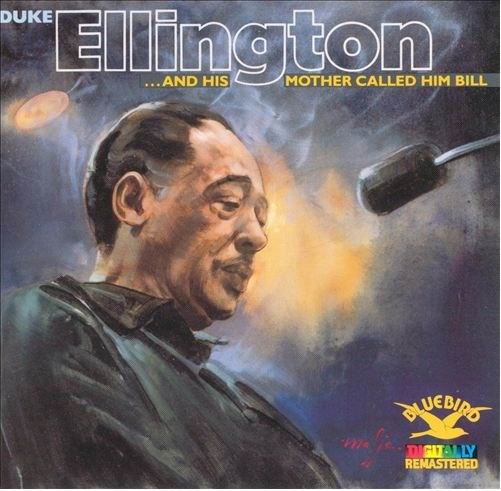 Duke Ellington “Blood Count” composed by Billy Strayhorn from Duke Ellington…and His Mother Called Him Bill (1967) on Bluebird — Duke on piano; Johnny Hodges, alto solo. Billy Strayhorn’s final completed compositions prior to his death on May 31, 1967. Strayhorn, who was in severe pain from a form of esophageal cancer, wrote this song as he lay dying in the hospital. He communicated the suffering, anguish and hopelessness of his battle with the deadly illness by writing this mournful ballad. Duke Ellington performed the work in concert a few times prior to his alter ego’s passing, though the official version wasn’t taped until August, 1967, for the historic RCA LP And His Mother Called Him Bill. Evidently, the piece had such an impact on Ellington that he never again played the song following this studio session.
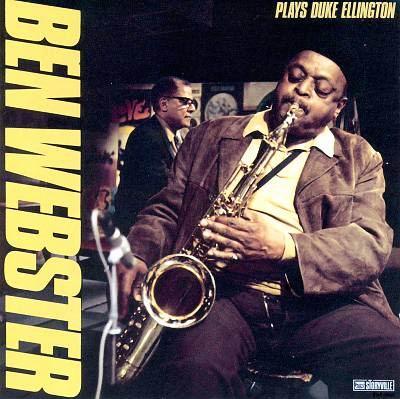 Ben Webster “Stompy Jones” composed by Duke Ellington from Plays Duke Ellington (1989) on Storyville. Although he was only a member of Duke Ellington’s Orchestra for three years from 1940-42 as a part of the Blanton-Webster band era, tenor-saxophonist Ben Webster played with Duke Ellington throughout his career. This release features Webster playing nine songs Ellington songs. The music features sessions with pianists Kenny Drew and Teddy Wilson and three with The Danish Radio Band.
Johnny Hodges “Mood Indigo” composed by Barney Bigard / Duke Ellington / Irving Mills from Everybody Knows Johnny Hodges (1964) on Impulse — Johnny Hodges and Russell Procope, clarinet; Paul Gonsalves, tenor; Cat Anderson and Ray Nance, trumpets; Lawrence Brown, trom; Jimmy Jones, piano; Richard Davis, bass; Johnny Hodges, jr., drums
Louis Armstrong All Stars with Barney Bigard “C JAM BLUES” composed by Ellington from Satchmo at Symphony Hall (1954) on decca — Louis Armstrong and his All Stars, recorded live at Symphony Hall in Boston, 1947. Features Louis Armstrong, leader; Barney Bigard, clarinet solo; Dick Cary, on piano with bassist Arvell Shaw, and drummer Big Sid Catlett.
Gary Giddins “Daybreak Express Intro” from Daybreak Express Intro
Gary Giddons intro_Duke Ellington “Daybreak Express” composed by Duke Ellington from Daybreak Express (1933) on RCA — Alto Saxophone, Soprano Saxophone – Johnny Hodges, Otto Hardwicke; Banjo, Guitar – Fred Guy; Baritone Saxophone, Clarinet – Harry Carney; Clarinet, Barney Bigard; Trombones – Joe “Tricky Sam” Nanton, Juan Tizol, and Lawrence Brown; Trumpets, Arthur Whetso
Clark Terry “COME SUNDAY” composed by Duke Ellington from Duke With a Difference (1957) on OJC — Trumpeter Clark Terry accompanied by some of the top Ellington sidemen of the period: trombonist Britt Woodman, altoist Johnny Hodges, tenor saxophonist Paul Gonsalves, Tyree Glenn on vibes, bassist Jimmy Woode, and drummer Sam Woodyard
Duke Ellington “What is jazz?” composed by Duke Ellington from What is jazz? — Interview
Duke Ellington “Indigo Echoes” composed by Duke Ellington from Duke Ellington: Dukes Men: Small Groups vol. 1 (1934) on Columbia — Duke Ellington, leader; Rex Stewart, cornet; Barney Bigard, clarinet; Cootie Williams, trumpet; Johnny Hodges, alto
Paul Gonsalves “Ready, Go” composed by Duke Ellington / Billy Strayhorn from Duke Ellington Orchestra featuring Paul Gonsalves (1962) on OJC — Backed by Ellington band regulars like Johnnyt Hodges, trumpeter Cat Anderson, trombonist Lawrence Brown, and clarinetist Jimmy Hamilton, among many others
Duke Ellington “Passion Flower” composed by Billy Strayhorn from Piano Reflections (1953) on Capitol — Duke Ellington, piano; Wendell Marshall, bass; Butch Ballard, drums
Cootie Williams “Do Nothin’ till You Hear from Me” composed by Ellington from Do Nothin’ Till You Hear from Me (1959) on Warwick
Wynton Marsalis “Duke’s Band” from Duke’s Band
Johnny Hodges “Just a memory” composed by Lew Brown / Buddy DeSylva / Ray Henderson from Just a memory (1959) on Verve — Johnny Hodges, leader, alto; Ellington on piano; Leslie Spann, guitar; Ben Webster, tenor; Roy Eldridge and Harry “Sweets” Edison, trumpet; Lawrence Brown, trom; Al Hall, bass; and Jo Jones, drums
The Blanton-Webster Band “Flamingo” composed by Grouya/Anderson from Never No Lament (1941) on Bluebird — Billy Strayhorn, piano; Herb Jeffries, vocals; Lawrence Brown, trom; Johnny Hodges, alto; Jimmie Blanton, bass; Sonny Greer, drums
Count Basie “Battle Royal” composed by Duke Ellington from Battle Royal (1961) on Columbia — Both Count Basie and Duke Ellington on pianos
Billie Holiday “SOLITUDE” composed by Duke Ellington from Solitude (1952) on Verve — Barney Kessel, guitar; Charlie Shavers, trumpet; Oscar Peterson, piano;
Duke Ellington and John Coltrane “The Feeling Of Jazz” composed by Ellington from Duke Ellington and John Coltrane (1962) on Impulse — John Coltrane, tenor; Duke Ellington, piano; Aaron Bell, bass; Sam Woodyard, drums
Louis Armstrong and Duke Ellington “Azalea” composed by Ellington from The Great Summit (1961) on Roulette — Louis Armstron, trumpet, vocals; Duke Ellington, piano; Trummy Young, trom; Barney Bigard, clarinet; Mort Herbert, bass; Danny Barcelona, drums
Gary Giddins “Duke and Cootie” from Duke and Cootie
Cootie Williams “Concerto for Cootie” composed by Ellington from The Blanton-Webster Band: Never No Lament (1940) on Bluebird — Cootie Williams solo on trumpet
Duke Ellington “Diminuendo and Crescendo in Blue” composed by Duke Ellington from Duke Ellington at Newport (1956) on Columbia
 Call and Response