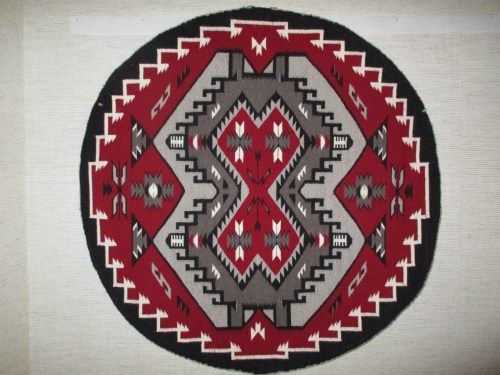
The Warp and Woof: Round Ganado Rug by Master Weaver, Mary H. Yazzie
Complex music, especially jazz, does not always have to be inaccessible. There are times when the musician is creative or clever enough to combine the complex with the accessible.
Mal Waldron is one.
Man, that guy can really play piano. You wouldn’t know it though unless you listened closely to his playing because he’s rarely out front, no matter the setting. Waldron seems to be perfectly satisfied to lay out behind the soloists. His introverted playing style is full of Monk-style spaces and brooding chord voicings, but always with swing.
Waldron’s jazz credentials run deep. New York City born, he cut his chops with tenor saxophonist Ike Quebec and his band, playing the Cafe Society Downtown (the original renamed nightclub post-1940). This led to working with Charles Mingus and others, but especially Billie Holiday, who he accompanied from 1957 until her death in 1959.
Waldron was firmly rooted in jazz traditions from an early age. While serving a two-year stint in the army starting in 1943 stationed at West Point, Waldron had the opportunity to listen to the jazz greats of the time playing on 52nd St. and elsewhere in New York City.
Though he had a straight-ahead jazz background, Waldron’s music has slowly evolved into more experimental and complex kinds of music which were not as commercially viable. Experimental or free jazz recordings were a risk for record companies. As it was, jazz records just weren’t selling very well during the 60s and 70s (jazz record sales had a 1.3 % of the total record sales in 1972; see Fabian Holt‘s Genre in Popular Music ). Despite the economic challenges that faced Waldron, he continued to successfully perform and record. By 1972 his music had evolved from the bop of his album Mal-1 (1957) to the avant-garde of Mal Waldron with the Steve Lacy Quintet. Waldron often played strictly duets (for economic reasons as well as creative) with soprano saxophonist Lacy during the 80s and 90s.
As an example, first here’s Mal Waldron’s “Transfiguration” with Idrees Sulieman on trumpet and Gigi Gryce on alto, from the 1957 album Mal-1:
And here’s Waldron almost thirty years later with Steve Lacy in a duet setting, a live recording of Billy Strayhorn’s “A Flower Is a Lovesome Thing” at the 1984 Berlin Jazz Festival:
While obviously radically different tonally and rhythmically, there is an experimental quality to the music that they both share.
Scott Yanow describes Waldron’s music as falling somewhere between hard bop and avant-garde. The thing about avant-garde jazz is that it can scare off jazz newcomers. Avant-garde jazz with its atonal and grating sounds can rattle the nerves of the most well-informed jazz fan. With hard bop, at least you don’t need to understand what your listening to in order to enjoy it. It just sounds good. But maybe the fact that it “just sounds good” is not the only goal for the musician. Both listener and musician have different jazz expectations.
The other night when I played “Warp and Woof” a Waldron’s composition from his 1961 album Quest it occurred is a good example of how jazz can combine the complex and accessible, like the “warp and woof” of a woven piece of fabric. What Waldron manages to accomplish with “Warp and Woof” is to weave his “experimental” jazz into a context of more traditional jazz stylings. Listen to “Warp and Woof.” Mal Waldron is on piano with Booker Ervin, tenor, Eric Dolphy, alto, bassist Ron Carter on cello, Joe Benjamin, bass and Charles Persip on drums:
Jazz thrives on that which is fresh, original, innovating, therefore, ensuring that as an art form, jazz will continue to improvise, to evolve, to change, maybe into something brand new, otherwise, it wouldn’t be jazz.
 Call and Response