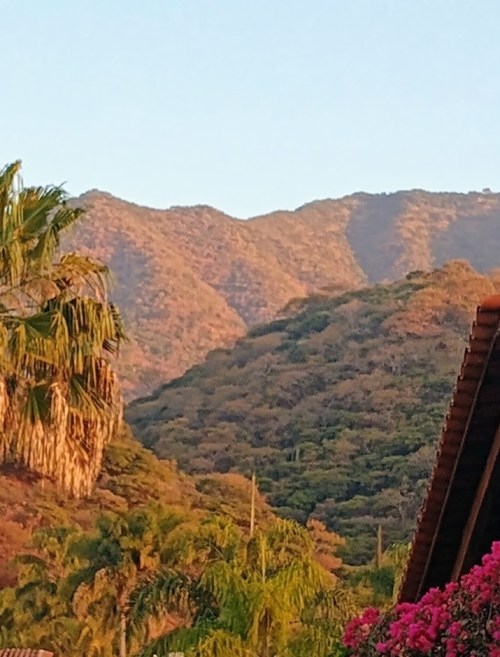
Sierra de San Juan Cosalá at dawn. Photo by author.
“Amanecerá y Veremos“:
The dawn will come and we will see.”
(Old Mexican proverb)
Like every other day here in Ajijic, the dawn slowly reveals the sights and sounds of this pueblo mágico. To the north of us, the first light softens the rugged silhouettes of the Sierra de San Juan Cosalá mountains that surround this lakeside town. On this morning, traces of mist cling stubbornly to its peaks. Shadows fade as sunlight drifts across the tranquil expanse of Lake Chapala, dappling the water with flecks of gold and silver. A faint scent of wood smoke lingers in the cool air, mingling with the earthy aroma of damp cobblestones, as the sleepy town begins to stir.
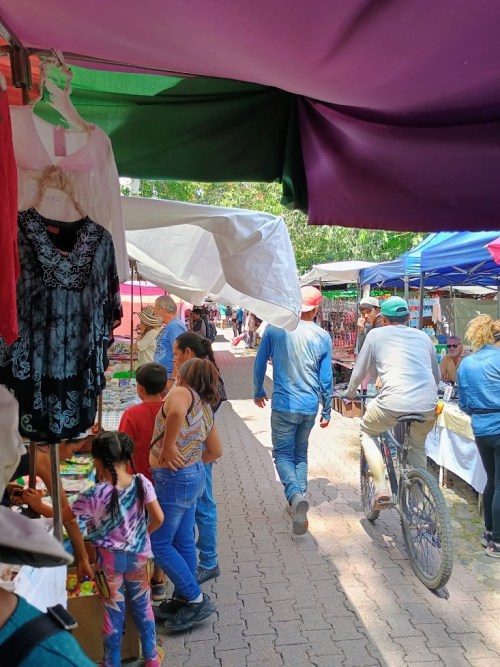
Wednesday, día de tianguis—market day
As the town wakes, its stillness gives way to the unmistakable sounds of morning arriving: the insistent crowing of roosters, the relentless barking of dogs, and the rumbling and rattling of delivery truck tires on uneven cobblestones. Then the bombas cohetes erupt, vying with the shouts of market vendors setting up their stalls (It is Wednesday, día de tianguis—market day). Meanwhile, the metallic grind of construction tools next door begins and mingles with the low growl of sanitation trucks collecting the day’s refuse—sharp, jarring sounds that slice through the soft morning’s light. Unrelenting cacophony vs. peaceful tranquility: This is the paradox that defines life here. Ah, Mexico at last.
Now the voices of the locals begin to echo through the narrow streets in front of our hotel. Of course, I can’t understand what they are saying. Yet, just listening to the melodious sound of their voices is enough for me. Outside, I hear neighbors greet each other on their way to work with a warm “buen día” or “buenos días” or just a simple “bueno.” These greetings are an integral part of daily life of Mexico mornings—a customary politeness ingrained in Mexican social interaction.
Even the clumsy Gringo neighbor is allowed a part of these interactions. As they pass me, Mexicans greet me with kindness, warmth, and respect, as if I had lived here all my life. To them, whether I’ve just arrived or I’ve lived here my entire life, it makes no difference. And if I happen to greet them first, they instantly come alive, no matter their age, no matter their station in life. There’s an interconnectedness I feel here (perhaps undeservedly so) among the people in these neighborhoods that I haven’t felt anywhere else, least of all north of the border.
Carlos Fuentes: “In Mexico, life is lived on the street, and to walk the streets is to be part of the dynamic of the country. The streets are a living tapestry of culture, art, and history.”
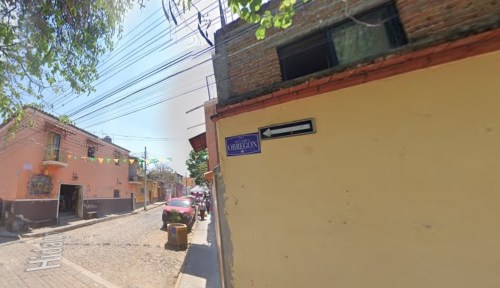
Corner of Calle Obregon and Hildago.
The chaos of Ajijic streets in el centro is remarkable. Narrow, cobblestoned, and mostly one-way, if you dare drive them, be forewarned: you can never be certain of their direction, even with directional arrows posted on the sides of street corner buildings. And the path others take isn’t always a reliable guide either. Mexican drivers, it seems, will often blithely drive the wrong way if they feel it’s necessary. It’s not so much because of they’re deliberately disregarding traffic laws; sometimes, out of habit or custom, it’s just easier to get where they’re going. I have often found myself happily driving in the right direction when suddely a car approaches me in the wrong direction. All I can do is politely pull over and let them pass.
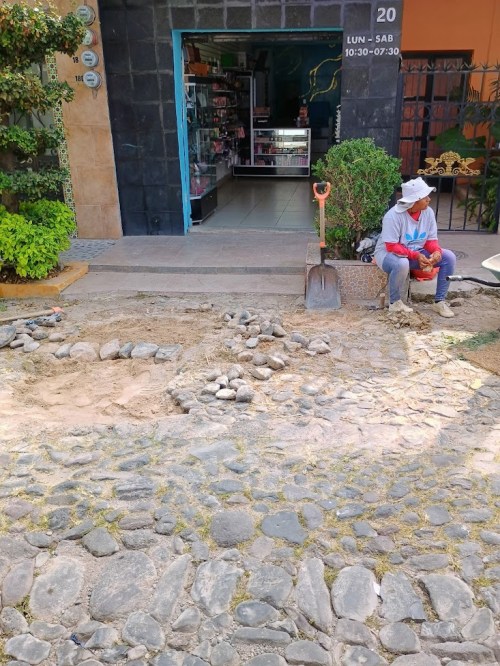
Street laborer taking a break from pulling up a section of broken cobblestones.
Once I drove down Hidalgo street—a main one-way street that runs due east from the Plaza Principal de Ajijic and parallel to the Carretera— on my way to a tienda de mascotas to buy kibble for Louie. It was a perfectly passable street on that day. But the very next day, going down the same street, a work crew suddenly had the cobblestones torn up, making the street impassable. The point is, when driving in el centro, expect the unexpected. It’s the Mexican way.
Ajijic’s sidewalks are also narrow and often in disrepair, creating dangerous hazards for expats who are not used to walking them. On the other hand, because the sidewalks are so narrow, walking can lead to interesting opportunities for greeting locals. As someone from a part of the U.S. where people aren’t routinely comfortable with casual, on-the-street greetings, I have always found these casual greetings a refreshing change. This is a chance to interact with people in the neighborhood who regularly walk these sidewalks, as well as an opportunity to practice my Spanish.
While I may project boldness and confidence in my language skills, whenever I see a local walking towards me, I can’t help but feel a slight sense of panic. A flurry of questions will suddenly flood my thoughts: How should I greet the person? What Spanish phrases should I use? How should I say it? And should I be the one who steps into the street to let the person pass? Or should we pass each other face-to-face? What is the protocol here? This anxiety, of course, is much ado about nothing. Almost always, the local gives way to the extranjero.
An elderly Señora, who I had often seen walking adeptly through the neighborhood, was approaching me, and I thought, This is my chance to greet her in Spanish. Then the overthinking began, and I felt an instant wave of panic. As we passed each other, she looked me right in the eye and said in the most familiar way, as if she had known me her whole life, “Buenos días Señor.” I managed to blurt out something that sounded like “Buen dios.” Cringing, I realized I’d just said “Good God” to her—which, in hindsight, might not have been such a bad thing after all. She paused for a moment, turned towards me and with a huge smile said, “¡Claro que sí, Señior!” Of course! It was a moment of connection, no matter how awkward, and a lesson learned about the kindness and patience of the Mexican people.
 Call and Response