It’s been over a year since my last brew session. I brewed a Belgian wheat style beer using my new brewery set up that includes a small 12 volt hot water pump I modified to work on 120 volts. Some pics:
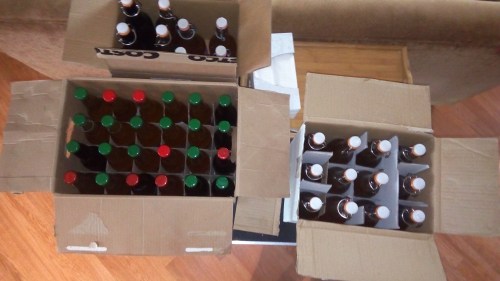
Here’s the end result: about three cases of freshly bottled Belgian wheat. Twenty-four bottles are capped and thirty bottles have flip-tops:
New brew set up. Finally out of the kitchen. Hot water (150 deg.) being pumped from kettle into my new mash tun. Smaller kettle to the right of mash tun used to hold first “runnings.” Runnings from mash tun are gravity fed to pump which pumps the wort to the smaller kettle where it is “held” until sparge. Sparge water is pumped into mash tun and slowly drained by gravity directly into the boil kettle below. Remainder of the wort is then gravity fed into the boil kettle. Pump is used only to pump hot water from boil kettle up into mush tun:
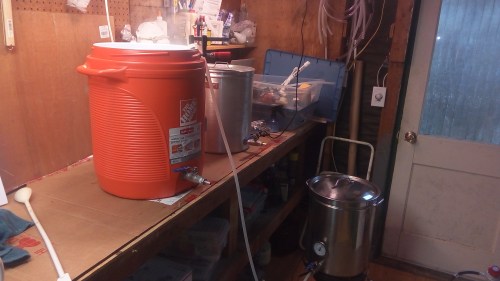
Mashing in—150 deg. water is pumped from the boil kettle below up into mash tun. One problem I faced is that the silicone hoses are “thin walled” and bend/crimp too easily as the hot water is pumped through them. Need thicker walled hoses to prevent pinching:
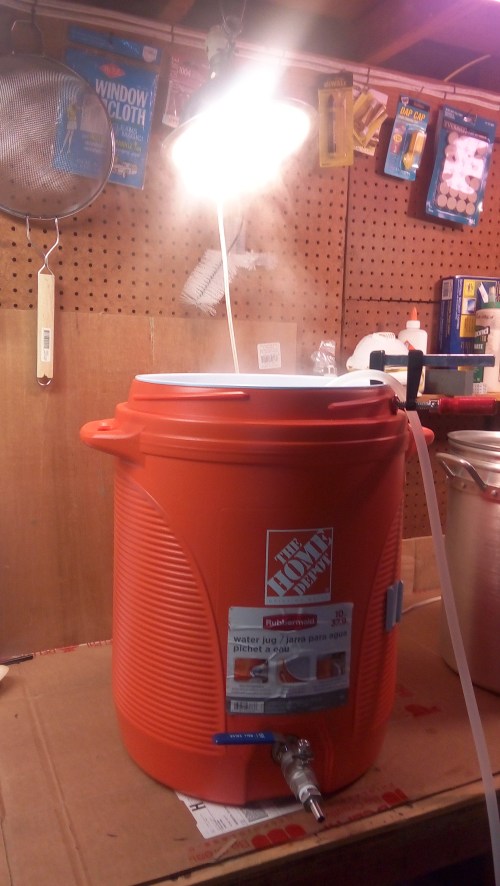
The real test of a good mash tun is its ability to hold the “target” temperature for 60 minutes. There is always heat loss due to transference of hot liquids through hoses, temperature of mash tun (necessary to preheat tun), and temperature of the grains that are added to the hot water. To ensure a stable temperature for the duration of the mash, I wrapped the tun with a heating pad (the kind that does not automatically turn off after a period of time), a car windshield sun reflector wrapped around the tun, and a blanket. The mash held a temp. 0f 148 deg. for the entire mash time of 60 minutes. This tun is far superior to my old chest style cooler for holding mash temps.

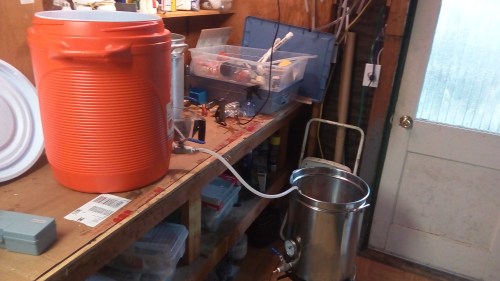
Missing a photo of pumping wort into secondary kettle to the right of mash tun. In the past I’ve had to transfer hot liquid by hand using a two-quart container. Pump eliminated this step. Photo below shows wort being transferred directly to the empty boil kettle using gravity during the sparge step. After first runnings are pumped into secondary kettle, 170 deg. sparge water is pumped into the mash tun. That leaves the boil kettle empty. After the step pictured is concluded, the first runnings being held in the secondary kettle are gravity fed into boil kettle.
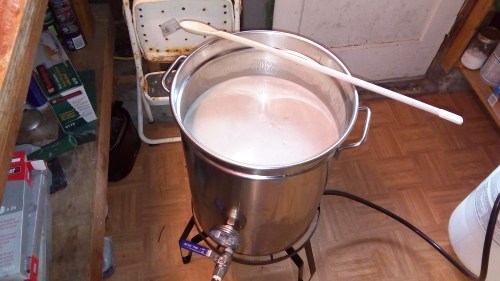
Starting the boil of about 7.5 gallons of wort which will boil down to about 6.5 gallons of sweet wort. Propane burner worked perfectly. Far more efficient use of BTU’s with propane than with natural gas on kitchen stove:
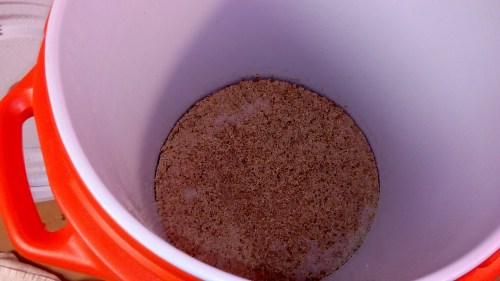
Spent grains get dumped on compost pile in the back yard for the hungry birds. They make short work of it. Still quite a bit of sugar content in these grains.
 Call and Response