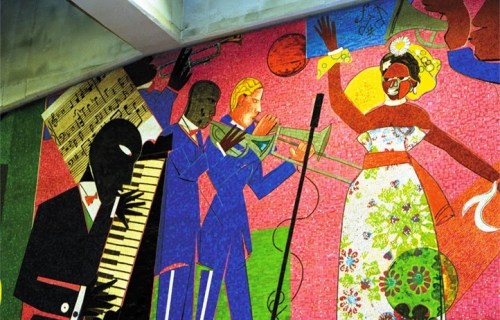
Romare Bearden’s mosaic Baltimore Uproar, 1983, located in the Upton / Avenue Market Metro Station, Baltimore, MD, depicts a jazz combo fronted by a singer who resembles Baltimore’s own Billie Holiday. (Credit: Baltimore Heritage)
The Story Tellers
Jazz has always had at its center musicians who, through their performances, become the “story-tellers” of their history, their culture, and their experiences. Their performances are the “stories” of jazz that have shaped and cultivated jazz into the rich and varied art form that we know today.
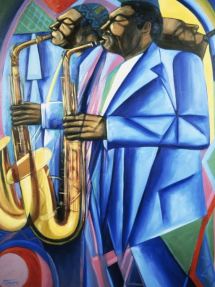
Jazz II, Maxwell Taylor, 1991/1991, From the collection of: Art Museum of the Americas
Jazz performances are a multidimensional form of storytelling that engages the senses of sight, sound, and movement. Similar to a captivating narrative, a jazz performance can transport the audience to experiences and emotions that may be outside of their immediate understanding. Through the lens of the musician, the music can take on a personal and subjective quality, offering a unique perspective on human experience.
Storytelling lies at the heart of every jazz performance, and is deeply ingrained in its aesthetic. Jazz musicians utilize their instruments to weave their narratives, tapping into their personal experiences, emotions, and cultural heritage to craft intricate and evocative musical tales. By immersing the listener in the storytelling, jazz music creates a rich and complex experience that invites deeper understanding and appreciation of the art form.
Call and Response: The Jazz Dialogue
Call and response is a fundamental technique used in many African and African-derived musical traditions, including jazz. In jazz, call and response refers to the exchange of musical ideas between different instruments or between a musician and the audience.
It is a way for musicians to communicate and interact with each other, and it also adds an element of improvisation and spontaneity to the music. Like a casual conversation, what happens during a jazz performance is not always planned out.
During a performance, musicians will engage in a dialogue-like interaction with each other and with the audience as well. Call and response provides the musical means for establishing a feeling of community and shared experience among musicians and between musicians and listeners that is an integral part of jazz performance.

West African drum line Source: South Florida Times
We can trace the roots of call and response directly to West African music traditions, which was then quickly adapted and Americanized into slave work songs, the blues, and later jazz. The call and response format is “as much a matter of social integration as an issue of musical structure (Ted Gioa, The History of Jazz). Gioa suggests that the use of call and response reflects the tradition of integrating performance into “the social fabric” through rituals such as a musician improvising for a listening audience, or African-American ministers calling out to an enthusiastic congregation in a Baptist church, or black prisoners singing a work song:
Or Bessie Smith bemoaning a double-crossing lover to Charlie Green who answers her with cries and growls from his trombone:
When you git good lovin’, never go and spread the news
Yes, he’ll double-cross you, and leave you with them empty bed blues
Clark Terry’s “Trumpet Mouthpiece Blues” (1957) is a particularly interesting example of call and response during the modern era of jazz. The tune features Clark Terry’s distinctive trumpet playing, as well as his virtuosity on the trumpet mouthpiece. During the middle section of the tune, Terry switches from trumpet to mouthpiece. What follows is a back and forth conversation between two people (supposedly a man and woman) where Terry plays both parts, imitating their voices using only the mouthpiece.
The Language of Improvisation
Improvisation is the act of creating or performing something spontaneously without prior preparation or planning. In theater, improvisation involves creating scenes, characters, and dialogue on the spot without a script. Improvisation is used in a variety of creative expression such as dance, visual art, writing*(see notes below), or comedy, anywhere the creator or performer generates ideas in the moment without following a predetermined structure or plan. And, of course, in music, improvisation involves spontaneously creating melodies, harmonies, and rhythms in real-time.
Improvisation is absolutely essential to both performing and understanding jazz. It is, in fact, one of the defining characteristics of the genre. At its core, jazz is about spontaneous creativity and the ability to express oneself in the moment. Improvisation allows musicians to do just that—take a melody or a chord progression and use it as a springboard for their own unique musical ideas and conversations.

“Tricky Sam” Nanton using a plunger mute
So then improvisation can be a form of impromptu story telling. The improvisational nature of jazz allows musicians to create and develop performance narratives in real-time, responding to each other’s musical ideas and building a cohesive story through their collective improvisation. In telling their jazz stories, jazz musicians often use their instruments to mimic the sounds of the natural world or to evoke particular moods or emotions, which emphasizes the narrative quality of their music.
Crucial to the story-telling characteristics of the jazz performance is the narrative quality of the jazz voice itself. “Tricky Sam” Nanton’s trombone technique is a good example of how an instrument can mimic sounds of the human voice. Nanton’s trombone technique came from the idea that the instrument itself should imitate and expand the natural capacities of the human voice. Here is an example of how Nanton incorporates these techniques into his improvisations: Nanton solo from Duke Ellington’s Orchestra performing “Black and Tan Fantasy,” probably recorded originally in 1927:
According to Duke Ellington’s son Mercer, the trombones were his favorite section, so it’s not surprising that his orchestra active between 1932 and the mid-1940s featured three of the greatest trombone musicians ever to play the instrument: “Tricky Sam” Nanton, Juan Tizol and Lawrence Brown (Edwards). It’s easy to understand because within a band of unique and dynamic personalities, the trombones provided Ellington with a range of three distinct voices from a single instrument.
Finally, many jazz musicians draw on literary and poetic traditions in their work, using song titles, lyrics, and spoken-word interludes to create a more explicit narrative structure. For example, Duke Ellington’s “Black, Brown, and Beige” is a three-part suite that tells the story of African American history, while John Coltrane’s “A Love Supreme” is a spiritual journey that traces the artist’s personal quest for enlightenment.
Overall, the narrative quality of jazz is a key part of its aesthetic, and one that sets it apart from other forms of music. Whether through improvisation, mimicking the sounds of the natural world, or drawing on literary and poetic traditions, jazz musicians use their instruments to tell stories and create deeply moving and evocative musical narratives.
Notes:
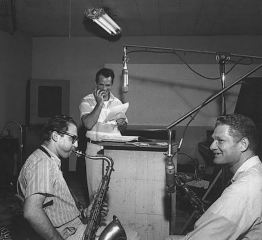
Al Cohn, Jack Kerouac and Zoot Simms, during the 1959 Hanover “Blues and Haikus” recording sessions
The classic example of improvisation applied to writing is Jack Kerouac’s concept of “spontaneous bop prosody,” a sort of verbal jazz. Kerouac had more than a passing interest in jazz. In fact, Kerouac developed a fascination with jazz at an early age and developed the view that his writing should be free from the constraints of traditional approaches to writing. By the time his novel On the Road was published, jazz improvisation became a “vital element in his fictional milieu…the essential influence on his writing” (Kastin). For Kerouac, his creative process was not that different from the jazz musician. As a result, Kerouac began “the most extensive experiment in language and literary form undertaken by an American writer of his generation” (Ann Douglas qtd. in Dastin).
Sources:
Edwards, Brent Hayes. “Music; An Essential Element In the Voice Of Jazz.” New York Times, 22 July 2001.
Gioia, Ted. The History of Jazz. Oxford University Press, 1997.
Kastin, David. Nica’s Dream: The Life and Legend of the Jazz Baroness. W. W. Norton & Company, 2011, pp. 58-62.
 Call and Response