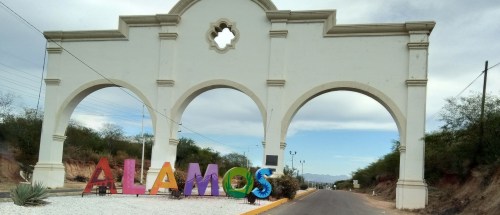
Colonial-Archway Entrance to Álamos (Jackie Gilde, photographer)
The Way to Álamos:
The trip to Álamos, Mexico, was not originally a planned stop. In fact when I first saw the town on a map, it seemed too far out-of-the-way to make the trip worthwhile. I was more inclined to stay on the pacific coast route. Why take a chance on a Mexico secondary road winding its way through the Sierra Madres, especially if there’s no Google “street-view” available? Isn’t that a sign right there to steer clear? Nonsense.
Jackie had other ideas anyway. She had done her research. Jackie knew that Álamos had been classified as a Pueblo Mágico and that it was one those Mexican colonial towns that had prospered during the era of silver mining. The idea that a small, Mexican town has some sort of “magical” connection was enough to convince me. It has always seemed to me that Mexico has always had a sense of magical realism.
Briefly, about Pueblos Mágicos:
The Mexican Ministry of Tourism has classified about 111 official towns in Mexico as Pueblos Mágicos (see interesting discussion at Mexico Mike), and in 2005, Álamos received that distinction. Classifying towns as Pueblos Mágicos is intended to promote an exclusive number of towns in Mexico as particularly notable for their rich culture, history, natural beauty, 18th– century architectural treasures (in 2000, 188 of its structures were declared National Historic Monuments), and, I believe, for the pueblo’s inherent “magical” properties.
Apart from the above qualities of a Pueblo Mágico, Álamos’ “magical feel” for us comes from los ciudadanos de Álamos, the citizens of Álamos. Truthfully, most all of the Mexicans we’ve met are friendly and warm, but in Álamos the people are exceptionally so. Everywhere we go in town, we are greeted with warm smiles and enthusiasm. It’s automatic. People in Álamos seem to go out of their way to please, to make you feel welcome. They’re not bothered or annoyed if you don’t speak their language; in fact (and you hear this all the time from experienced travelers), they are flattered when you make the attempt.
The “Magic” Begins:
From the moment we enter Álamos we can sense this town has a different feel.
Our destination was Rancho Acosta B&B, RV Park and Guest Ranch, about a half mile just outside of town, adjacent to the Panteón de Álamos, the village’s municipal cemetery (how about that for a harbinger of magical properties?). Though our route to Álamos was straight forward from Navajoa to Álamos with smooth and well-maintained two-lane roads, once we drove under the imposing, colonial-style entrance to the town, the street immediately begins to narrow, so narrow it is impossible to imagine how any type of RV vehicle could manage to squeeze its way through the maze of one-way streets up ahead of us. Clearly, Pueblos Mágicos do not easily admit visitors without first undertaking a series of challenges to ensure the worthiness of her guests. Álamos is no different.
First challenge: Wayfinding:
It’s no surprise that a large portion of our youth population have grown up without having the physical experience of manipulating a non-digital map. Thanks to GPS and the use of “smart phones,” the physical act of sensing one’s environment using a map then “navigating spatially” has all but been lost. All cultures practice wayfinding — sensing one’s environment for barriers to travel, then navigating spatially to a remote destination.
We were following the directions to the park from both the Church’s book Mexican Camping and the Google mapping app. But the “google-map world” looks much different on the ground, no matter how closely you study their maps. How did we ever find our way in a pre-Google, pre-GPS world? We used gas station paper maps, of course, or the big spiral-bound Rand McNally Road Atlas, and first-person descriptions. In any event, I took a wrong turn in spite of (or because of) Google “directions” into a one-way street. Had to back up the truck camper blind, surrounded by mid-afternoon traffic, nerves on a razor’s edge. I noticed a man in a car right next to me signaling me that he would guide me while I backed up.
I was able to successfully back up in the heavy traffic and turn myself around. This time I was pointed the right way but down an unknown street that continued to get narrower and narrower. I had to pull over to try to get my bearings. Not successful.
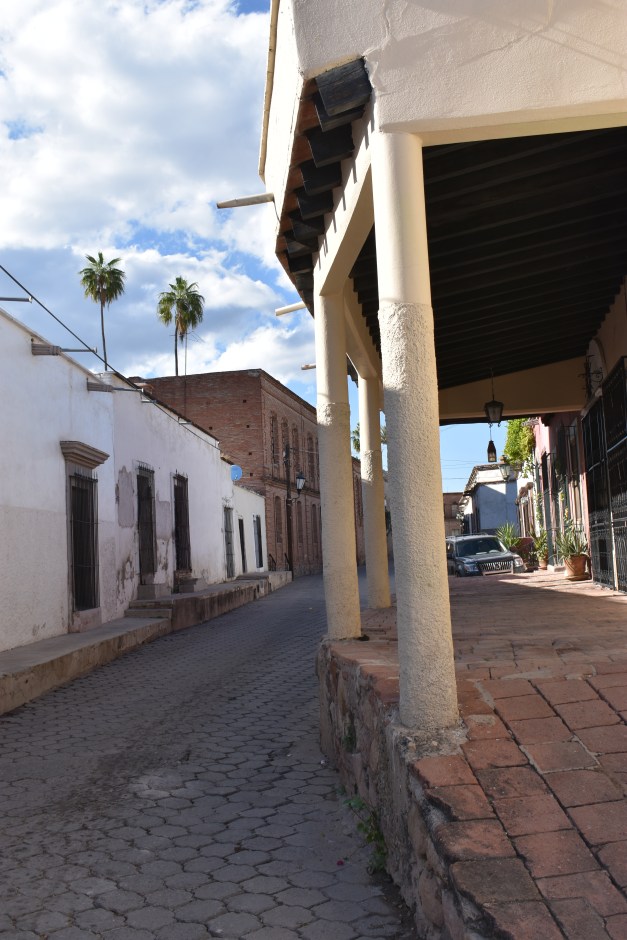
Some buildings jut awkwardly into the street, making vehicle passage even more narrow.
The challenging part of negotiating your way through a small town like Álamos is identifying street names. Sometimes there are street names posted on the corner; sometimes they are posted on the sides of buildings; sometimes they are nonexistent.
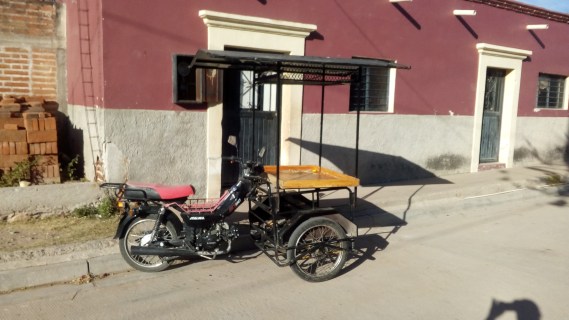
One of the many ubiquitous three-wheeled, motorized food carts.
Lost, with no sense of how to regain my sense of direction, I noticed a man on a motorized three-wheeled food cart waving at me from behind. He pulled along side of me on his trike and asked in English, “Señor, where you going?” After telling him, he sped ahead and waved for me to follow him all the way to Rancho Acosta.
The Flood Waters of Álamos:
Not only are the streets narrow, but the concrete and cobblestone curbs are extraordinarily high—and for good reason. Rainy season is during the July/August summer months and because the town is nestled at the foot of the Sierra Madres, occasional monsoon-like rains tend to cause flash flooding. The mountain runoff is carried through the streets and into the arroyos. The curbs are about four feet high, keeping the businesses and pedestrians high and dry—for the most part, I imagine.
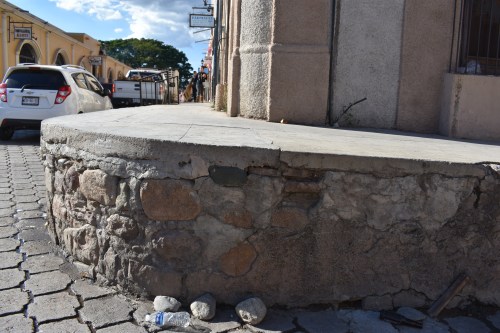
While the curbs are four feet high, the pedestrian sidewalks are very narrow like the streets themselves, passable one person at a time.
Not always in the best of repair, tourists have to be on constant alert for fear of catching a toe on a crack or stray piece of concrete and taking a dangerous tumble. I prefer taking my chances walking in the streets—all part of the magical charm of Álamos.
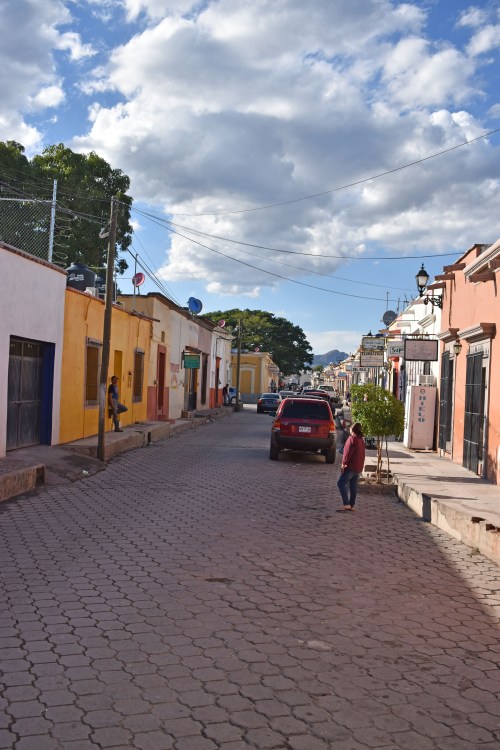
Pedestrians in the narrow streets and sidewalks of Álamos. The Sierra Madres in the background.
The flooding can be fairly dramatic as the following photographs demonstrate. The Arroyo la Aduana cuts through the center of Álamos and becomes a bone dry and dusty street for truck traffic, dirt bikes, and even the occasional horseback rider:

Pic I took of the pedestrian bridge crossing the dry arroyo.
Here is a pic of the same area flooded after torrential rains:
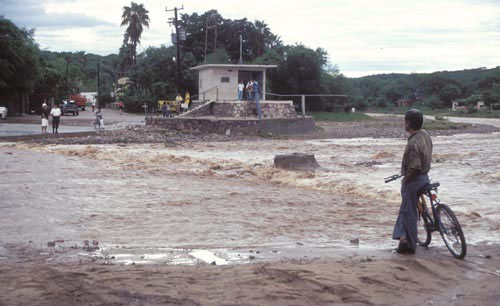
Young man pondering the efficacy of crossing the arroyo with his bike. From Alamos-Sonora-Mexico
Here’s a video of the arroyo flooding:
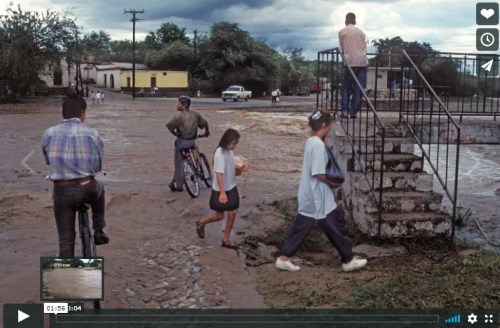
Shows the opposite end of the pedestrian bridge over the flooded arroyo. Click on this link to access video on Vimeo: Summer Flooded Arroyos
I was told by the local taxista that we regularly use that once the rain stops, the flood waters magically (dare I say Biblically?) begin to recede. For the ciadaduanos de Álamos the flooding has become a welcomed part of the delicate balance of life here, not something to be feared or dreaded.
 Call and Response