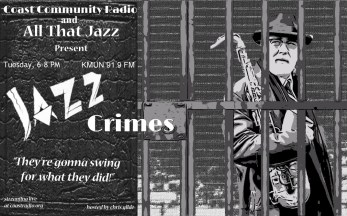
 Searching for musical ideas for my last jazz program led me to discover the very unusual category of crime jazz.
Category is probably not the right word to use to describe a classification of jazz music. Classification works, I suppose, but only as a way of talking about jazz and its many forms, as a way of identifying jazz’s historical evolution, and as a way of building a common jazz genre vocabulary.
Crime Jazz, in my view, is not really a classification or sub-genre of jazz the same way we can categorize hard-bop as a sub-genre of bebop or acid jazz as a sub-genre of fusion. Crime jazz is neither a reaction to nor an evolution from an earlier style of jazz. Unlike bebop, for example, it has no artistic or intellectual justification for its existence.
Understanding into what category Crime Jazz fits is more a matter of understanding its function. All music has a function, at least in the sense that it is used for a particular purpose or to elicit some kind of response. What comes to mind as an example of function is swing. Swing is dance music; that was and continues to be its primary function. While I’m sure when Benny Goodman

Sedate audience during Goodman solo at Carnegie Hall
played Carnegie Hall in 1938, as tempted as the audience was to break out into the Lindy Hop or the Jitterbug, from newsreels and photo stills of the concert, it appears they politely restrained themselves because, after all, they were in Carnegie Hall, the citadel of American high culture. Instead, the audience behaved themselves and just listened.
On the other hand, bebop practitioners Charlie Parker and Dizzy Gillespie created an art form intended to be enjoyed on an intellectual rather than emotional level. With bebop you went to a club to listen, not to dance. For example New York’s The Vil lage Gate allowed no dancing and very little singing (Living with Music: Ralph Ellison’s Jazz Writings Ralph Ellison, xxviii). As a side note, Ralph Ellison, according to Albert Murray, had a “strong distaste” for bebop for that very reason: because that style of jazz disconnected itself from “the ritual form of the dance.” Ellison’s dislike was based on his notion that jazz functioned as a participatory art, requiring an immediate emotional response—jumping, hopping, dancing— whereas bop solicited a “mainly intellectual” kind of response.
So it should come as a surprise to no one that when Hollywood during the fifties and sixties started looking for a type of music to accompany popular crime-themed movies and television programs they turned to jazz music. Hollywood found a “darker use for jazz” (Jazz Noir: Listening to Music from Phantom Lady to The Last Seduction, David Butler). They believed jazz music would be perfectly suited for crime film and television soundtracks, especially film noir, private eye and hard-nose cop shows, and even to some extent blaxsploitation films of the early seventies. Hollywood saw (or heard) a correlation between jazz’s historical reputation as “immoral” music and the thematic core of their films about crime. There is always, for example, a jazz club to be found, a meeting place for private dics who have jazz singer girlfriends (e.g. Peter Gunn) or where corrupt members of the underworld plot crimes and await payoffs over drinks with jazz combos playing jazz in the background.
A classic example of a Hollywood noir film exploiting jazz’s reputation is the 1944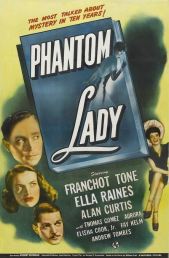 film The Phantom Lady. I first saw this film the first time in a jazz in film course I took in the summer of 2005 taught by Krin Gabbard at Washington University in St. Louis. What stood out for me was an overtly sexual scene between a jazz drummer, Cliff, who has witnessed a murder (portrayed by one of my favorite actors Elisha Cook, Jr.) and a “hep kitten” who goes by the name Kansas (played by Ella Raines). Cliff is playing drums—Gene Krupa style, you know, wild and crazy—and spots Kansas. For effect and as a visual metaphor, the film rapidly cuts back and forth between Cliff’s frenetic drumming and Kansas’ suggestive dancing, pouring of booze, and kissing of Cliff. What follows is a frenzied drum solo scene that grows in intensity, aided by equally frenzied editing between Cliff’s orgiastic drum pounding and wild facial expressions and the sometimes pained looks of ecstasy from Kansas. Hey this is great stuff, a great bit of film making and a perfect example of jazz’s prurient appeal in film.
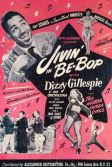 Ironically, in 1947 Dizzy Gillespie appeared Jivin’ in Bebop, a musical where even Dizzy himself is puttin’ on the moves. His dancing was widely praised apparently. The film features the Hubba Hubba Girls (make what you will of that) as well as Helen Humes and “A Big Cast of Stars.” I thought beboppers frowned on dancin’? Hey, after watching the Wrecking Crew this week, musicians shouldn’t be elitist and turn down jobs.
Upon the release of his 2001 documentary Jazz, Ken Burns wrote that jazz was about sex…the way men and women talk to each other, and negotiate the complicated rituals of courtship; a sophisticated and elegant mating call that has all but disappeared from popular music in recent times.” And that jazz is “about drugs and the terrible cost of addiction and the high price of creativity” (Ken Burns Jazz).
The popularity of crime themes in film, especially film noir, drove Hollywood’s pursuit of jazz musicians to write, arrange, and record film soundtracks. When shows about crime, cops, and private eyes became popular, producers wanted soundtracks that would define the content of these programs. Television programming needed a signature sound to stand out above the competition. And that need spawned Crime Jazz. So why not program a show that highlights some of the best of Crime Jazz?
Here are some of the show’s highlights (for the complete playlist go here):
 Miles Davis “Nuit Sur Les Champs-Elysees” composed by Miles Davis from Soundtrack from Elavator to the Gallows (1958) — Miles Davis wrote the score for director Louis Malle’s 1958 black and white film Elevator to the Gallows about the perfect crime, foiled by imperfect luck. Miles Davis and four Parisian jazzmen sat in a darkened studio, watching Louis’s loops and and improvising, wrote the complete score in four hours.
 Jackie McLean “O.D.” composed by Freddie Redd from The Music from The Connection (1960) — “O.D.” The Freddie Redd Quartet with Jackie McLean from the soundtrack The Music from The Connection, 1960. Freddie Redd (piano), Jackie McLean (alto sax), Michael Mattos (bass), Larry Ritchie (drums). The film uses actual musicians to play the roles of heroine addicted jazz musicians. The movie’s title refers to a drug dealer who brings heroin for the musicians and other addicts hanging out in a friend’s loft. Sadly, Jackie McLean was a true-life heroine addict. See http://www.newyorker.com/culture/richard-brody/movie-week-connection.
 John Zorn “Spillane” composed by Spillane from Spillane (1986) — Zorn uses a collage of sound techniques inspired by Mickey Spillane’s’ Mike Hammer detective novels. This is brilliant stuff, full of sound-effect collages and chilling voices, all blended into a jazz arrangement.
 Sammy Davis Jr. “Johnny Cool” composed by Billy May from Johnny Cool (1963) — Billy May is a jazz composer best known for his work with Frank Sinatra1963 crime film directed by William Asher. Sammy’s voice and swagger is unbelievably cool. He even wears an eye patch in the film.
 Jimmy Smith “Slaughter on Tenth Ave” composed by Richard Rogers from Slaughter on Tenth Ave — Main theme based on Richard Rogers song from a ten minute ballet; the 1957 film Slaughter on Tenth Avenue is about the waterfront wars in New York City during the fifties; Jimmy Smith on organ
 Modern Jazz Quartet “No Happiness for Slater” composed by John Lewis from No Happiness for Slater — “No Happiness for Slater,”The Modern Jazz Quartet from film soundtrack for Odds Against Tomorrow, 1959 Blue Note John Lewis (piano), Milt Jackson (vibes), Percy Heath (bass), Connie Kay (drums). Singer Harry Belafonte plays a hip, blues-singing vibist who’s also a compulsive gambler and aspiring bank robber. In other words, your typical modern jazzman.
 Duke Ellington “Anatomy of Murder” composed by Ellington from Anatomy of Murder Soundtrack — Duke Ellington and his orchestra from the 1959 film. This is brilliant stuff because Ellington takes writing the soundtrack serious enough to make a masterpiece that beautifully reflects the dark tone of the film.
 Roy Ayers “Brawling Broads” composed by Roy Ayres from Cofy Soundtrack (1973) — Roy Ayers soundtrack to blaxploitation 1973 masterpiece Coffy staring Pam Grier. Roy Ayers on keyboards and vibes and his band defined the soul jazz, tripped-out funk of this film genre. Ayers is a brilliant vibraphonist and this is pure funk and soul.
 Willie Hutch “Foxy Lady” composed by Willie Hutch from Foxy Brown soundtrack (1974) — Theme from another Pam Greer blaxsploitation film, 1974 Foxy Brown; Willie Hutch vocals and guitar lend pure funk and soul jam sounds to the soundtrack
 George Duning “Jazz Chase” composed by George Duning from The Naked City: Musical Portraits — From the 1958 television police drama; John McIntire, who also stars in the series, does the narration; series was based on the successful 1948 film
 Shorty Rogers “Hot Blood (The Wild One)” composed by Leith Stevens from Hot Blood (The Wild One) — “Hot Blood,” from Hollywood’s first great biker flick The Wild One, a semi-factual story of a small California town terrorized by rival motorcycle gangs. Marlon Brando, in black leather jacket with skull & crossed pistons on back, was Johnny, leader of the gang. 19-piece band featuring Shorty Rogers (trumpet), Bud Shank (alto sax), Shelly Manne (drums). Composed by Leith Stevens. Arranged by Shorty Rogers.
 Buddy Morrow “Johnny Stacatos Theme” from Johnny Stacatos Theme — “Johnny Staccato,” Buddy Morrow, trombone, from the 1959 film Staccato starring John Cassavetes. Johnny plays jazz piano at a Greenwich Village nightclub and doubled as a streetwise private eye during the day.
 Gerry Mulligan “I Want to Live” composed by Johnny Mandel from I Want to Live! Soundtrack — “Theme from I Want to Live,” Johnny Mandel’s score performed by Gerry Mulligan sextet is from the 1958 film I Want to Live! the true story of three lowlifes who, after murdering a disabled widow during a botched robbery, are executed in San Quentin’s gas chamber. Tough sound for a tough theme.
 Elmer Berstein “Frankie Machine” composed by Bernstein from The Man with the Golden Arm (1955) — “Frankie Machine,” from the 1955 Otto Preminger film The Man with the Golden Arm. The squalid story of a junkie card dealer and wannabe jazz drummer played by Frank Sinatra. Elmer Bernstein wrote this hit single and plays trumpet with a large orchestra featuring Shorty Rogers (flugelhorn), Pete Candoli (trumpet), Shelly Manne (drums).
 Ray Anthony “The Peter Gunn Theme” from The Peter Gunn Theme — “The Peter Gunn Theme,” from NBC’s suave TV 1958. Craig Stevens played the role of a hip private eye with a sexy, jazz-singer girlfriend Edie Hart (Lola Albright), who sings smoky ballads at Mother’s. Ray Anthony (trumpet) and Plas Johnson (tenor sax)—a great version of Mancini’s tune.
 Henry Mancini “My Manne Shelly (from more music from Peter Gunn)” from My Manne Shelly (from more music from Peter Gunn) — Pete Candoli (trumpet), Dick Nash (trombone), Victor Feldman (vibes), John Williams (piano), Joe Mondragon (bass), Shelly Manne (drums), Bob Bain (guitar)
 Jazz at the Movies Band “Naked City” composed by Miklós Rózsa / Frank Skinner from White Heat: Film Noir — Title theme from 1948 motion picture The Naked City; Timothy May, guitar; Bill Cunliffe, piano; Gary Foster, clarinet; Warren Luening, trumpet. This is an incredible band. Don’t let their name dissuade you from listening.
 Mundell Lowe and Clark Terry “Theme from Mr Lucky” composed by Henry Mancini from Themes From Mr. Lucky The Untouchables And Other TV Action Jazz (1959) — Theme from the short-lived 1959 television series Mr. Lucky who is an honest professional gambler with extraordinary luck. He carries a pocket watch whose chimes play the first five notes of the Mr. Lucky theme music.Mundell Lowe, guitar; Clark Terry, flugelhorn.
Read Full Post »
 Call and Response
Crime Jazz
Posted in Jazz, Jazz History, Jazz Playlists, Music, Significant Jazz Releases, Social Commentary, tagged Albert Murry, Benny Goodman, Carnegie Hall, Crime Jazz, Dizzy Gillespie, jazz categories, jazz dancing, jazz soundtracks, Ralph Ellison, swing on July 27, 2015| Leave a Comment »
Category is probably not the right word to use to describe a classification of jazz music. Classification works, I suppose, but only as a way of talking about jazz and its many forms, as a way of identifying jazz’s historical evolution, and as a way of building a common jazz genre vocabulary.
Crime Jazz, in my view, is not really a classification or sub-genre of jazz the same way we can categorize hard-bop as a sub-genre of bebop or acid jazz as a sub-genre of fusion. Crime jazz is neither a reaction to nor an evolution from an earlier style of jazz. Unlike bebop, for example, it has no artistic or intellectual justification for its existence.
Understanding into what category Crime Jazz fits is more a matter of understanding its function. All music has a function, at least in the sense that it is used for a particular purpose or to elicit some kind of response. What comes to mind as an example of function is swing. Swing is dance music; that was and continues to be its primary function. While I’m sure when Benny Goodman
Sedate audience during Goodman solo at Carnegie Hall
played Carnegie Hall in 1938, as tempted as the audience was to break out into the Lindy Hop or the Jitterbug, from newsreels and photo stills of the concert, it appears they politely restrained themselves because, after all, they were in Carnegie Hall, the citadel of American high culture. Instead, the audience behaved themselves and just listened.
On the other hand, bebop practitioners Charlie Parker and Dizzy Gillespie created an art form intended to be enjoyed on an intellectual rather than emotional level. With bebop you went to a club to listen, not to dance. For example New York’s The Vil lage Gate allowed no dancing and very little singing (Living with Music: Ralph Ellison’s Jazz Writings Ralph Ellison, xxviii). As a side note, Ralph Ellison, according to Albert Murray, had a “strong distaste” for bebop for that very reason: because that style of jazz disconnected itself from “the ritual form of the dance.” Ellison’s dislike was based on his notion that jazz functioned as a participatory art, requiring an immediate emotional response—jumping, hopping, dancing— whereas bop solicited a “mainly intellectual” kind of response.
So it should come as a surprise to no one that when Hollywood during the fifties and sixties started looking for a type of music to accompany popular crime-themed movies and television programs they turned to jazz music. Hollywood found a “darker use for jazz” (Jazz Noir: Listening to Music from Phantom Lady to The Last Seduction, David Butler). They believed jazz music would be perfectly suited for crime film and television soundtracks, especially film noir, private eye and hard-nose cop shows, and even to some extent blaxsploitation films of the early seventies. Hollywood saw (or heard) a correlation between jazz’s historical reputation as “immoral” music and the thematic core of their films about crime. There is always, for example, a jazz club to be found, a meeting place for private dics who have jazz singer girlfriends (e.g. Peter Gunn) or where corrupt members of the underworld plot crimes and await payoffs over drinks with jazz combos playing jazz in the background.
A classic example of a Hollywood noir film exploiting jazz’s reputation is the 1944 film The Phantom Lady. I first saw this film the first time in a jazz in film course I took in the summer of 2005 taught by Krin Gabbard at Washington University in St. Louis. What stood out for me was an overtly sexual scene between a jazz drummer, Cliff, who has witnessed a murder (portrayed by one of my favorite actors Elisha Cook, Jr.) and a “hep kitten” who goes by the name Kansas (played by Ella Raines). Cliff is playing drums—Gene Krupa style, you know, wild and crazy—and spots Kansas. For effect and as a visual metaphor, the film rapidly cuts back and forth between Cliff’s frenetic drumming and Kansas’ suggestive dancing, pouring of booze, and kissing of Cliff. What follows is a frenzied drum solo scene that grows in intensity, aided by equally frenzied editing between Cliff’s orgiastic drum pounding and wild facial expressions and the sometimes pained looks of ecstasy from Kansas. Hey this is great stuff, a great bit of film making and a perfect example of jazz’s prurient appeal in film.
Upon the release of his 2001 documentary Jazz, Ken Burns wrote that jazz was about sex…the way men and women talk to each other, and negotiate the complicated rituals of courtship; a sophisticated and elegant mating call that has all but disappeared from popular music in recent times.” And that jazz is “about drugs and the terrible cost of addiction and the high price of creativity” (Ken Burns Jazz).
The popularity of crime themes in film, especially film noir, drove Hollywood’s pursuit of jazz musicians to write, arrange, and record film soundtracks. When shows about crime, cops, and private eyes became popular, producers wanted soundtracks that would define the content of these programs. Television programming needed a signature sound to stand out above the competition. And that need spawned Crime Jazz. So why not program a show that highlights some of the best of Crime Jazz?
Here are some of the show’s highlights (for the complete playlist go here):
Read Full Post »