Mexico Federal Highway 15 looking south.
Driving in Mexico, like anywhere really, can be nerve-racking—but no more or less nerve-racking than driving in the states, especially in California; the drivers in California are murderous.
The majority of the Mexico highways is made up of carreteras, which are the undivided (literally no lane dividers) or divided two-lane highways, often without shoulders as I describe below.
The four or more lane “high-speed” freeways or expressways are known as autopistas and have either restricted (toll) or unrestricted access. Non-toll roads are referred to as carreteras libres (free-roads).
Most of the expressways are expensive toll roads or autopistas de cuota. Mexico’s toll roads are some of the most expensive in the world. One interesting fact about Mexico’s toll roads is that the toll usually includes a “travelers’ insurance” (seguro del viajero) which “covers” any accident on the cuota, which is why it is highly recommended to keep all toll receipts.
The carretera from Sonoyta just across the border from Lukeville, AZ, (SON 2) is a well-maintained divided two-lane highway with enough shoulder to stradle the line to let vehicles pass you. There are even rest areas (Area de Descanso) where there is enough space on the shoulder to pull completely off the highway.
Driving through or around Mexico’s bigger cities is a different matter. In order to get to Bahia de Kinos, we either had to drive through Hermosillo (never a good idea to drive through any major city in Mexico) or take a bypass around the inner city and avoid the extremely heavy traffic.
The traffic along the Hermosillo bypass, however, was chaotic at best, with narrow divided roads and right-hand lanes that often are occupied by street vendors who have moved from the sidewalk into the street for better access to potential customers. I never knew what to expect—at any moment, no matter how cautious of a driver I am, someone, some car, some dog, some window washer could lurch in front of me without warning. Still it was better than driving through the city proper.
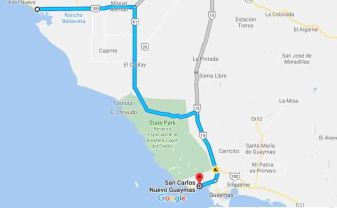
So when it was time to leave Kino Bay and head south to San Carlos, we were able to find an alternative route that bypassed Hermosillo altogether, and in doing so, shave off an hour from our drive time.
Mexico hwy 61 (all Mexico north-south carreteras are odd numbered) was well-maintained with no pot holes or cracks in the road. The only drawback is that this road was one of the carreteras with no shoulders beyond the white line, which makes sharing the road with Mexican monster semi-trucks a heart-stopping experience. With the wide wheel-based truck camper, I could ride the edge only so far, but just far enough to safely squeak by the oncoming trucks.
Eventually, SON 61 meets the unrestricted autopista SON 15, Mexico’s major north-south freeway, about 30 miles from San Carlos.
There was some heavy road construction going on at the junction (in Mexico, there’s always some sort of heavy road construction going on) so we were forced into a truck stop and fueling station right along hwy 15. Jackie spotted a taqueria between an OXXO and a rough-looking hotelito for Mexican truckers who are in need of a bed for the night. While I took Louis for a brief walk, she dashed over to grab some tacos.
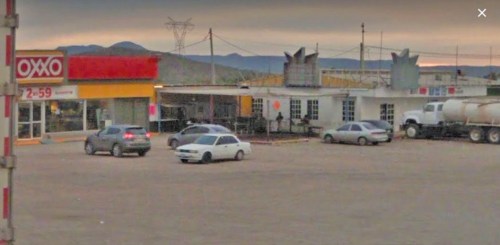
At the junction of SON 61 and 15. OXXO on left, the taqueria center with seating, hotelito on right with tanker truck parked in front.
We rested before moving on by eating a couple of tacos al carbon and drinking a couple of beers. They were delicious. Thirty minutes later we made it to Totonaka RV Park in San Carlos:
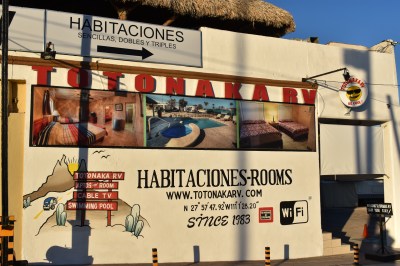
The Totonaka RV Park sign on the side of a building that greats visitors.
Totonaka is primarily a stopping over point for Canadians, many, many Canadians, who are on their way to Mazatlan for the winter. We have met some who stay here all winter long. Met one interesting man from Alberta who arrives here in late October and won’t return to Canada until May. Even then he says there’s a threat of snow.
The Canadians, at least those I have met thus far, are a friendly sort for the most part. A bit aloof I’ve found, but so are Astorians.
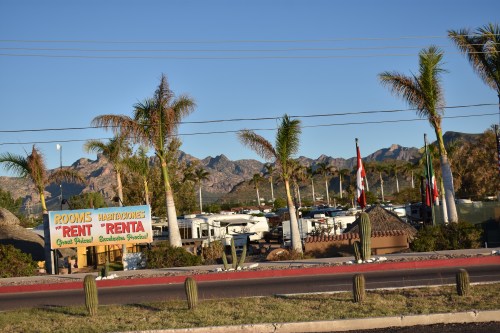
A park full of Canadians: View of Tototanka with jagged mountains in the distance.
The landscape surrounding San Carlos—the expansive bay, the rugged mountains, and the endless beaches—is stunning. The most notable landmark we see as we first enter the town is the twin-peaked mountain called Tetas de Cabra (Goat’s Teats) which looms magically over San Carlos Bay.
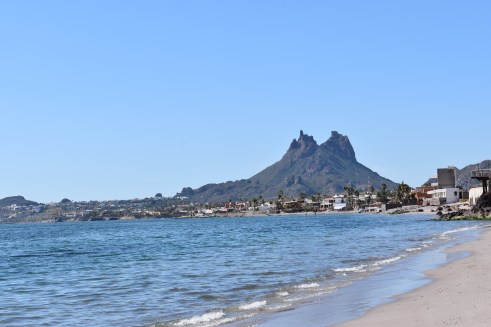
Tetas de Cabra
We stay here for at least a week before moving on to Álamos next week. Next: some of the food we’ve experienced so far in Mexico.
 Call and Response