We arrived in La Playa Huatabampito at El Mirador last week from Álamos and Rancho Acosta, and the change of scenery from a colonial pueblo high in the foothills of the Sierra Madres to a beach campground perched on the edge of the Sea of Cortez couldn’t be more dramatic. The transition is a keen one.
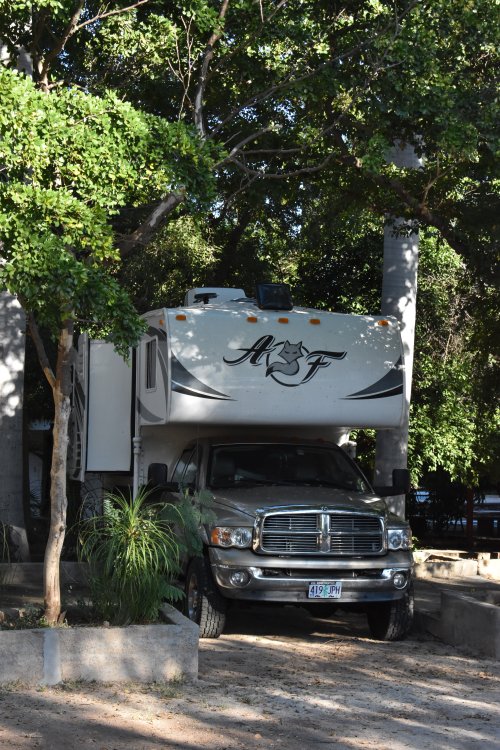
Rocinante under the shade of cottonwoods and lime trees.
From Rancho Acosta nestled in the foothills of the Sierra Madres, where the brisk air is rich with the fragrance of limes, oranges, and pummelos, where the shade of cottonwood and lemon trees surround each campsite, and where the evenings are chilly and the days warm and dry, we arrive at the Mirador on the Playa Huatabampito with its humid sea air and wide expanse of the limitless blue Sea of Cortez, its treeless campsites, and its beaches that seem to stretch endlessly, disappearing into the horizon.
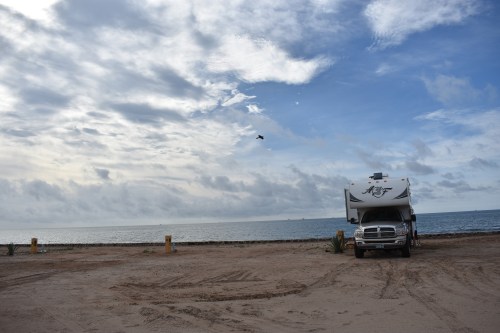
Humid sea air and the calm of the Sea of Cortez on La Playa Huatabampito
At El Mirador the days are almost hot, and the immense coconut palms that dot the beach landscape offer little relief from the intense Cortez sun, that is until it begins to set and the cooling offshore breezes begin.
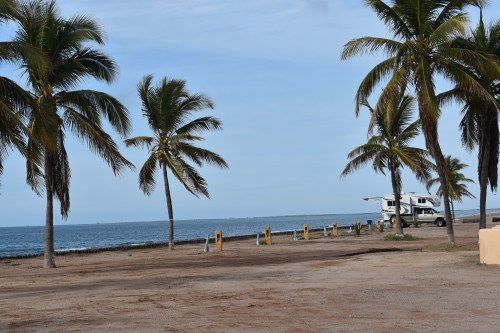
The tall coconut palms scattered throughout provide little relief from the sun’s heat until the late afternoon breezes begin to cool things down.
At the El Mirador when we arrived, we had our pick of beach-front sites. No one else was here. We camped right on the beach at a site that faced south (rather than west) into the Sea of Cortes. Looking at a map, we can see La Playa Huatabampito sits on a peninsula-like land mass whose coastline stretches east-west, rather than north-south.
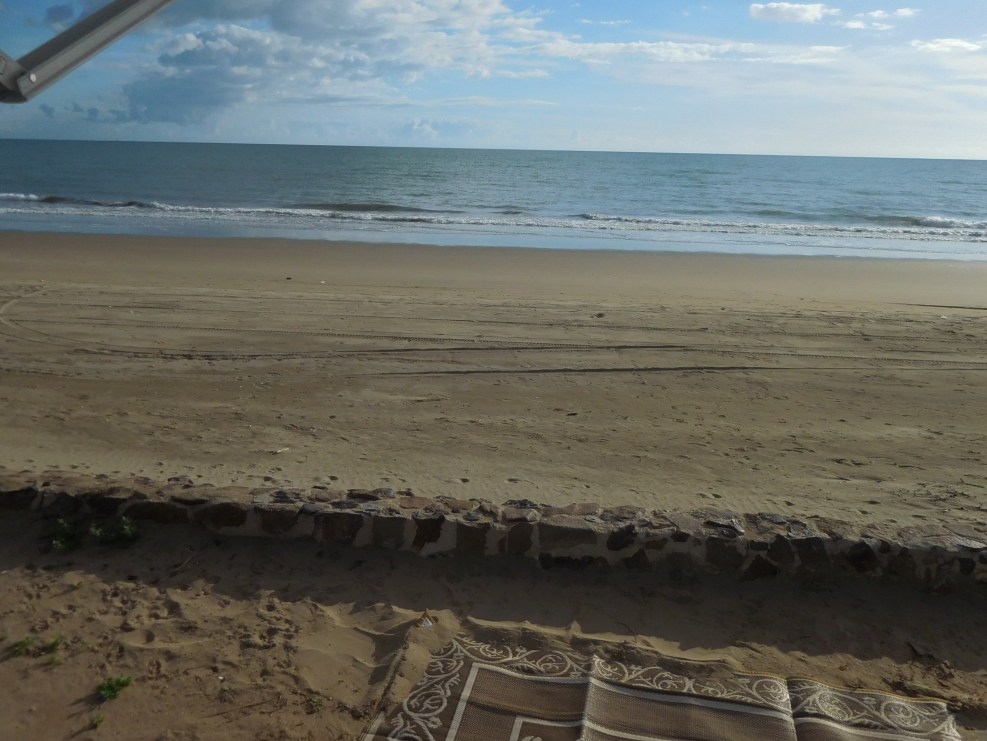
Looking south out the rear door of the camper towards the Sea of Cortez
The rear door of the camper faces south rather than west, so we are witness to the phenomenon of watching both the sunrise in the morning and sunset in the evening along the same horizon. It took me a while to figure out why this is. I automatically assume whenever I see a coastline that I am looking west, not south.
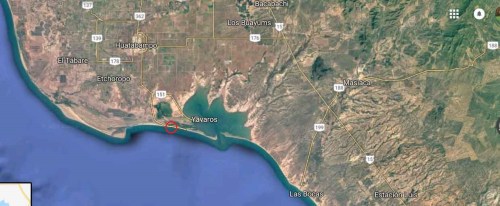
The red circle on the map is our location along an west-east peninsula-like land mass.
If you will note on the map above, just to the northeast of us is the very small fishing village of Yavaros. With a large body of water to the east of the village and a natural barrier of sand bars, Yavaros is also one of six ports in the state of Sonora. There flotillas of pangas, the ubiquitous, open, out-board motor powered fishing boats Mexican fisherman use, go out every morning past the bar, then return in late afternoon in time to unload their catch and sell it to the local restaurant retailers. They set up tables on the water’s edge where they beach their pangas and then clean their catch and sell it to the locals.
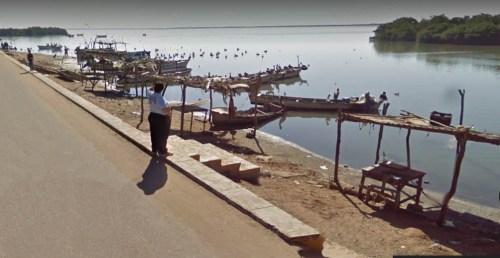
Pangas beached and floating in Yavaros Bay with cleaning tables in the foreground. Entrance to the port in the background. Source: Google Maps
One evening, craving seafood, we ate in the El Mirador restaurant which is adjacent to the RV park. It’s a modest restaurant with a palapa covered outdoor eating area and an inside dining area. Both restaurant and RV park are owned and run by a local family. The patriarch of the family, Carlos, came up to me one morning and introduced himself. He spoke no English, but was very tolerant of my less-than-satisfactory attempts at small talk in Spanish. Not only was he not bothered by my poor Spanish, but he, like many of the Mexicans I have met since arriving, seemed to be flattered by the fact that a norteamericano would even attempt to speak his language. There is, however, a kind of unwritten trade-off: I can try out my Spanish, but I also have to be willing to be corrected. In Mexico, life is all about bargains and trade-offs. I try to imagine a similar language-learning scenario in the states, outside of a classroom anyway. Americans are just generally much less tolerant.
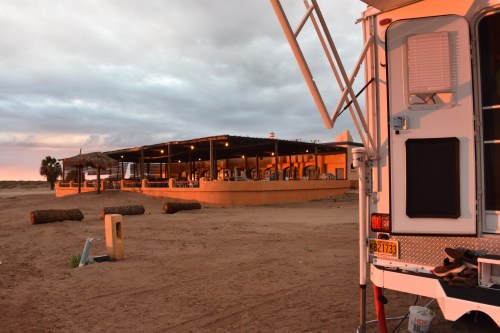
El Mirador restaurant at sunset. Outside dining area with flat palapa-style roof. We had to eat early because the mosquitoes come out at night..
Carlos’ sobrina, Carla, runs the front desk. I met her when we first arrived and as was my usual protocol, I immediately asked her ¿Habla used ingles señor? “A little señor.” Which was hardly accurate, for in fact, she in fact spoke very good English. But like many of the Mexican people who I have met with good English language speaking skills, Carla was very modest about her skills. I was relieved that this time I did not have to struggle with my Spanish.
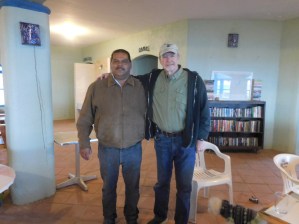
Daniel, our Mirador Restaurant waiter who was feeling very well at the time.
The second time we ate in restaurant we met Daniel, our waiter, who did not speak English, other than casual greetings. He found my attempts at Spanish very amusing. Every time I tried to use my Spanish on him, he’d crack this big smile, nod at me vigorously, completely amused at my pathetic attempts at Spanish. Not one to be easily dismayed, whenever I said something that I wasn’t completely certain about, I would ask him ¿Lo dije correctamente? Did I say that correctly? He would crack another big smile and say, “Oh, no señor, no,” and that’s all.
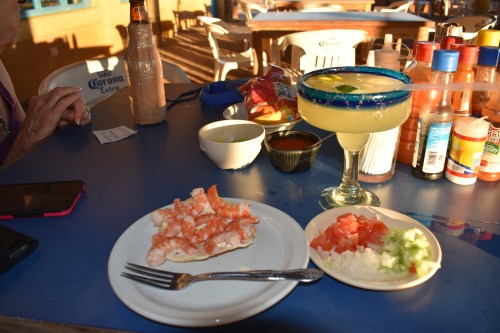
To start, margarita and mariscos fresca on a tostada.
That night I had the most amazing fish dinner. Pargo frito. Freshly caught red snapper that is breaded and then deep fried to a golden brown. Absolutely delicious. Another example of Mexican food that is simply cooked and presented. Never had anything like it before.
More pics:
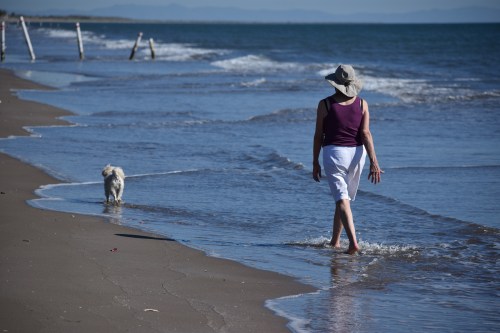
Jackie wandering the beach with Louie.
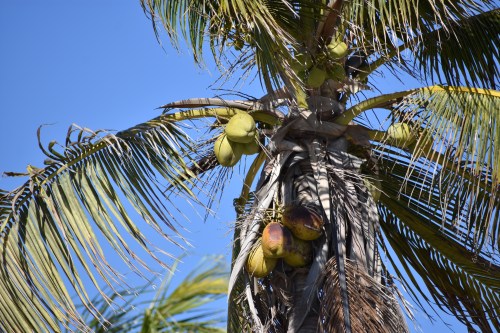
La playa huatabampito coconut palm
 Call and Response