
All-Grain Pumpkin Ale
The “Mixed Grist”
A fellow homebrewer friend of mine recently shared a recipe for a Java Stout with me last month and I was anxious to give it a try. His recipe called for grain bill of 8 lbs: pale malt, Maris Otter, two shades of crystal malt, and chocolate malt, plus 8 ozs. cold infused coffee and an oz. of cocoa nibs both added to the last five minutes of the boil.
A week before brew day, I dropped my grain bill off at Mainbrew my favorite home brew supply store in Hillsboro, OR, planning on picking up my crushed grains later in the day. Typically, I order extra grains to have some on hand if needed. Unfortunately, I failed to mention to the clerk that I wanted the grains crushed separately, so I ended up with 13 lbs. of mixed, crushed grains. My fault.
Normally, brewing with 13 lbs. of grain would not be a problem for a brewer who uses a ten-gallon pot. Thirteen pounds grain requires on average a big enough brew pot to handle a pre-boil volume of 7 gallons. The boil pot I have now—an old turkey fryer pot—can only handle about 6 gallons depending on the recipe, and I sometimes have to split my wort boil between two pots.
The Cellar Dweller
I used beersmith to design smaller batch recipes using the “mixed grist” grains from my original 13 lbs. Using the program, I whittled the 13 lbs. down to 4 lbs. I also had about 5.5 lbs. of amber liquid malt extract lying around that I wanted to use up, so I thought I would try to brew a Partial-Mash recipe, using both extracted sugars from a mini-mash and and “equal” amount of LME. Beersmith is an extremely useful program for all-grain recipe designing, though understanding how the program makes basic calculations for things like total water needed for the brew session, for example, is still beyond me. The basic brew math and chemistry I have a handle on, so I understand how beersmith makes most of its calculations, but I couldn’t figure out how to set the program up to build a recipe for brewing with both a grain mash and LME. Clearly there is a way—countless beersmith tutorials on youtube can attest to that. But thanks to Gash Slugg at cellardweller.net and his Sierra Nevada Pale Ale Clone “mini mash” recipe, I was able to design a recipe using my “mixed grist” grains and the LME, using his brewing technique. Slugg is an Aussie with punk sensibilities and a proclivity for minimalist brewing techniques, as his many videos demonstrate.
When I first started brewing years ago (I brewed my very first batch in 1978 in Pine Grove, Or), I brewed exclusively with Liquid or Dry Malt Extract as, I’m sure, the majority of beginning brewers do. The grains in extract recipes or kits were typically not mashed; they were steeped (like tea). Steeping offset the often excessive sweetness of the mashed grains by adding distinctive non-malted grain flavors. Also like many like many home brewers who stick with it, I eventually moved to all-grain brewing. Once I understood the chemistry of brewing (or at least dangerously familiar), I had more control over designing my own recipes.
Every all-grain brewer, at some point, quickly comes to realize that equipment requirements for brewing all-grain recipes can quickly grow out of control. So what I found particularly useful in partial or mini-mash brewing is that this brewing technique divides the fermentables almost equally between mashed grains and LME (there is, however, math at work here, so it is not always a fifty-fifty division), and this allows the home brewer to consolidate equipment needs (combining brew pot and mash tun, for example), shorten brewing time commitment, and make the tiring process of clean up much quicker. Gash Slugg refers to his partial or mini-mash method as “stove top,” meaning all of the brewing steps can be done strictly on the stove, no external mash-tun or propane burner needed.
I had to give this a whirl using my “mixed grist” recipe.
Brew Day—Yeast Starter
To make my brew day interesting, I decided to use my own cultured yeast. I’ve been experimenting with “washing yeast,” the technique of harvesting flocculated yeast from the bottom of a primary fermenter by “washing” with sterilized water, storing the resulting slurry in a large jar, letting the yeast settle in suspension, then transferring the yeast only into smaller jars for storage for later use.
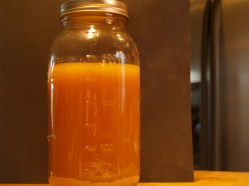
Jar of washed yeast with yeast in suspension and trub settling to the bottom.
Once the yeast cake settles to the bottom, it is stored in the refrigerator until needed. The day before my brew day, I removed the jar and made a yeast starter in an an Erlenmeyer flask.
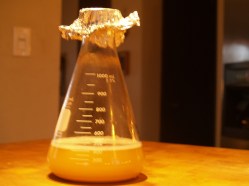
Yeast Starter in Erlenmeyer flask.
This is what I eventually pitched into the primary fermenter.
The “Mini-Mash”
Since I wasn’t using a mash tun to extract wort from my grains, instead I used a nylon paint-strainer bag to hold the grains during mash in.
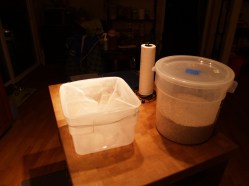
Four lbs. of my “mixed grist” grains and the “brew bag.”
I took the nylon bag and stretched it over a plastic container which held the bag in place while I measured out the grains directly into the bag.

Four lbs. of grain in grain bag.
Here’s a close-up of the “crush.” The aroma is amazing.
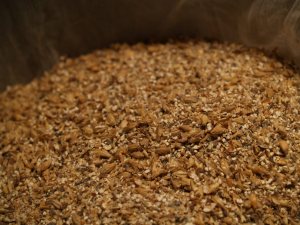
Crushed grains.
Mashing-In
Here’s my stove-top setup: the pot on the left holds the sparge water (just under two gallons) and the one on the right is a three gallon pot, holding 1.5 gallons of water for the mash in.
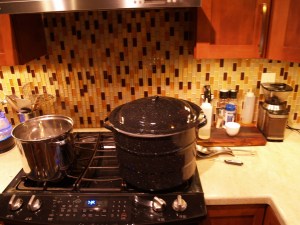
Pots for sparge and mash in water.
Mashing in the grains is just a matter of heating the required volume of water to mash-in temperature (150° mash-in temp requires 168° to account for temp. loss) and then submerging the grain bag into the heated water.
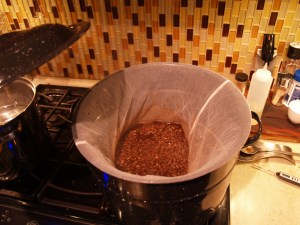
Grains in nylon bag suspended in mash water.
The grains in the bag are completely soaked by the mash water at proper temp and conversion instantly begins. The nylon bag holding the grains is stretched over and held in place by the rim of the 3 gallon pot. The bag that I used is too small for the size of the pot I was using. Ideally, the bag should be big enough to allow the grains to reach the sides of the pot. As the above photo shows, because of the smaller bag, the grains are balled together in the center of the pot. I had to thoroughly stir to distribute the heat through all of the grain since there were hot spots in the mash that had to be dissipated.
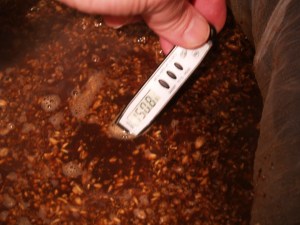
Mash temp at 150°
The trick is to hold the mash temp as close to 150° as possible for, in the case of this recipe, 90 minutes. I had to closely monitor the temp throughout the 90 minute period, stirring to distribute the heat and turning on the gas burner when necessary to raise the temperature.
Sparging the Grains
After 90 minutes the grain bag is fished out of the wort, dropped into a strainer large enough to hold five lbs. of soaked grains, and allowed to drain off the remaining wort from the soaked grains.
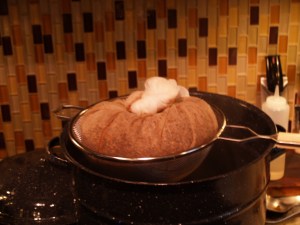
Grain bag draining wort into the pot
After emptying the “first runnings” into my boil pot, the grain bag goes back into the original pot for the sparging step.
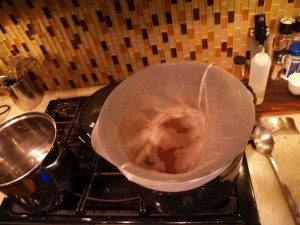
Grain bag back into the pot for sparging.
Sparging the grain bag is then just a matter of carefully pouring 168° sparge water from the pot on the left in the photo over the grains. The grains are then covered and allowed to rest for five minutes, at which time they are again strained and the second runnings poured into the boil pot. It’s always important to have enough sparge water on hand just in case you come up short. The wife recently purchased a nifty quick boil induction style electric boil kettle that can boil 1.5 ml of water in a few minutes.
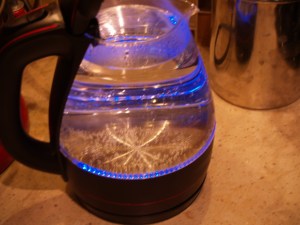
Induction boil kettle.
The kettle enables me to quickly have heated water on hand whenever I need it.
The Boil
Beginning boil volume of the wort requires adding water up to starting level for the boil—about 2.6 gallons, bringing my total pre-boil volume to about 5.25 gallons. Flame on.
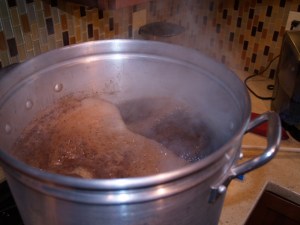
Five gallons of wort in the boil pot at a galloping boil.
The LME is a late addition to the boiling wort. It was added in the last 15 minutes of the boil. Once the wort started boiling again, I set the timer for 15 minutes.
The Gravities of the Situation
With a brewing technique like this, there are several pre-boil gravity readings to consider: after 1st runnings added to the pot; after 2nd runnings added to the pot; after adding water to pre-boil level; after a 45 minute boil, before adding LME; after 60 minute boil, wort is cooled to 65-70°, and added to fermenter before adding yeast. The OG of cooled wort in the fermenter was 15 Brix or 1.060. Since the original recipe I followed did not have a target OG, without further research, I had no way of knowing if I hit the OG target.
Pitching
I pitched the yeast I cultured and within six hours I was seeing fermentation. Two days later fermentation was dwindling. After a week I’ll transfer to the secondary, add coffee and nibs, and after another week or so I’ll bottle. I’ll let you know how it turned out.
 Call and Response