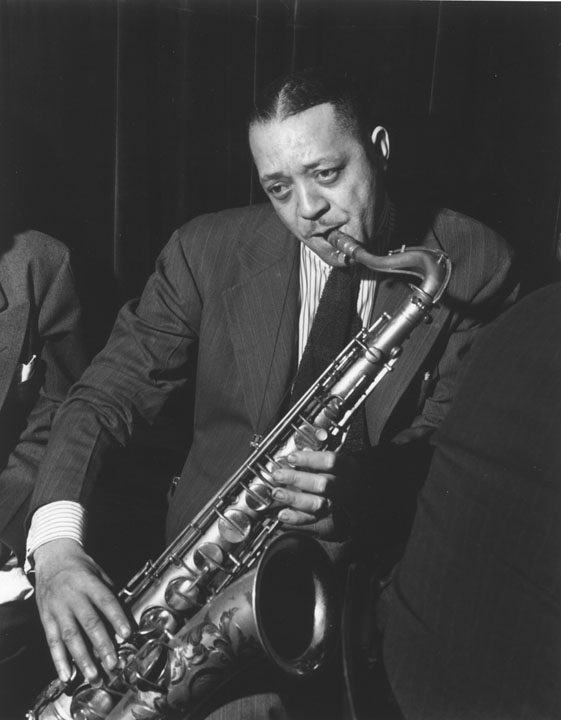
Lester Young on tenor displaying that unusual way of holding his instrument.
Lester Young and Charlie Parker have birthdays this week. It’s a challenge putting together a playlist that would do justice to these two jazz titans, especially as programmers on a public radio station are limited to no more than three selections from any one artist. I think this is all about royalties and getting paid in the age of digital music and the internet. Musicians need a way to make a living, and obviously digital music has radically altered and limited the way they can do that. So I try to adhere to the code, but it is difficult if a programmer wants to program a show that celebrates the accomplishments of a single artist—like Lester Young and Charlie Parker.
The way around it, for me at least, is to determine if the musician is leading the band or a member of the band. That has its challenges too. For example, Charlie Parker joined Kansas City musician Jay McShann’s territory band in 1938 and made his recording debut with McShann. However, McShann recorded under his own name. Now, of course, those early recordings are reissued as Charlie Parker with Jay McShann and His Orchestra, even though Parker shares solo space with other members of the band and is not necessarily highlighted in any way. A good example of this is in McShann’s “I Found a New Baby.” Parker’s solo is not particularly distinctive, certainly not any more than the other solos, other than it is an example of a very early recording of an eighteen-year old Charlie Parker. It’s still Jay McShann’s band, still his arrangements.
While I suppose this kind of record album billing may overshadow the importance of Jay McShann’s contributions to jazz history, anyone who understands anything at all about Jay McShann will know better.
Here are a couple of examples worth noting:
Lester Young “I Guess I’ll Have to Change My Plan” from The Jazz Giants (1956) — Lester Young, tenor; Roy Eldridge, trumpet; Vic Dickenson, trom; Teddy Wilson, piano; Freddie Green, guitar; Gene Ramey, bass; Jo Jones, drums. Lester Young is all about sweetness of tone. His solo style has been described as “floating above the rhythm,” a combination of melody and rhythm that never interferes, never detracts, and is always a product of pure imagination and creativity. We can witness this in a video from the 1957 CBS television special Jazz in America. Billie Holiday sings her classic “Fine and Mellow,” backed by a contingent of jazz titans. After Billie sings the first verse, Ben Webster takes the first solo. The tempo is a slow blues. Webster’s tone sweet, dark, smokey. But it swings with just a hint of blues wail at the end of each phrase. Pure soul. Look at the expression on Billie’s face:
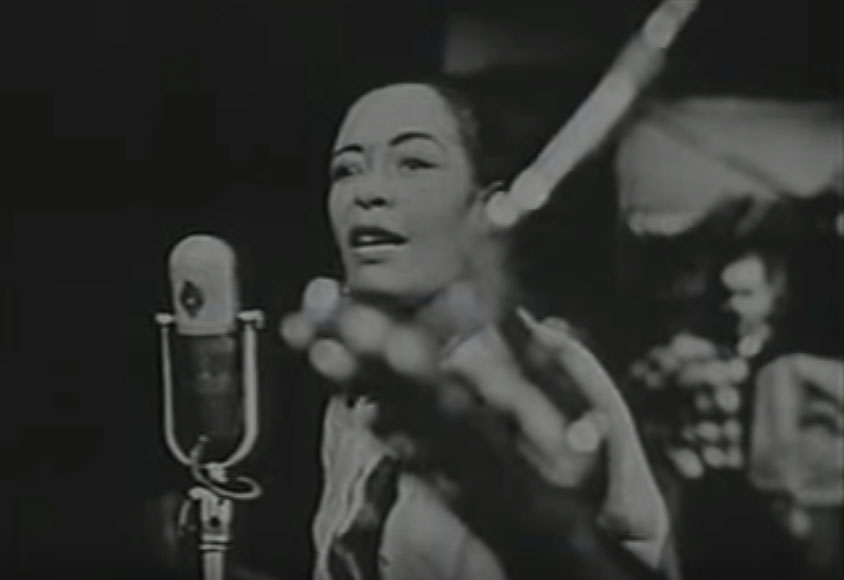
Lester Young is next, and the contrast between the two tenor styles is startling. As soon as he blows that first note you know it’s a response to Webster’s conversation. His side of the dialogue just floats above the rhythm, all full of sweetness and serenity, yet a completely reasonable jazz argument. His intent is not to convince anyone of anything; he just wants to add a little something to the conversation. And, oh man, does he have something to say. Just watch Billie’s facial expressions in the cut-away during his solo—they’re all full of smiles, head nods, peering, leaning in, exactly what you would see in a conversation between two people who have a very deep emotional and intellectual understanding of the musical message.
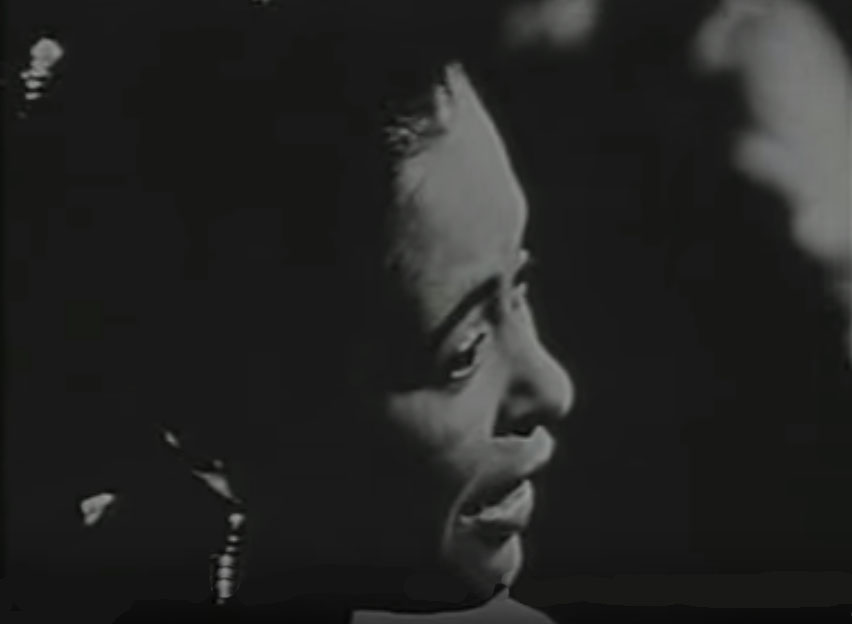
She is awestruck; we are as well. Here’s the video of the entire performance:
Charlie Parker “Salt Peanuts” from YardBird Suite (1953) on Rhino Records. This, of course, is from the most famous of all Bird records and rightly so. Despite Parker’s drug health problems, it’s been well documented that for the most part these problems had no effect on his ability to play (although for the Massey Hall concert there was a close call: Parker did not have his sax because, according to many sources, he had pawned it to buy smack; he ended up playing a Grafton plastic alto sax loaned to him by Grafton sales rep). Nothing but innovation and brilliance shine through. Amazing.
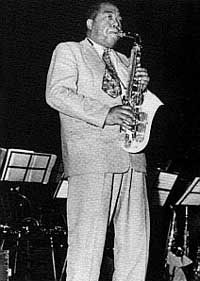
Bird playing a plastic Grafton alto sax.
The evening’s playlist:
Wynton Marsalis “Como Fue” from Live in Cuba (2015) — Wynton Marsalis with Jazz at Lincoln Center Orchestra, live at the Mella Theater in Havan, Cuba, 2010
Stan Getz “Blues in the Closet” from At the Opera House (1957) on Verve — Stan Getz, tenor; J.J. Johnson, trom; Oscar Peterson, piano; Ray Brown, bass; Connie kay, drums
Cannonball Adderley “Bohemia after dark” composed by Oscar Petiford from West Coast Blues (1963) on Kendal — features cornetist Nat Adderley, the versatile Yusef Lateef on tenor, flute and oboe, pianist Joe Zawinul, bassist Sam Jones and drummer Louis Hayes
Barry Harris Trio “Chasin The Bird” composed by Parker from Barry Harris Trio
Lester Young and billie Holiday “My Man” from Billie Holiday and Lester Young
Kenny Drew “Groovin’ the Blues” from The Pot’s On on Filton
Charlie Parker “Bloomdido” composed by Parker from Bird and Diz (1950) — Charlie Parker, alto; Dizzy Gillespie, trum; Thelonious Monk, piano; Curly Russell, bass; Buddy Rich, drums
Charlie Parker “Au Privave” composed by Parker from The Magnificent Charlie Parker (1951) on Clef — Charlie Parker, alto; Miles Davis, trum; Walter Bishop, Jr., piano; Teddy Kotick, bass; Max Roach, drums
James Carter “Nuages” composed by Reinhardt from Chasin the Gypsy (2000) on Atlantic — James Carter on bass sax
Joe Henderson “Mode for Joe” composed by Walton from Mode For Joe (1966) on Blue Note — Modern jazz at its best: Joe Henderson, tenor; trumpeter Lee Morgan, trombonist Curtis Fuller, vibraphonist Bobby Hutcherson, pianist Cedar Walton, bassist Ron Carter, and drummer Joe Chambers
Zoot Sims “One to Blow on” from The Rare Dawn Sessions (1956) on Biograph Records — Zoot Sims, tenor; Bob Brookmeyer, valve trombone; Jerry Lloyd, trumpet; John Williams, piano; Milt Hinton, bass; Gus Johnson, drums
Joshua Redman & The Bad Plus “As This Moment Slips Away” from The Bad Plus Joshua Redman on Nonesuch
Horace Silver “The Back Beat” from Do It Again — Horace Silver, piano; Lee Morgan, trumpet; Hank Mobley, tenor
Jay McShann & His Orchestra “I found a new baby” from Charlie Parker with Jay McShann and his orchestra
Lester Young “Ad Lib Blues” composed by Young from Ad Lib Blues (1956) on Verve — Lester Young, tenor; Oscar Peterson, piano; Barney Kessel, guitar; Ray Brown, bass; J.C. Heard, drums
 Call and Response