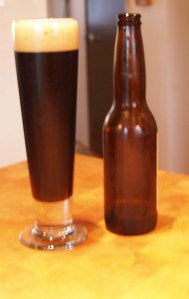
Chocolate Java Stout
Brewed my 25th batch of homebrewed beer yesterday, and that occasion deserves a post… and a brew. The style: a holiday stout. A 5 ½ gallon batch. My grain bill was 13 ½ lbs, using 2-row pale malt, maris otter, crystal, chocolate malt, and roasted barley flakes. Added fresh grated ginger and cinnamon sticks during the last five minutes of the boil and 1 lb. of organic honey at flameout. The batch is bubbling in the fermenter as I write
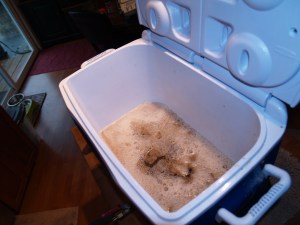
Mashing in my 60 quart box cooler from Homedepot. I opted for the box style as opposed to the bright orange round cooler style because of the price difference. But the lid on this cooler is a pain in the ass: It’s a two-piece split lid so I had to duct tape the two together on the outside; and the lid closes too easily. The round orange coolers have screw on lids and don’t have that problem.
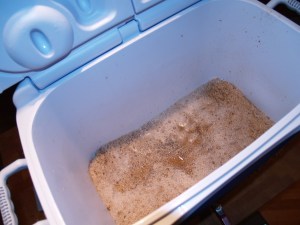
Thirteen lbs. of grain doesn’t look like much in the cooler. Added four gallons of 170° strike water to room temp grains. Mash cooled to 148° target temp. Mashed for 90 minutes, then did an iodine test to determine amount of starch to sugar conversion. This is interesting chemistry. If you add water heated to a specific temperature—usually in the range of 148°-158°—to crushed, malted grains, the starches in those grains will convert to sugar in the solution. The goal is always “complete” conversion; the more starches that are converted, the more sugar available to convert to alcohol in the primary fermenter. What’s interesting is the amount of time required to complete conversion. Thanks to youtube.com there are some interesting videos that demonstrate how long it actually takes to convert the starches in a mash to fermentable sugars using iodine. One such experiment demonstrated that it can convert in as little as 40 Minutes. Generally, most of the calculations done on beer brewing software use a mash period of 60 minutes to complete conversion. How is this significant? The answer has to include a discussion of mash temperatures because the higher water temperature used, the sweeter and fuller body the beer will be. Again, this is chemistry the brewer has to learn to understand how unconverted starches at higher strike temperatures can result in a “thicker,” sweeter, and lower in alcohol beer.
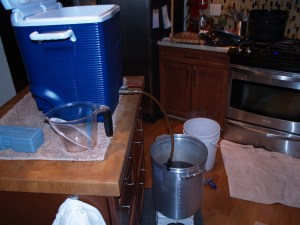
The first “runnings” after an hour of mashing. Iodine test showed complete conversion of starches to sugar. Wort at this stage is very sweet to the taste. I poured off four gallons of wort into the white bucket. Total strike and sparge water needed for this five gallon batch required a total of 8 1/2 gallons. My boil pot is really too small. It can handle only 7 1/2 gallons. So I split the first and second runnings into two separate pots.
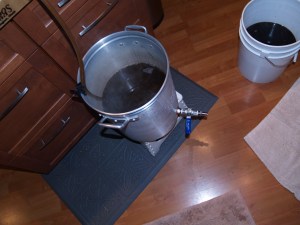
As this photo shows, I have already poured off first runnings into the white bucket. Second runnings are being drained into boil kettle. While draining off the second running, I thought about John Palmer’s Oak Mild (Shire Beer) recipe. Oak Mild was originally brewed in the Middle Ages in England from the second runnings, the wort being lighter in color and lower in sugar. Making a five gallon batch of this style of beer requires a kettle that will boil eight or more gallons of wort, coming from four gallons of heated strike water, then almost five gallons of heated sparge water. I mixed the two pots of wort as much as I could and ended up with two pots of wort to boil, the bigger kettle with five gallons and a smaller pot with four. Note the 1/2 in. ball valve with weld-less kit installed on my pot. This was originally used as a turkey fryer that I bought from a guy in Portland who specializes in selling housewares out of his house. Once cleaned, it works satisfactorily to boil wort. The problem is that as I learn more about brewing, the more I needed to upgrade my equipment. Hence, the new ball valve that lets me use the kettle as hot liquor tank, mash tun, and a boil pot. I used the kettle to heat strike water on the stove, then drain the water into the cooler directly below.
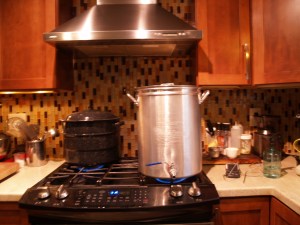
Wort boil split between two pots. Brought wort in both pots to a boil then transferred wort from smaller to larger pot to a volume of seven gallons and continued boil. Gas stove works surprisingly well for boiling large volumes of liquid. I’ve been tempted to spend money on single-burner propane stove and a tank of propane, but as long as this works for brewing five gallons of beer, why spend more money?
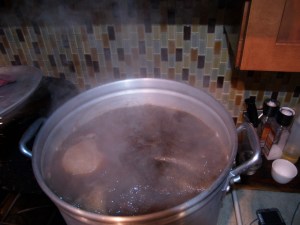
Wort has a good, rolling boil. Just added first hop addition—one oz. of Cascade. This will boil for sixty-plus minutes, depending on boil off. To get my five gallons of stout to bottle at the end of the fermentation process, I had to have at least 5.75 gallons of wort by the end of the boil. To keep my boil volume accurate, I added additional wort from the second pot. After sixty minutes I had just under six gallons, so I extended the boil until I reached that point. Volumes are tricky. I could target 5.75 gallons of cooled wort (to 75°), but there is a 4% loss of volume because of cooling.
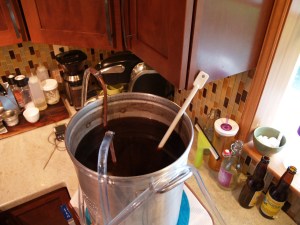
Photo shows cooled wort shrinkage about a half gallon lower. My final volume is just about right. The ball valve allowed me to drain wort directly into fermentation bucket set on a stool just below the kettle of wort. Draining the wort this way eliminates the need for siphoning equipment. To filter the sediment at the bottom, is a tube filter. Final volume to the fermenter (not shown) was 5.1 gallons, giving me enough fermented and conditioned stout to fill about fifty 12 oz. bottles.
 Call and Response