
Colorized version of famous black and white photo of Pops playing for Lucille and the Sphinx, 1961—© Bettmann/Corbis photo
As fate would have it, the one rare time Louis Armstrong’s August 24th, birthday (114th) happens to fall on a Tuesday, the day of my jazz show, I was out of town. I’ve programmed Armstrong birthday jazz shows almost every year since I started programming jazz 16 years ago, but my shows were always either before or after his birthday, never on his birthday.
Whatever fate wants, fate gets…I think Bob Dylan said that.
Being away from the board for two weeks meant that I needed a sub for two shows. Subs for regular show hosts can sometimes be an iffy proposition—not unlike the many times I needed a classroom sub. I try not to complain. I’m grateful that they can fill in to play jazz. Fortunately, Pam Trenary, who has wonderful taste in jazz, filled in for me, and she put together a enjoyable playlist for the evening.
Thanks to Marc Myers, Wall Street Journal music and arts writer and long-time jazz blogger, I discovered jazz photographer Herb Snitzer. He’s had a prolific career (born in 1932) as a professional photographer, taking photographs that, in his words, bear out the truth that “Art has the capacity to transform and transcend that which is pedestrian and commonplace.”
I am drawn to his jazz photographs. He has photographed jazz musicians from Louis Armstrong to Wynton Marsalis, capturing them in particularly revealing and human moments.
Here are a few examples of his work:
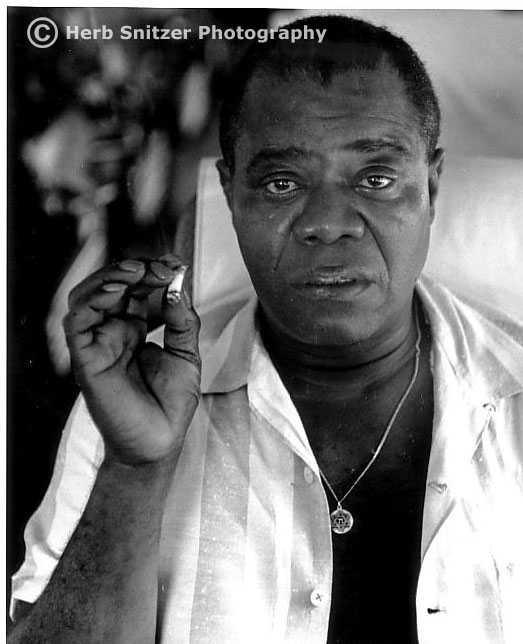
Pops on tour, 1960, photographed by Herb Snitzer.
This is one of the most unusual photographs of Pops I’ve ever seen. Taken in 1960, Pop’s looks beat in this pic: With cigarette in hand, wearing his Star of David around his neck, the blown upper lip, Snitzer has captured him with a distant, far-away looking expression on his face. It’s neither a sad nor a painful looking expression—he’s just somewhere else at that moment. The Star of David he’s wearing around his neck is a gesture of respect for the Karnofskys, the New Orleans Jewish family who showed Louis so much kindness and who helped raise him.
It’s common knowledge among Louis Armstrong scholars that the Karnofskys encouraged Louis’ interest in music: “They really wanted me to be something in life…It was the Jewish family who instilled in me singing from the heart”(qtd. in Garfinkle 156). It is also well-known story that the Karnofskys lent him five dollars to buy his first cornet, which he purchased from Jake Fink who ran Fink’s Loan Office at Rampart and Perdido in New Orleans, specializing in musical instruments.
In this next photograph, taken during a New England tour in Tanglewood, MA, June 1960, Louis just looks tired. Once onstage, however, his performances, even toward the end of his life, never disappointed his beloved audience. He was transformative as a musician and performer for both his audience and himself.
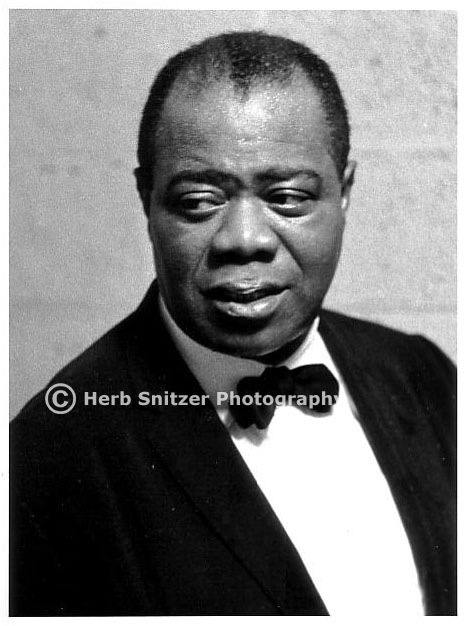
Somber Louis by Herb Snitzer
Pops was always happiest (just look at that smile on his face) at his home in Queens, New York, just hangin’ out, listening to old records and his reel-to-reel tapes, creating his beautiful jazz collages, a visual output of his creative genius, and with Lucille always right by his side.
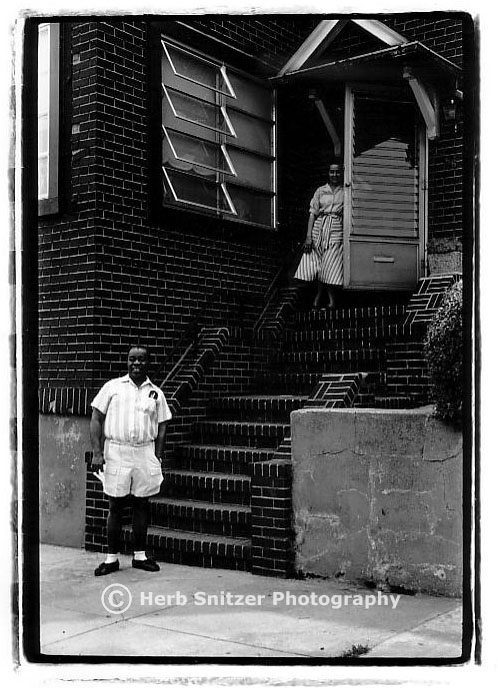
Louis with Lucille outside his beloved home in Queens, NY, in 1960.
Finally, here is an example of Pops’ elaborate collage work he used to decorate as many as 500 reel-to-reel boxes. Double that number because he covered both front and back with his collages:
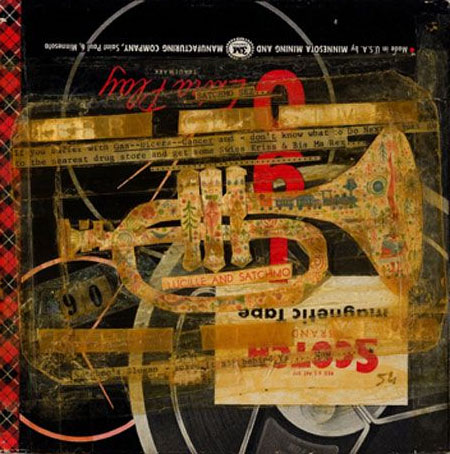
This is a flipped image of the original from the Louis Armstrong Archives, which resides at Queens College in Flushing New York. You can see typed reference to Swiss Kriss.
It’s hard to make out the lettering on this one.
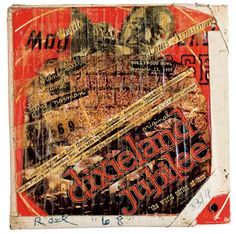
From Louis Armstrong Archives, Queens College, Flushing, New York
Marian McPartland of Piano Jazz fame with “Swiss Kriss” descriptions.
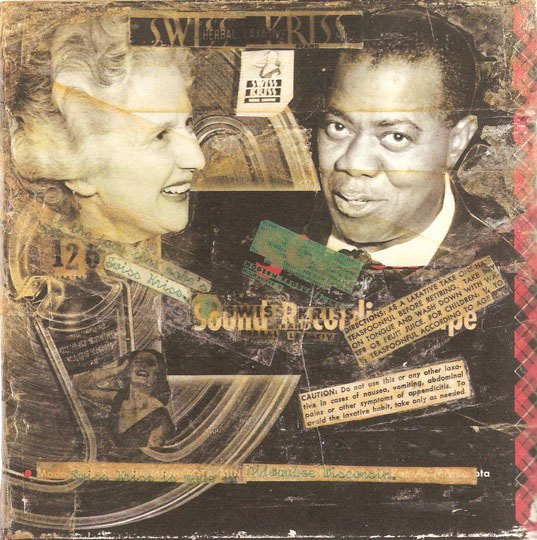
Jazz pianist Marian McPartland, Louis, and “Swiss Kriss.” From the Louis Armstrong Archive, Queens College, Flushing, New York
For more on Louis Armstrong’s collages and collection of reel-to-reel taps, see this edition of the spring 2008 edition of The Paris Review.
The Louis Armstrong aesthetic is complex, yet it belies an unmistakable child-likeness that allows us see Pops as one of us, one of the family. I certainly have always seen him that way, and I thank him for it.
 Call and Response