 During the month of April, KMUN celebrated thirty years of broadcasting a variety of music and information to the north coast community. I started thinking about just how significant an event like that is. As one of the many jazz programmers at KMUN, this is significant for a couple of reasons: for one, it means thirty years of KMUN jazz programmers broadcasting jazz; for another, it means that thirty years of jazz broadcasting establishes KMUN as credible agent for the continued preservation of a valuable musical art form and, consequently, helping to keep it from becoming a distant memory to new generations of listeners.
Historically, this has always been a challenge for jazz; that is, staying alive and well. Because jazz has had a particularly fluid history, its popularity and survival has more often than not been dictated by fickle commerciality rather than by the listening public’s sincere interest in a musical art form. Jazz styles have constantly changed and evolved, influenced both by history and popularity. Following World War I, the popularity of New Orleans jazz gradually disappeared, giving way to Swing, arguably the most popular of all jazz forms. But after the cataclysm of World War II, the popularity of Swing began to dramatically wane. Goodman, Ellington, and Basie were no longer selling records. Swing band leaders were out of jobs. Pre-war Swing had evolved into the post-war jazz of Beboppers like Charlie Parker and Dizzy Gillespie. Even though their complex and sophisticated music lacked the potential commercial success of Swing, their music was nonetheless still historically and artistically important. It just wasn’t popular enough to sell records. So how and where could you still hear Swing and Bebop? This situation reminded me of something else.
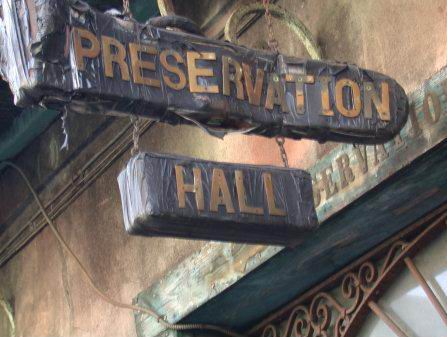
Preservation Hall New Orleaans
Anyone who is familiar with New Orleans and New Orleans jazz is also familiar with Preservation Hall.Founded fifty years ago in January of last year, the Hall’s sole purpose was to keep New Orleans jazz alive. Founders Allan and Sandra Jaffe created Preservation Hall in 1961 as a sanctuary, to protect and preserve New Orleans jazz. At the time Preservation Hall was founded, New Orleans Jazz, and jazz in general, had lost much of its popularity to the ever-evolving forms of modern jazz and jazz’s upstart child Rock ‘n Roll. Jazz as an art form was again beginning to disappear. How was jazz to survive? How then would the musical traditions of this uniquely American art form be passed on to a younger generation to protect and perpetuate jazz’s rich musical history and culture? The Jaffe’s Preservation Hall continues to preserve New Orleans jazz to this day. In a like manner, after thirty years of broadcasting, KMUN has become in its own way a kind of public radio Preservation Hall of jazz.
Throughout the country, listener supported, public radio stations like KMUN (yet so unalike in many ways) play an important—and more often than not unrecognized—role in the continued popularization, cultivation, and preservation of music, and especially jazz. All kinds of jazz. Just check out the jazz programmers’ playlists found on the KMUN website. What you’ll find represents a wide spectrum of jazz. So it is entirely appropriate to this jazz programmer that both the Smithsonian-sponsored Jazz Appreciation Month (JAM: first launched in April of 2001) and KMUN’s 30th anniversary occurred during the month of April. It’s appropriate because KMUN, like many public radio stations throughout the U.S., is virtually one of the only places left where the listening public can easily tune in to their radio (analog or digital) and listen to a wide variety jazz styles broadcasted from their own local, often rural communities, programmed by volunteer program hosts who religiously minister to the content of their shows. What’s more, the musical knowledge of KMUN’s jazz programmers deepens our own understanding and appreciation of America’s classical music. By providing a valuable context to the jazz they broadcast, information about the lives and careers of artists, past and present—in a way commercial radio simply can’t or won’t—KMUN’s jazz programmers ensure the continued preservation of this music genre, and with it the rich cultural history of our nation, well into the next thirty years.
As a programmer, when I’m playing jazz for our listeners, I’m not really thinking about how I’m preserving jazz and keeping it from dying off; I’m playing it because we have listeners who have tuned in to the show because they love jazz too. And the jazz they love to listen to is there because KMUN is there as the agent of what they love to listen to, regardless of the kind of music we play. If the jazz on KMUN brings some measure of joy to the listeners, then the preservation piece is just an added benefit.
 Call and Response