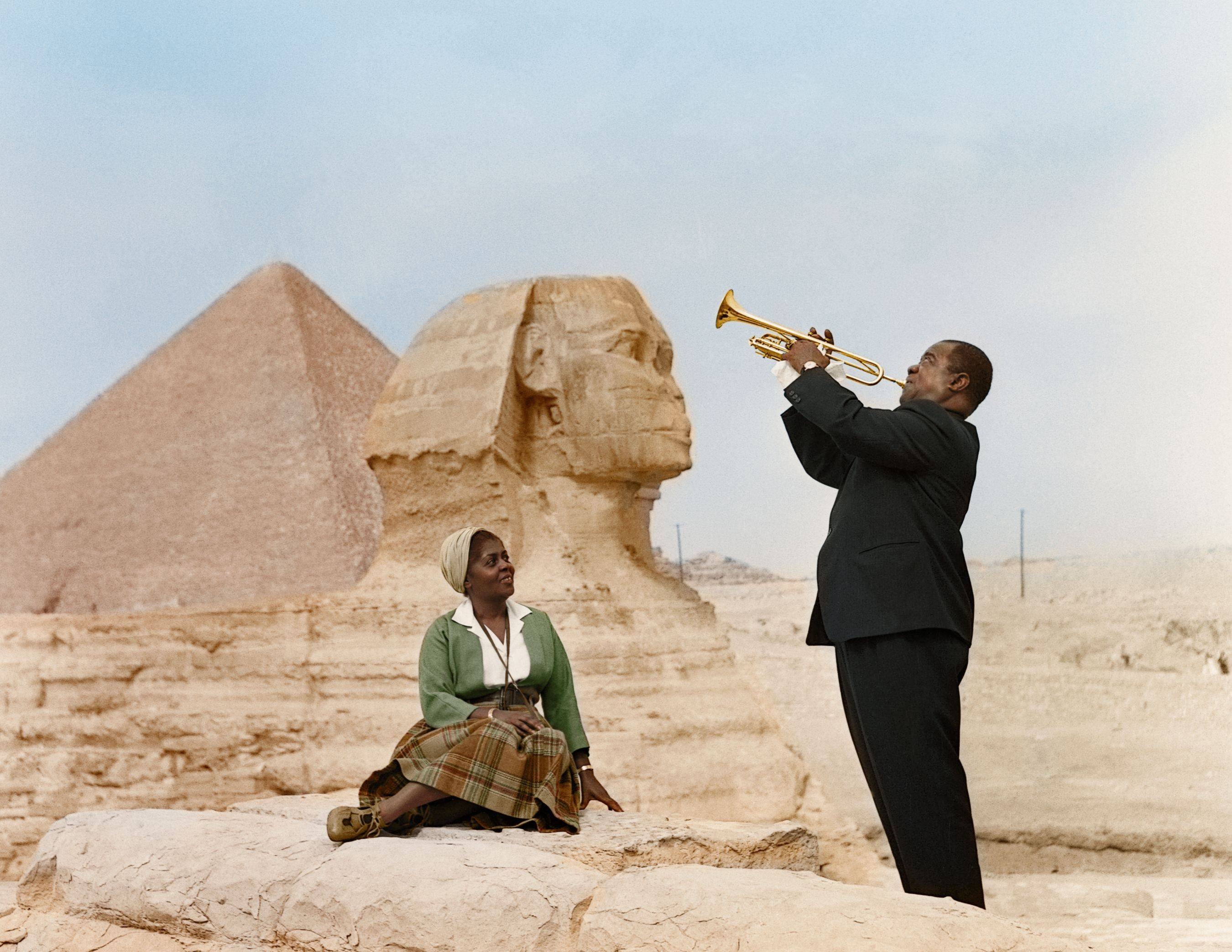
 When preparing a playlist for my jazz show to be aired on the day after Martin Luther King, Jr.’s birthday, I thought it apropos to find any references to jazz music he may have made during his career. I assumed a connection existed between the Civil Rights Movement and jazz in much the same way as I would have assumed a connection between Louis Armstrong and the Movement. Not so. It was surprising to me to discover, years ago, that Armstrong was, up to a point, especially reticent about vocalizing his views about civil rights in public. Because of this Armstrong suffered criticism, but Armstrong was a musician, not an activist, or at least not in the broad sense. Armstrong was a complex personality, and did not fit easily into political stereotypes. This lack of outspokenness did not mean an indifference to the suffering of his people (note the deeply personal interpretation of the lyrics to “What Did I Do to be so Black and Blue” in 1929; his refusal to tour the Soviet Union as “Cultural Ambassador” in reaction to the failure of the U.S. government to intervene in the segregation of southern schools; and in his refusal to ever play for his hometown of New Orleans because of the forced segregation of his audiences). In much the same way, because MLK never really spoke about jazz and its influences on the movement, did not necessarily suggest he saw no connection. I think he did.
On the one hand I may find it a bit unsettling to note that Martin Luther King, Jr. said little (on the record) about jazz’s influence on the Civil Rights Movement of the 6o’s. On the other, I recognize that this lack may be more about the Civil Rights Movement’s influence on jazz.
Much of what we call jazz or blues for that matter is a direct outgrowth of Black culture or the Black experience. The music of that culture, naturally, is a direct reflection of the black experience in this country, politically, spiritually, and racially. Race, then, is at the core of this Black experience. Wynton Marsalis, in one of the many interviews he gave for Ken Burns in his documentary Jazz, describes race as being part of an “American mythology.” Race is the thing that you must do in order for the “kingdom to be well and it’s always something you don’t want to do.” Race is a trial, according to Marsalis, that is tailor-made for failure because it requires you to confront yourself with the realities of your condition. Success or failure of your trial, then, depends on whether or not you can confront this trial with the kind of honesty and heroism that will give you “the energy to sustain an attack on it.” And since jazz music is at the center of the American mythology, jazz becomes the metaphor for the experience of racism in America.
All That Jazz Playlist:
Duke Ellingtion “Come Sunday” composed by Ellington from Black, Brown and Beige (1958) on Columbia – Vocals from Mahalia Jackson.
Nina Simone “I Wish I Knew How It Would Feel to Be Free” composed by Taylor from Songs of Freedom (1968) on Columbia — this song was written in 1967 by noted jazz pianist and educator Dr. Billy Taylor (along with Dick Dallas), and was recorded by Simone that same year. It quickly became one of the musical mainstays of the movement.
Billy Taylor “I wish I knew how it would feel to be free” composed by Taylor from Billy Taylor At the London House (1967) on Hallmark
Max Roach “Driva’man” composed by Roach from We insist (1960) on Candid
Louis Armstrong “What Did I Do To Be So Black And Blue?” composed by composed by Fats Waller with lyrics by Harry Brooks and Andy Razaf. from Louis Armstrong and His All Stars (1952) on JSP Records
Bay Area Artists “Berlin Jazz Festival Speech” from Choral reading of MLK Jr. intro. brochure comments to the 1964 Berlin Jazz Festival
Charles Mingus “Original Faubus Fables” composed by Mingus from Mingus presents Mingus (1960) on Candid — A caricature of Orval Faubus 36th Governor of Arkansas, serving from 1955 to 1967. He is best known for his 1957 stand against the desegregation of the Little Rock School District during the Little Rock Crisis
Gil Scott-Heron “Winter In America” composed by Gil Scott-Heron from Winter In America – (Live) (1974) — Gil Scott-Heron, the poet and recording artist whose syncopated spoken style and mordant critiques of politics, racism and mass media in pieces like “The Revolution Will Not Be Televised” made him a notable voice of black protest culture in the 1970s a
Billie Holiday ““Strange Fruit” ” composed by Lewis Allan from At Jazz at the Philharmonic (1956) on Verve
Oscar Peterson ““Here’s That Rainey Day”” from Solo (1972) on Verve
John Coltrane “Alabama” composed by Coltrane from Live at Birdland (1963) on Impulse — John Coltrane’s painful eulogy for the four little girls killed in a Klan bombing of the 16th Street Baptist Church in Birmingham, Alabama on September 15, 1963. McCoy Tyner, piano; Jimmy Garrison, bass; Elvin Jones, drums
James Brown “Say It Loud – I’m Black and I’m Proud, Pt. 2” from The Singles, Vol. 5: 1967-1969 on Hip-O Select — Socially conscious funk, James Brown style. So, how is this jazz? Need you ask?
Hank Crawford and Jimmy McGriff “Lift Every Voice” from Steppin’ Up (1987) — In 1919, this song (by James and John Johnson) was adopted by the NAACP as “The Negro National Anthem.” Its resonance in the civil-rights movement is indisputable and, like all of the songs in this brief overview, it remains an incredibly moving piece of
Marian Anderson “I’ve been ‘buked” from He’s Got the Whole World in His Hands (1964) on RCA
Oscar Brown Jr. “Forty Acres and a Mule” composed by brown from “Forty Acres and a Mule” (1965) on Verve
Christian McBride with Inside Straight “Gang Gang” from People Music (2013) on Mack Avenue — Christian McBride, bass with his quintet Inside Straight. part jazz suite dedicated to four iconic figures in the Civil Rights movement: Rosa Parks, Malcolm X, Mohammad Ali and Dr. Martin Luther King
Sam Cooke “This Little Light of Mine.” from Sam Cooke At The Copa (1964) — “This Little Light of Mine.” 1964 in New York’s Copacabana. Sam Cooke popularized a song that people were singing at sit-ins and marches and by bringing it into America’s white nightclubs, putting the music of The Movement in front of an audience that pro
Rahsaan Roland Kirk “Volunteered Slavery” composed by Kirk from Volunteered Slavery (1969) on Collectables — An album that merges the psychedelic spiritualism of the 60’s with the traditional spiritualism of gospel, blues, and the new black nationalism of the era—Volunteered Slavery became a hymn of the movement
Grant Green “The Selma March” composed by Green from His Majesty King Funk (1995) on Verve — Grant Green/Donald Byrd. Jazz guitarist Grant Green seems to reflect the jubilation surrounding the third Selma march’s completion of King’s four-day march. A 1965 recording, it also features Harold Vick (saxophone), Larry Young (organ), Ben Dix
 Call and Response