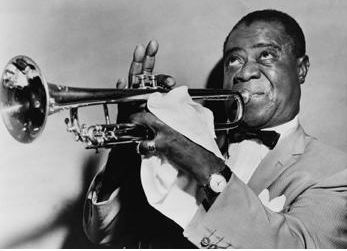
 At the time of this writing, Louis Armstrong’s 111th birthday, on August 4th is approaching. However, throughout his lifetime, Armstrong claimed the 4th of July as his birth date, though no evidence existed to support his claim. But that didn’t matter because it seemed appropriate that the man who embodies jazz as an American art form have his birthday on the 4th. It wasn’t until after Armstrong’s death in 1971, that Tad Jones, a New Orleans music historian and jazz scholar, came across Armstrong’s actual birth certificate while conducting research in the Sacred Heart of Jesus Church in New Orleans. A major “A-ha” moment. The birth certificate he found was dated August 4th, 1901. Jazz critic Gary Giddins first wrote about Jones’ discovery in his 1988 book Satchmo: The Genius of Louis Armstrong—a wonderful read, by the way, if you are interested in a factually accurate biography of Armstrong. According to Giddins, it was common for poor blacks who did not know their birth dates to choose a famous or significant date such as the 4th of July as their birthday. So anyway, Armstrong’s birthday got me thinking about the first time I ever heard his music.
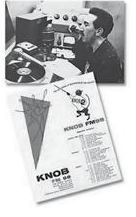 The first time I ever heard Louis Armstrong’s music or any jazz for that matter was in L.A. back in the early sixties on an old beat-up AM/FM tube radio my father kept in our living room. It was the only radio in the house. Since I was in high school at the time, my musical interests were limited to listening to AM top-forty rock and roll on KRLA (especially late-night Wolfman Jack), KFWB, and the low-watt station KHJ. But around dinner time and for the rest of the night (and all day on weekends), that radio dial would be tuned only to KNOB FM 98, the Jazz Knob with Sleepy Stein, L.A.’s first great jazz radio D.J. in L.A., broadcasting from the first jazz radio station in the world. I remember Stein because he had one of those resonant FM radio voices most programmers would die for, a voice perfectly suited for jazz: low, smoky, and whisky-throated: “This is the Jazz Knob; K-N-O-B, Long Beach.” For me, that voice, and certainly Armstrong’s “voice” as well, became synonymous with jazz. The Jazz Knob broadcasted from a station on Signal Hill in Long Beach, CA, and Stein played jazz on LP’s from his personal collection, collected over a lifetime. Stein loved and understood the historical importance of Dixieland jazz, so he would play Armstrong often. Armstrong’s signature tune “When It’s Sleepy Time Down South” caught my attention in particular. Even though at the time I didn’t really understand what I was listening to, I still felt a connection to Armstrong’s music—it just sounded good to me. I was hooked. Armstrong was good at that: hooking his audience, no matter their age. It doesn’t matter to the music that racial stereotypes are in the song; it was the nostalgia-driven lyrics and the mellow swing-time of the sound that connected with people (they just wanted to dance anyway):
Steamboats on the river a coming or a going
Splashing the night away
Hear those banjos ringing, the people are singing
They dance til the break of day (Clarence Muse, 1931)
Naturally, Stein didn’t just play only Dixieland. The full range of Stein’s Jazz curriculum (and my father’s jazz record collection) helped school me early on in the ways of Jazz. Now, I see it as my duty to help jazzify our listeners in the art of listening to jazz. I’ve been a jazz programmer at KMUN since 1998, and I have come to love many different kinds of jazz (hence, my show is All That Jazz), so I try to choose music that might be something new for listeners, something they might never have heard before, something that takes them by surprise. Certainly, all of the programming on Coast Community Radio strives to help our listeners discover what music they like by exposing them to a variety of music choices.
In closing, Armstrong once described Jazz as a good New Orleans gumbo: a subtle blending of the distinct cultural and ethnic racial groups who live there, each with their own traditions, values, and understandings of their culture, each adding their own unique blend of spices, some of which are hot, some cool. I like ‘em both.
 Call and Response