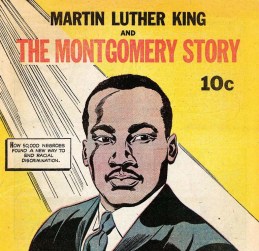
“Comic” book: Martin Luther King and the Montgomery Story
I was fifteen years old when Martin Luther King, Jr. and the “Big Six” organizers took to the streets of Washington D.C. in August of 1963. I had just finished my freshman year of high school, and while I was not at all socially conscious enough to understand why the march was happening, I did sense the monumental importance of what was happening because it was playing out on t.v. in our living room. Thanks to parents who were both socially and politically conscious, and who took pains to explain it to a kid (like it or not) who would rather be outside, hanging out with friends, the events of that day stuck with me and later became the baseline upon which my future understandings of social injustice would develop and grow.
Part of that understanding tells me that while changes have occurred in the pursuit of civil rights, much has remained the same. Despite the gains that came, in part, from that Civil Rights March on Washington 50 years ago and even after the Civil Rights Act was signed into law in July of following year, the struggle to achieve civil rights continues, and rightfully so. The fact remains that many of the demands of the marchers 50 years ago continue to be the same demands of civil rights activists today because the “dream” has yet to be fully achieved. Perhaps that’s the point: achieving the dream is more about the process, the struggle to achieve it than it is about the dream itself.
What Dr. King refers to as “the struggle,” achieving civil rights, suggests a process of activism that is ongoing, non-stop, forever dynamic and changing. It continues to be a struggle only because there is someone, some thing, or some force out there trying to either restrict these rights, diminish or modify them, rename them, or simply take them away entirely. “The struggle,” by its very nature ensures the survival of civil rights movement because the truth is, left unclaimed, civil rights are more easily denied. King may say that we must not take these civil rights for granted. We must not assume that those rights will always be there when the time comes to claim them. We must not assume that we have a trusted custodian of our civil rights out there who will protect them and prevent them from disappearing or from being stolen. If it’s not worth “struggling” for, it may not be worth keeping. There is no protector, of course, because we are the protectors.
The act of denying civil rights seems to be an unfortunate byproduct of the institutional machinery of democracy ensuring its survival: Republican party’s desire to politicize voting rights by restricting access to the polls for Americans, to push back against raising minimum wage for workers who are struggling to make ends meet, and to radically restrict women’s access to health care. Protecting the civil liberties of one segment of society often includes denying the liberties of another. Corporations are a good example of this. Often the pursuit of profits (a pursuit seen by big business as a constitutional right subtly woven into the fabric of capitalism), come at the expense of restricting, limiting, or outright denying individual civil rights. Looming large as an example of a corporation that seeks obscene profits with a scorched-earth expansion strategy is the ubiquitous Wal-Mart, bane of small business ownership and unionized jobs.
Many would claim that these inequalities are simply the price you pay for living in a democracy. Too many voices, too many views, not enough tolerance and understanding make it easier for the bellicose voices in the crowd to drone out those voices we rarely hear.
 Call and Response