Jazz has thrived as an urban musical form primarily because it is largely an urban music. The shift in African-American population during the great migration between 1915 and 1930 from southern (and racist) rural communities to the industrial cities of the north had a major impact on the development of jazz as a part of popular black American culture.
Louis Armstrong left New Orleans for Chicago in 1922 to join King Oliver and his band at the Lincoln
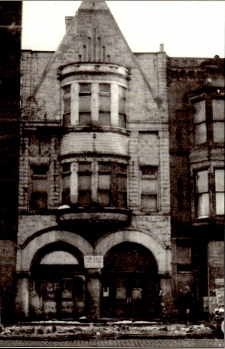
Lincoln Gardens Chicago
Gardens because that’s where the music was happening. Big cities like Chicago and New York City had venues where people could go to listen to jazz and dance, which meant jobs for the musicians like Armstrong. It was in the cities where musicians were able to make money recording their own tunes, making records, and sell them. Recording companies preferred bands like Oliver’s to write and record their own tunes because they didn’t have to pay royalties for recording famous tunes.
So it’s not surprising that life in the big city for blacks, sometimes good and sometimes tragic, inspired the music itself in a variety of different and interesting ways. Often the songs themselves reflected a kind of cultural image of the city where they were produced. Jazz from L.A. was distinctly different from the music produced in New York City or Chicago. Jazz sounds were classified—often inaccurately—according to its geographic region: west coast cool jazz, the Chicago sound, and so on. But big city jazz sounds also reflect more than just geographical regionalism; jazz can also reflect urban disenchantment, disappointment, and decay. When Frank Sinatra sings of Chicago as “that toddlin’ town,” and that you’ll “lose the blues in Chicago,” he’s not referring to the South Side of Chicago, the part of town where 50,000 blacks from the urban and rural south settled during the Great Migration north. Poverty, joblessness, racism, drug addiction, and alcoholism was the reality of Chicago life for the black population. So it’s also not surprising that social injustice and racial intolerance influenced both jazz and the blues. One of the tunes I played last night was the late Gil Scott-Heron’s “The Bottle” about the terrible hold alcoholism has over his people:
See that black boy over there runnin’ scared
His old man in a bottle
He done quit his 9 to 5
He drink full time and now he’s livin’ in a bottle
See that black boy over there runnin’ scared
His old man got a problem
And it’s a bad one
He done pawned off damn near everything,
His old woman’s weddin’ ring for a bottle
And don’t you think it’s a crime when
Time after time after time
People in the bottle
There’s people livin’ in the bottle
The lure of the city can also be the source of irresistible temptation, as Oscar Brown Jr.’s song “The Call of the City” describes:
Some folks long for peaceful valleys.
Me, I’m strong for streets and alleys,
And a subway with a crowd around
That swingin’ symphony of sweet city sound…
You can keep the peace and quiet
Lead me to that rush hour riot.
While themes of city life in jazz are incredibly complex—they can be both celebratory and cautionary—what they can tell us about the connections between the music and the human spirit is invaluable and uplifting.
Tuesday Night’s Playlist:
Branford Marsalis “Scenes In the City” composed by Mingus from Scenes in the City (1983) on Columbia. Branford Marsalis’ cover of the Charles Mingus tune “Scenes in the City.”
Mingus wrote the narration, which is read by the actor Wendell Pierce (of HBO’s The Wire fame). Marsalis plays tenor and soprano. Mingus’ theme is a combination of his avowed love of jazz interwoven with the cacophony of city life—one cannot exist without the other.
Oscar Brown Jr. “Call of the City” composed by Brown from Mr. Oscar Brown, Jr. Goes To Washington (1965) on Verve.
Unusual song choice (see above) in view of the human isolation theme of his more famous song “Brother, Where Are You?”
Grover Washington Jr. “Inner City Blues (Make Me Wanna Holler)” composed by Marvin Gaye / James Nyx, Jr. from Inner City Blues (1971) on Verve — Grover Washington on tenor; Eric Gale, guitar.
Washington’s tone seems to waver between the soft, smooth tones of a style he will soon embrace commercially and serious “inner city” funk qualities characteristic of soul jazz.
John Scofield “Out of the City” composed by J. Scofield from Hand Jive (1993) on Blue Note.
Gil Scott-Heron “The Bottle” composed by Gil Scott-Heron from Winter in America (1974) on Charly Records / Charly UK.
The power of Scott-Heron’s voice—both musically and politically—is perfectly reflected in this recording. I don’t think he is admonishing the behaviors as much as he is warning us of the social consequences of alcoholism.
Bobby Womack “Across 110th Street” composed by J.J. Johnson / Bobby Womack from Across 110th Street (Film Soundtrack) (1972) on United Artists.
Bobby Womack’s soulful voice makes this “Blaxploitation” themed song (written by both J.J. Johnson and Womack) a brilliant piece of urban music.
Ella Fitzgerald “Drop Me Off In Harlem” composed by Duke Ellington / Nick A. Kenny from The Complete Ella Fitzgerald Song Books (1956) on Verve.
Where else would she want to go?
Charlie Shavers “Echoes of Harlem” from Sweet Georgia Brown (The Best Of) on Werner Last’s Favourites Jazz
Chick Webb “Go Harlem” from Chick Webb – Spinnin’ The Webb (1938) on decca
Terrance Blanchard “Harlem Blues” composed by W.C. Handy from Mo’ Better Blues (Score) (1990) on Columbia — Cynda Williams on vocals w/Branford Marsalis quartet.
While Spike Lee’s film is a piece of self-indulgent junk —I hope he doesn’t read this—the updated arrangement of Handy’s song shows how well a modern reading of dated jazz tunes can be successful.
Mary Lou Williams “Little Joe from Chicago” composed by Henry Wells / Mary Lou Williams from Mary Lou Williams Story (1941) on archive — with And Kirk and the Clouds of Joy.
She is pure genius!
Paul Butterfield Blues Band “Born in Chicago” composed by Nick Gravenites from The Paul Butterfield Blues Band (1965) on Electra.
I was surprised I received no calls when I played this classic blues tune.
Jelly Roll Morton “Beale Street Blues” composed by W. C. Handy from Dr. Jazz (1929)
Quincy Jones “Summer in the City” from Summer in the City.
I don’t know why, but I love these types of Quincy Jones arrangements—crisp, clean, jaunty, hip-me-to-it, with just a hint of swing. The vocals by unknown even work.
James Moody “The World is a Ghetto” from The World Is Ghetto on Airline Records.
Doc Cheatham & Sammy Price “Memphis blues” from Duets & Solos on Sackville
Bill Frisell “Blues for los Angeles” composed by Frisell from Gone, Just Like a Train
Booker T and the MG’s “L.A. Jazz Song” from Melting Pot
Josh Rifkin “Country Club-Rag Time Two Step” from Scott Joplin Piano Rags
Bessie Smith “St. Louis blues” from Bessie Smith Collection (1923) on Columbia
Sidney Bechet “Perdido Street Blues” from Sidney Bechet 25 Grandes Éxitos on Producciones AR
Duke Ellington “East St. Louis Toodle-o” composed by D. Ellington from Okey Collection
Illinois Jacqet “Harlem Nocturne” from New York for Lovers
Count Basie “Kansas City Shout” from Chairman of the Board
The Meters “Talkin’ ’bout New Orleans” from Fire On the Bayou (2004) on Rhino/Warner Bros.
Jack Teagarden “Chinatown my Chinatown” from Royal Garden Blues
Jack McDuff “I Cover the Waterfront” from Another Real Good’Un on Savoy Jazz
 Call and Response