Despite their flaws, and like any other city in the world, Mexico’s cities are incredibly interesting. Probably more so than any of the cities I’ve been in north of the border.
What makes the cities of Mexico so interesting is that they share a certain magical quality about them that is inherent in all of the colonial cities. These are qualities that are instantly recognizable and are uniquely characteristic of Mexico.
In particular is the plaza principal or central square, ubiquitous to most if not all of Mexico’s cities, towns, and pueblas. From our experience, we have not been to any Mexican town that did not have a central plaza of some kind. And once you’ve experienced a few of them, it’s easy to see why they are everywhere.
By the very perfection of its design, residents and tourists are naturally (magically) drawn to these plaza principales. Consequently, they are the very nexus of everything in the community that is religious, political, economic, and cultural.
The design perfection of Mexico’s plaza principal is a product of 16th century colonial city planning, what in Spanish is called la traza. La traza dictated that the design of all new Spanish American cities built during the colonial era be based upon the layout of an organized grid of streets and buildings emanating from a specific central point.
The origins of la traza, in fact, can be traced back to the ancient Greek and Roman civilizations—think “All roads lead to Rome.” Their use of a grid pattern in the designing of major cities gradually spread throughout Europe and the ancient world.
Ironically, the Spanish colonizers of the New World were a little slow to incorporate the use of the grid pattern in the building of their new cities. In fact, it took more than a generation before the Spanish began using central squares. They didn’t actually start to appear in the cities they founded until the 1530s (Stanislawski 105).
Once the Spanish adopted la traza, and los plaza principals began to appear, they quickly became the religious, political, economic, and cultural heart of every city.
What makes los plaza principales, to my way of thinking, so fascinating, so magical is that they all share certain features common to all plaza principales:
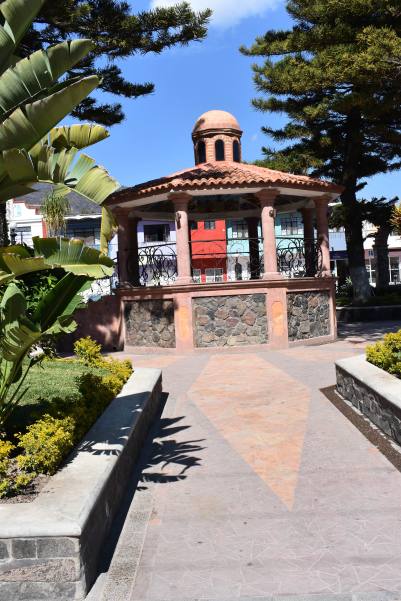
Kiosco in San Antonio Tlayacapan
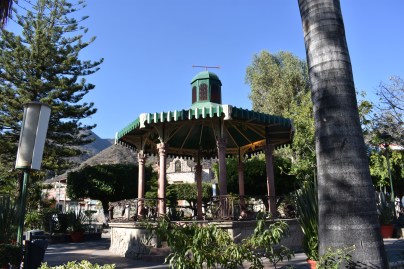
Kiosco in neighboring Ajijic. Much more ornate than San Antonio, but no more central to the importance to the community.

Example of the contemporary ironwork that surrounds the sides of the kiosco in Ajijic. Iron sculpture of an egret surrounded by branches of a tree. The work is an example of how the modern can enhance the traditional, but in a way that does not detract from the colonial feel of the kiosco and the square.

Jackie and companion sitting on one of the many benches that line the perimeter of the main square. Note vendors and outdoor cafes in the background. The main square has an economic draw as well as a cultural one.
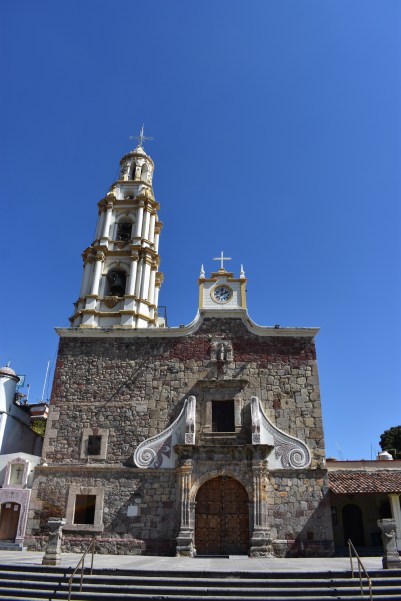
Construction of this beautiful, colonial parish church began in 1749. Its imposing facade dominates the central plaza in Ajijic. Everywhere you walk, the steeple keeps watch.
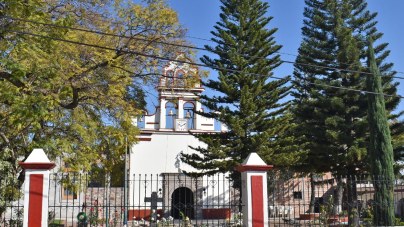
San Antonio Tlayacapan parrish church. Not as imposing as Ajijic’s, but you can see the pride the parishioners have in their church by seeing how immaculately kept the church grounds are.
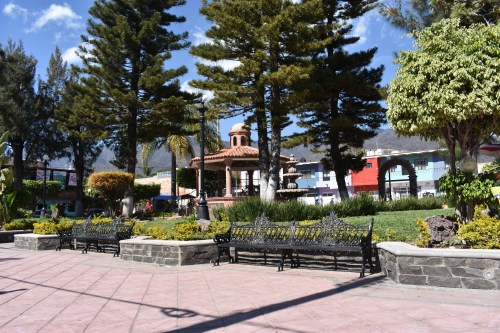
Wrought iron benches and beautifully manicured and maintained gardens surrounding the kiosco in San Antonio Tlayacapan.
No matter where a person walks either in Ajijic, San Antonio Tlayacapan, or Chapala, eventually they will find their way to cultural heart of the community: la plaza principal.
Stanislawski, Dan. “The Origin and Spread of the Grid-Pattern Town.” Geographical Review, Vol. 36, No. 1, 1946, pp. 105- 120.
 Call and Response