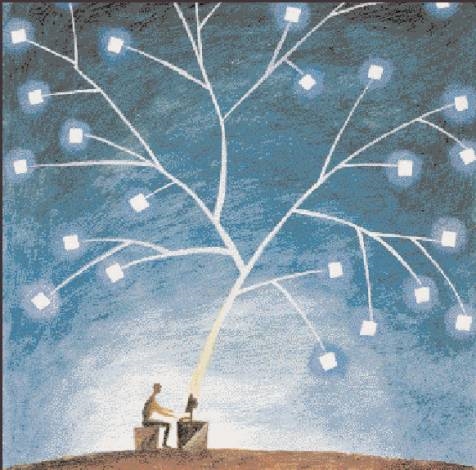
Online education has been around for many years. Thanks to a former colleague’s generosity, back in 2003 I got the chance to fool around with Moodle, a “learning platform” specifically designed for creating personalized learning environments for students.
Before Moodle, I tried out creating my own class web pages with assignment lists, deadlines, handouts, and so on. I could post them on the district server and students who at computers at home connected to the internet could access them on line. At one point, I paid to have my class pages hosted by an educational website hosting service and transferred files using a ftp client.
But when Moodle came around it was radically different for students. Moodle was interactive. Students could post their assignments on the platform, I could read them and give feedback, and then they could access my feedback and their grades. Moodle became an alternative classroom for many of my students who had challenges attending class on a daily basis for whatever reason (and there were many reasons). One year, 2006, as part of state grant, I got the opportunity to put together a hybrid English course. Half of the course was completed online, either at their homes or in a computer lab set up specifically for the course, and half the course was spent in my regular classroom, depending on what we were learning at the time. The senior research paper project was perfectly suited for hybrid learning environments. Instruction and demonstration took place in the regular classroom; the practice and research took place online. I continued to use Moodle and online learning for the remainder of my teaching career. In fact, thanks to the district IT dept., all of the original courses are still there for students to use.
Like the open-source software movement, the free online learning movement has exploded. What used to be a few lecture courses digitally recorded and posted on University web sites for free access has become a huge open-university system allowing anyone interested in pursuing academic-level learning to enroll in an amazing variety of university courses.
Coursera, for example, (whose vision for education, by the way, is “We envision a future where everyone has access to a world-class education. We aim to empower people with education that will improve their lives, the lives of their families, and the communities they live in.” Wow.) is an educational platform that partners with top universities worldwide to offer free courses online. One particular course that caught my interest is Modern and Contemporary American Poetry offered by the University of Pennsylvania. So I enrolled because I love poetry, but I don’t have the discipline to sit down and read any with focus and purpose. Need the focus for the purpose.
So, University of Pennsylvania online poetry course, I’m gonna try you out. First reading: Emily Dickinson’s “I dwell in Possibility.”
 Must have read this poem a dozen times before I could get my own handle on it. What comes to mind with this dwelling and house stuff is the idea of poetry as the architecture of the soul. Don’t know where I got that. Just popped in my head when I started to see the poem from my own perspective.
Saying “I dwell in Possibility” sounds to me like an old fashioned way of saying “I live in possibility,” in the same sense of what some of us might say, “I live in hope.” Of what? Well, in the case of my childless, unmarried daughter, her parents “live in hope” that some day the kid will get married and we’ll have some grandchildren. Now, I don’t want to give up hope, so I guess we also live in the possibility that it will happen.
But what of the idea for Dickenson that “Possibility” is just a metaphor for poetry? I—or rather Dickenson— live in poetry or through poetry, so that the traditional purposes of a house share the traditional purposes of a poem? Just as we can live in a house—it protects us, keeps us warm and dry, staves off our enemies, it’s where we sleep and dream, take our sustenance, where we take our family, our guests—so also we can live in our (or through?) poetry. Perhaps, even under poetry’s protection. Our poems do all of the things our house does. Is poetry not “fairer” than “Prose”? Plenty of long-in-the-tooth discussions about that here. By a long shot it is. Does poetry not have more “Windows” and are the poets at these windows always doing what poets are supposed to do? The poet’s occupation (“This”) is to be at their windows at all times and to see (window=wind eye) what others lack the time or insight to observe. Plus most of them (poets) do a better job reporting what they see than I do. “Superior…Doors”? It’s just my take on this, but I just don’t buy the good professor’s view (which by the way he seems to go a long way to sell this idea to those confused-looking, but well-intentioned students) that this “house” somehow reflects a higher social class, so, of course, Dickenson is gonna have better doors than anyone else. I see those “Doors” differently. When I was younger, I read this A. Huxley book The Doors of Perception (sometimes while listening to the Doors). Not many folks can open those doors by themselves. They need a little help from friends, like Huxley. But what if Dickenson means “Doors” that lead to the inside of a poem (and outside for that matter; once in, you gotta be able to get out of the thing). Again, I’m talking about “Possibility” as poetic architecture.
All right, might be far-fetched, but I just don’t buy the idea that the only “Visitor” to Emily’s “house” are the social elite, the “fairest.” If metaphorically the house is poetry, “Possibility” is poetry, not everybody is going to stop by for a “visit,” because not everybody understands or comprehends the “house/poem” and that’s normal. I agree with the group that you have to work at it, like anything. But maybe “fairest” has a different meaning here: only visitors who are open-minded, non-judgmental, willing to take the risk of seeing the world as the poet sees it.
Finally, the good professor just glossed over what I believe to be the most important and interesting part of this poem: “The spreading wide my narrow Hands/To gather Paradise.” Man, I love that line. This is the poet’s reach. Note contrast between “wide” and “narrow” as if that which is “narrow”—narrow-mindedness—can be made “wide” which is, of course, what you need to do if what you want to do is “gather” (to understand, comprehend, or even collect) something as “wide” and limitless as “Paradise” which is somewhat of a paradox: “gather”ing requires a sense of limitation, of knowing when what you are gathering has been gathered; you cannot, in other words, “gather” that which is un-gatherable, know that which is unknowable. The beauty of this is that we have discovered that this is what Dickenson will do for us whenever we visit her “house.”
Can’t tell if, after reading the poem, the sigh I hear is one of relief for getting out of the poem with all my faculties or one of awe for staying behind.
 Call and Response