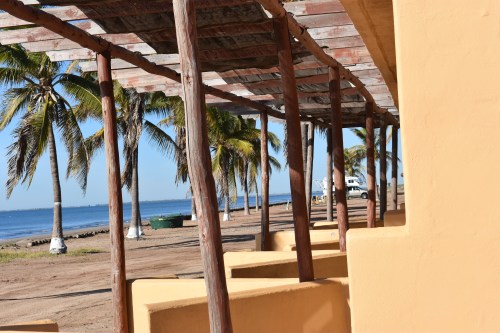
Beach front at La Playa Huatabampito El Mirador. Truck Camper visible at the end of the beach.
Huatabampito’s allure is strong; it’s hard to break away from a place so beautiful. Even so, we had to move. Still cities for us to visit and explore: Guadalajara, Lake Chapala, Patzcuaro, Paracho (I hear those guitars playing to me), San Miguel de Allende, et al. But our next major destination, Lake Chapala and Roca Azul, is still twelve hours away, this according to Google Maps which means it could be even longer.
Jackie and I tossed around some ideas about how we could break up that twelve-hour drive (our running rule is no driving more than four hours a day). My suggestion was an overnighter at an undeveloped RV park I had heard about just north of Los Mochis, then a two-day recovery stopover at Villa Celeste, a campground ninety minutes north of Mazatlan, and then another overnighter at Trailer Park Los Pinos in Tepic, Jalisco. From there it’s only a two and a half hour drive to Roca Azul on Lake Chapala.
Because the drive from Huatabampito to Celeste was about six or more hours south, too long for a one-day drive, the plan was to stop for the night somewhere. I had recently read a Facebook posting from “Tequila” Paul, a Mexico caravan operator out of Texas who generously posts current information about road conditions and RV campgrounds, that mentioned a new campground that was being built just north of Los Mochis. It had no utilities installed yet, but the owner was allowing acampar seco, dry camping inside his gated compound. If this was good information, the campsite would make a perfect stop for the night.
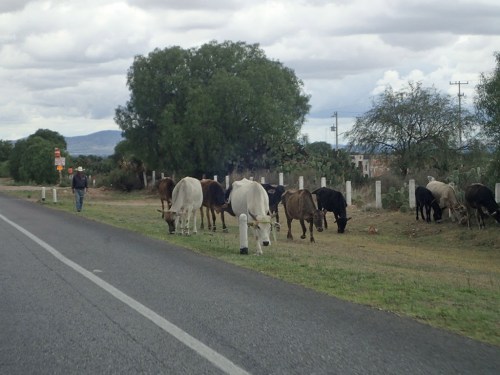
Mexican cattle grazing at the side of a busy highway. This is something that is part of the challenge of driving in Mexico. Photo source: Cozumel4you
We left El Mirador and Huatabampito at 1:30. Google Maps calculated the route as a two-plus hour drive to the aforementioned campground. Fully aware of possible traffic slowdowns and potential nasty road conditions ahead of us, we had little time to spare to get to this “possible” overnighter before it started to get dark. One thing you hear over and over again about driving in Mexico is never drive at night. During the day you can easily see why this is so. Rural Mexico has a lot of farm and ranch land. Vegetable farms are everywhere. I’m impressed (I don’t know why I should be) how rich the agriculture industry appears to be. Even organic farming. Also interesting, and unlike the states as far as I know, is the prevalence of open range for livestock grazing. It is very common to see livestock wandering freely along the roadside, usually, but not always, with someone who keeps them off the highway. I’ve seen cattle mostly, but I’ve also seen horses, burros, even pigs and, of course, chickens. Open range. Imagine, if you will, driving at night with no lights other than your headlights. Disaster waiting to happen.
While on the subject, a few more thoughts regarding “nasty road conditions ahead”:
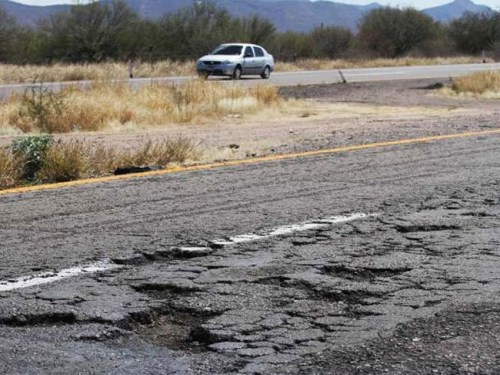
Perfect example of the kind of road condition drivers can face in Mexico. Photo source: Mexiconewsdaily.com
I’ve learned from experience (I don’t mean to sound here like an old road-worn Mexico traveler, which I am definitely not), when driving in Mexico, one must always assume that at least 30 percent (maybe more in some areas) of the roads are going to be in piss-poor shape.
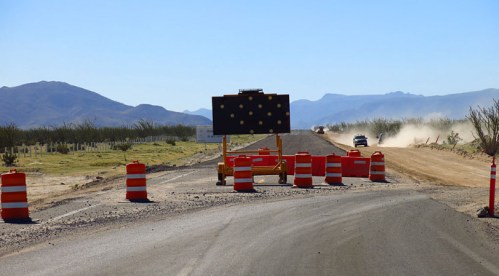
Road diversions in Mexico allow traffic on one side to proceed while the other is being reconstructed. Photo source: pizzamanagement.com
That could mean anything from an undivided highway without shoulders or markings of any kind, to the hated (and feared) las desviaciónes, road construction (actually a good thing) diversions that appear suddenly, without warning, and switch the unsuspecting driver back and forth between a two-lane south-bound highway to a north-bound two-lane, and then back again, and again, and again.
Or it could mean what I like to call “phantom potholes,” those axle-cracking, tire-flattening, bone-rattling, knee-deep craters that suddenly appear out of nowhere in the middle of a perfectly good highway. Or it could mean the kind of endless stretches of rough, ground and broken pavement that you see in highways that are waiting for new pavement.
Traveling in Mexico requires an open mind and a calm spirit in all things. Road conditions like these are simply one of many facts of life in Mexico and you can choose to accept them or not. One fact, for example, is that cuotas or toll roads (autopistas) don’t automatically equate to smooth road conditions. Just not reality. Bad road conditions can exist regardless of whether or not the road is a toll road. I’ve driven on non-toll libres that were in near-perfect condition. Paying a toll on a Mexican highway doesn’t guarantee that the road you’ll be travelling on is going to be in good condition. It doesn’t work that way in Mexico. Remember, this is the land of “magical realism” where “nothing is/But what is not” (sorry, I’m a retired English teacher; I’m always looking for an opportunity to sneak in a Shakespeare reference; Macbeth no less). The “magic” of Mexico comes in part from the unexpected. In the states expectations are always high. Just don’t bring them to Mexico.
Back to the overnighter:
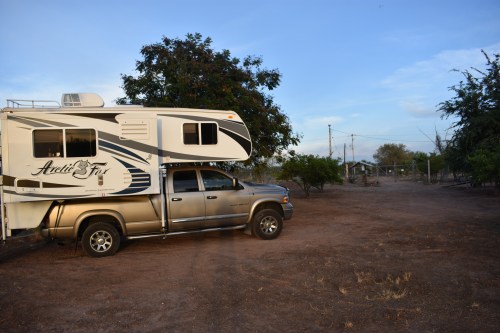
Rocinante parked inside electrified fence of El Jíto as dusk descends.
We did arrive at the campground about an hour before sunset. I was fortunate to have accurate GPS coordinates supplied by Tequila Paul. I would have driven right passed the campground if Jackie hadn’t noticed a woman off to our right waving frantically at us. I turned around and drove back towards a very nice señora who opened the gate to the compound for us.
The campground was made up of both an outer fence and an inner fence. The owner, Adrian Felix Gutierez (Yani Felix for short), was the gracious and friendly proprietor. He had created two separate camping compounds: a fenced outside compound intended for larger rigs, and an electrified fence (¡No toques la valla, señor!) inside compound for smaller rigs. The inside compound is also Yani’s farm, full of ducks and geese, pigs, and other farm animals. He has fruit trees all around.
Yani charged us ten American dollars to spend the night, a little spendy considering the lack of utilities. I wasn’t about to barter; we just wanted a good night’s sleep. It’s easy to understand he was a business man. He had big plans for his campground. He assured us that the next time we stayed, he would have all the utilities we would need. “Even internet?” I asked him. “Of course, señor,” looking a little hurt. “¡Tendremos todo!”
As a way of convincing us how serious he was about his future campground plans, he had his son pull out a freshly painted sign from under his newly constructed palapa that spelled out in very bold, black, if not slightly uneven, letters EL JÍTO on a white background. He had his son reluctantly hold it up high over his head so that we could get the full effect of what it would be like as we drove our RV up to his brand new gate. “El letrero es muy bonito, ¿no?” ¡Claro que sí, señor! Of course, I told him.
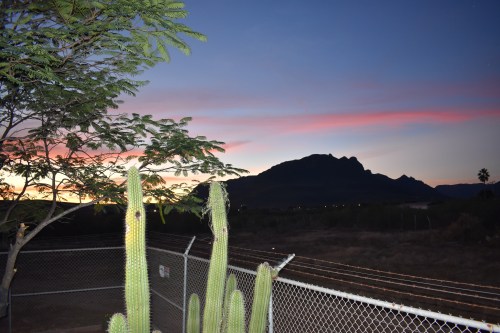
View of the electric El Jíto’s electric fence at nightfall with mountains north of Los Mochis in background. Site was actually perfect for an overnighter.
Before we left the next day, I told Yani I was so appreciative that he flagged us down so we could stay at his campground that I was going to let the whole world know where he was located by posting a review on ioverlander.com. All I needed was his name. He was so thrilled that I would do such a thing for him, he gave me his business card which, besides his name, also indicated that he was an owner of a thirty-room hotel in Los Mochis. Señor Yani was quite the business man.
 Call and Response