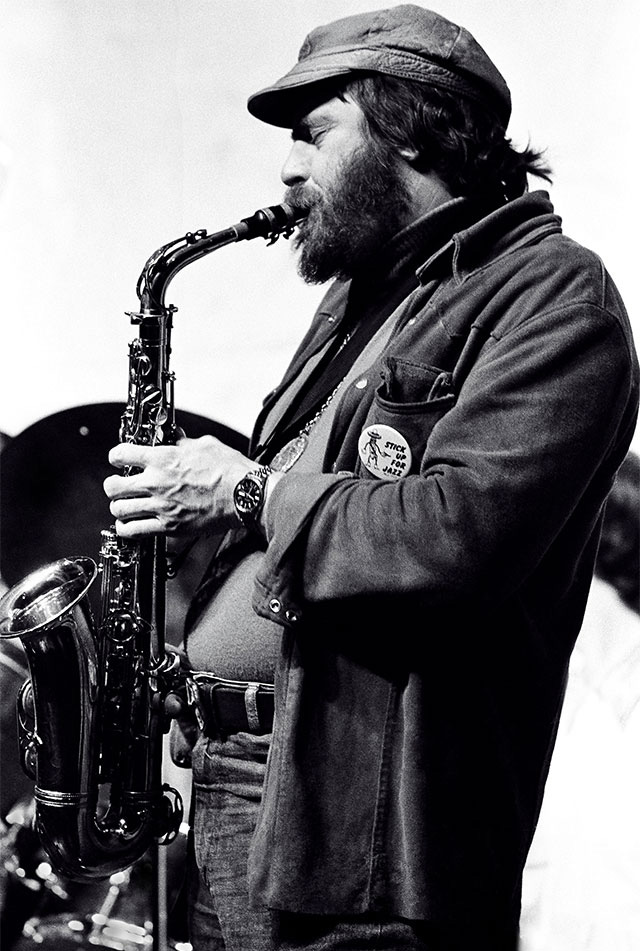
Phil Woods in 1978. Photo by Tom Marcello.
Sad news on the jazz scene: I heard from Jazztimes.com last week that the jazz world lost a jazz giant recently. Jazz legend, altoist Phil Woods passed away this past month on September 29th. Below I list songs performed by Phil Woods that I played on the show last week and offer a few thoughts about Phil Woods.
Phil Woods come along as a musician during an era in jazz that for a variety of reasons was in decline. Had Woods been born ten years later, his musical influences would have been radically different. He would not have been able to, as he says, learn at the feet of the Masters. Two things stand out in my mind that made this possible: time and place.
Consider, for example, where Phil Woods stood on the jazz history timeline  when he first started playing seriously as a young man. He was born in 1931. It was the early forties when Woods got his first saxophone at the age of twelve-years old. By thirteen he had found a local teacher who introduced him to the music of Benny Carter, Johnny Hodges, and Duke Ellington, and taught him how to improvise. And by the age of sixteen, in 1947, he was studying music in New York City under the tutelage the great jazz teacher and bebop piano player Lennie Tristano. But Woods would tell you he really came to NYC to hear Charlie Parker. As important as that first really good teacher is to a young musician, it is just as important for a young, developing musician to have a hero to emulate; for Phil Woods, that was Charlie Parker. So because of fate
  or destiny or whatever mysterious agent who creates the dynamics of these things, it was inevitable that time and place would conspire to allow an impressionable Phil Woods to fulfill that destiny and hear Charlie Parker play his alto live, and eventually jam with him.
Also, the chance to go to NYC, study under Lennie Tristano, and meet Charlie Parker, however, could never have happened if Phil Woods was born in Chicago or St. Louis or LA. There would have been different influences, of course, and Woods’ music, obviously, would have been different. Instead, he grew up in Springfield, MA, a small town comparable in population to Eugene, OR. Growing up in Springfield put Woods in close proximity to New York City, 150 miles away. A three to four hour bus ride! A day-trip from NYC by bus made lessons with Tristano in the summer of 1947 possible. Sixteen-years old and taking music lessons from Lennie Tristano. Amazing. After lessons with Tristano, he and his
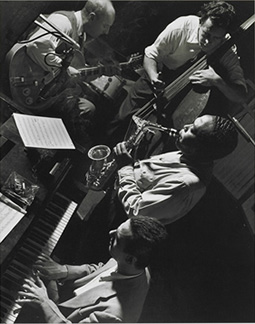
Lennie Tristano, piano; Charlie Parker, alto; Billy Bauer, guitar; Eddie Safranski, bass; NYC 1946
pal Hal Serra, who played piano, would head to Manhattan to hang out and buy records and go to the jazz clubs on 52nd St. to hear the jazz musicians perform. He finally got his chance to hear his hero live when Tristano invited him to the club where Tristano and Parker were performing. After the show, Woods and Serra were invited backstage to meet Bird, who was eating cherry pie. Woods said in an interview, “I’ve always wanted to meet God.”
The genesis of Phil Woods’ as a master altoist is part of a pattern or cycle that all great jazz musicians (or any great musician for that matter) experience. Like the young Louis Armstrong who stands on a sidewalk outside the Funky Butt Hall in New Orleans, listening to Buddy Bolden play the cornet for the first time and imagining that he too could someday play like that; and like the young Bix Beiderbecke from Davenport, IA, listening to the jazz sounds of Louis Armstrong’s cornet wafting from the deck of a Mississippi riverboat, dreaming of making cornet sounds like that; and also Phil Woods’ dreaming of meeting Charlie Parker (“God”) changing his musical life forever.
Woods tells a story that he probably has told dozens of times in interviews and on stage to audiences about an encounter he had once when he was very young with Charlie Parker. The story is a kind of modern-day parable Woods likes to tell because it reveals a particular truth he learned about himself and about human experience in general, and his public retelling is intended to do what parables do: teach us all lessons about human experience. During the early fifties, Woods had become very unhappy with his sound. Having just graduated from Julliard in 1952, he found himself playing “Harlem Nocturne” and “Night Train” ten times a night, every night, at the Nut Club , a striptease
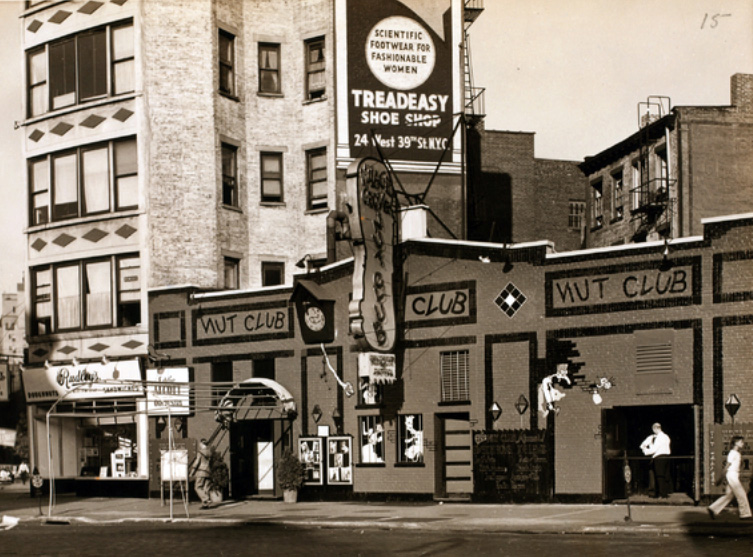
The Nut Club, West Village 1940
joint at 7th Avenue and Grove St. He was dissatisfied with just about everything related to playing the alto—he didn’t like his mouthpiece, he didn’t like the reed, he didn’t like the horn. He didn’t even like the strap. One night someone told him that Charlie Parker was playing across the street at Arthur’s Tavern on Grove St. just south of 7th Ave. in the West Village (in operation since 1937 and still going strong to this day), so he went across the street to listen to him. Parker didn’t have his horn, so he had borrowed someone’s baritone to play instead. Woods saw that Parker was having a hard time of it so he offered the use of his own horn. “Son, that’d be very nice.” Parker played “Long Ago and Far Away” flawlessly. While listening, Woods realizes there there was nothing wrong with his horn. “Mouthpiece sounds good. Reed sounds good. Horn sounds good. Even the strap sounded good.” When Parker is finished, he hands Woods the horn and says, “Now you play.” Charlie Parker, the hero, the God, wants Phil Woods to play for him:
When I was done, Bird leaned over and said, ‘Sounds real good, Phil.’ This time I levitated over Seventh Avenue to the Nut Club. And when I got back on the bandstand there, I played the shit out of Harlem Nocturne. That’s when I stopped complaining and started practicing. That was quite a lesson. (qtd. in JazzWax interview with Marc Meyers)
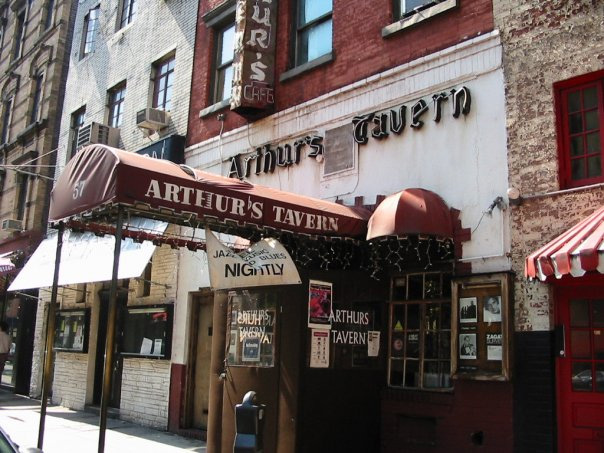
Arthur’s Tavern, Grove and Seventh, West Village
This lesson, of course, is the crux of Woods’ parable. We all face that same moment at some time. You know, the one where we confront our fear, maybe our worst fear; the one that feels like it will change the course of our life if we don’t get it right; the one where we have to decide whether or not to stand our ground, accept the fear, do what we have to do, and then get on with it. Students tell Woods, Man, I can’t play for you. I’m too awestruck. Woods would tell them, “Hell, get over it. I had to play for God.” I love that idea. We all have to “play” for God sometime.
Phil Woods’ playlist for Tuesday night’s jazz show.
Phil Woods Septet “Cool Aid” composed by Woods from Pairing Off (1956) on Prestige — Phil Woods, leader, and Gene Quill, altos; Donald Byrd and Kenny Dorham, trumpets; Tommy Flanagan, piano; Doug Watkins, bass; Philly Joe Jones, drums
Gene Quill Quartet “Crème De Funk” composed by Woods from Phil & Quill (1957) on Prestige — Gene Quill quartet with Phil Woods, altos; George Syran, piano; Teddy Kotick, bass; Nick Stabulas, drums
Donald Byrd and Phil Woods “House of Chan” from The Young Bloods (1956) on Prestige — Donald Byrd, leader, trumpet; Phil Woods, alto; Al Haig, piano; Teddy Kotick, bass; Charlie Persip, drums
Phil Woods Octet “Prelude and Part I” composed by Woods from Rights of Swing (1960) on Candid — Phil Woods, leader, alto; Sahib Shihab, Baritone Saxophone; Julius Watkins, French horn; Tommy Flanagan, piano; Curtis Fuller, trom; Benny Bailey, trumpet; Buddy Catlett, bass; Osie Johnson, drums
The Italian Rhythm Machine with Phil Woods “Samba du Bois” composed by Woods from Woods Plays Woods (2001) on Philology — Phil Woods, alto, with pianist Stefano Bollani, bassist Ares Tavolazzi, and drummer Massimo Manzi.
Phil Woods “Steeplechase” composed by Parker from Ornithology (1994) on Philology — Phil Woods, alto, with an Italian rhythm section led by the fine pianist Franco D’Andrea.
Zoot Sims “Wee Dot” composed by J.J. Johnson from Jazz Alive. A Night at the Half Note (1959) on United Artists — Zoot Sims and Al Cohn, tenors; Phil Woods, alto; Mose Allison, piano; Knobby Totah, bass; Paul Motian, drums.
 Call and Response