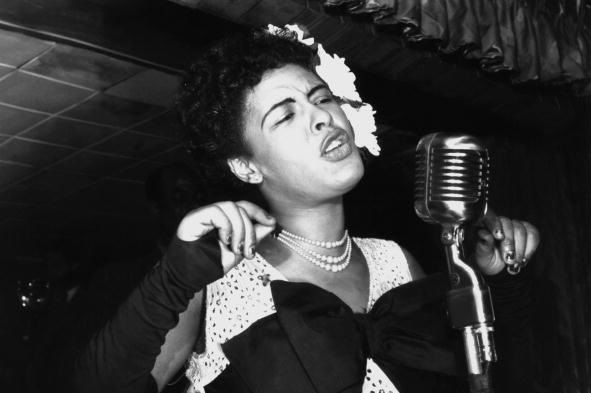
 April is Jazz Appreciation Month and I have been trying to be disciplined enough to highlight at least a few (if not more—depends on discipline) notable jazz artists during the month on this blog.
As it happens, April is one of those months that is rife with the birthdays of famous jazz artists, many of whom are iconic figures in the pantheon of jazz greats. Sadly, I missed Billie Holiday’s birthday last April 7th. It was her 100th birthday! I’ve been on a road trip to Sonora, California, for the next two weeks, so I needed a sub for two of my jazz shows. The first Tuesday I was gone was Lady Day’s centennial.
Billie Holiday’s life was complex and tragic—complex in the sense that such an artist—considered by many to be the greatest jazz vocalist of all time—could emerge from a background of such wretched poverty, rampant racism, sexism, and an industry that sought to silence her voice; tragic in the sense that it seemed inevitable—with the help of bad relationships, questionable friends, alcohol, heroin, and being “hunted” by the Federal Bureau of Narcotics—that she would self-destruct. It may be trite to quote Lao Tzo, but here it is: “The flame that burns twice as bright burns half as long.”
Billie’s discography is immense, even though her actual recording career was only twenty-four years (she made her

Holiday with Teddy Wilson, Newport, 1954
first recording on Brunswick Records with pianist and band leader Teddy Wilson in 1935). A cursory search for Billie Holiday recordings on allmusic.com will reveal hundreds of albums, re-releases, and compilations. Her popularity only seems to grow with younger generations discovering her magnificent voice. This is a good thing.
Billie had many hits to her credit, some more significant historically than others, but arguably her most successful and controversial recording is “Strange Fruit,” first recorded it in 1939. Billie was under contract to Columbia records at the time, and when she approached them to let her record the song, they refused to let her, fearing repercussions from record retailers in the south. Even John Hammond, the record producer who discovered Billie at Covan’s, a club on West 132nd Street in New York City, refused to record it. According to Robert O’Meally in his book Lady Day: The Many Faces of Billie Holiday (2000), she turned instead to Milt Gabler, who owned the jazz record label Commodore Records, and he agreed to record it on his label. Columbia agreed to release her from her contract for one session, and on April 20, 1939, she recorded it with Frankie Newton and his eight-piece Cafe Society Band (the house band at Barney Josephson’s Cafe Society in Greenwich Village, and New York’s first integrated nightclub).
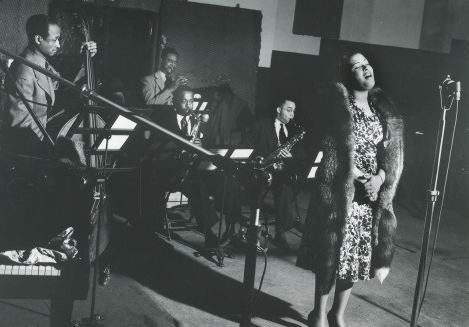
Billie Holiday Commodore “Strange Fruit” session, 1939
The musicians at that session included Frankie Newton, trumpet and leader; Tab Smith, alto saxophone; Kenneth Hollon and Stanley Payne on tenor; Sonny White, piano; Jimmy McLin, guitar; John Williams, bass; and Eddie Dougherty on drums. Billie recorded at least five versions of “Strange Fruit” from 1939 to 1956, according to the jazz discography site jazzdisco.org (however, the extremely thorough and credible Billie Holiday discography web site billieholidaysongs.com lists six recorded versions of “Strange Fruit”; also, Wikipedia claims that there were two Commodore versions, one in 1939 and one in 1944—my cursory research suggests that this is either incorrect or confused).
Most of the versions are readily available and easy to find on any number of compilations. I was able to find them all except the 1939 original version recording. However, purely by accident I came across the 1939 version on a compilation entitled Billie Holiday: Jukebox Hits 1935-1946 on Acrobat records (track 18). It is not, for the time period, a high quality recording, which stands to reason because Commodore Records simply did not have the same quality of  recording equipment that Columbia Records had at the time. Nevertheless, the informed listener senses the importance of this session, so sound quality is of minor importance. O’Meally describes Milt Gabler’s concern that the recording would be too short for commercial purposes—Billie’s vocals runs just short of two minutes. So Gabler had Frankie Newton and Sonny White improvise solos for the first sixty seventy seconds. Frankie Newton takes the first solo, playing a mournful sounding trumpet solo for the first twenty-five seconds. Sonny White on piano improvises for the remaining time until Billie begins her vocals. The result is as close to the kind of performance we might have heard Billie actually give at the Café Society in 1939 in front of a racially mixed audience. When Abel Meeropol first heard Billie sing his masterwork, he said,
“She gave a startling, most dramatic and effective interpretation of the song which could jolt the audience out of its complacency anywhere. This was exactly what I wanted the song to do and why I wrote it. Billie Holiday’s styling fulfilled the bitterness and the shocking quality I had hoped the song would have. The audience gave a tremendous ovation.”
 Call and Response