Clavellinas RV Park, San Antonio Tlayacapan
After two days at Roca Azul, we were anxious to move on to Ajijic. The town is about 17.5 miles east along carretera hwy 23, a heavily traveled and well-worn road. Since the new 15D Libramiento opened a year or so ago, the carretera is getting a good deal more traffic.
Travelers coming from Tepic and the pacific coast heading for Lake Chapala area can now bypass Guadalajara to the west instead of using the Anillo Periferico Sur. The Libramiento saves a good deal of time and I gotta tell you, the pavement on the Libramiento is as smooth as silk.
The Church’s book Traveler’s Guide to Mexican Camping (invaluable resource for us on this trip even though most recent 4th edition was published in 2009) mentions Roca Azul as the only open campground.
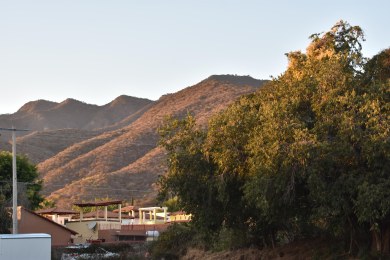
Sunrise on the Sierra de San Juan Cosala mountains just to the north of Clavellinas.
However, since 2009, three campsites have opened: the RV Park Chapala, six miles north of Chapala in the Sierra de San Juan Cosala mountains; Ajijic RV Park, on Calle Rio Amazonas in the foothills of the mountains, on the west side of Ajijic, quarter mile north of the carretera; and Clavellinas RV Park in San Antonio Tlayacapan. Clavellinas is the only campground without a presence on the web, but I managed to find the park and a phone number by doing a general search of the Ajijic area in Google Maps.
Clavellinas, Arturo, Lete y Agua
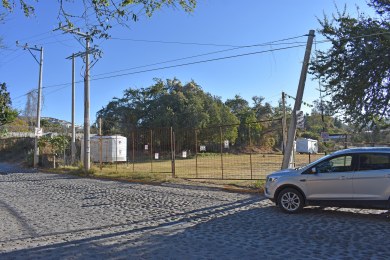
Double-gated front entrance to Clavellinas RV Park. Entrance is on Calle Allen W. Lloyd. Street tends to be very busy almost all hours of the day because of the gated gringo community El Parque directly across from Clavellinas, with cars constantly coming and going , and the traffic going to and coming from the Instituto Loyola de Chapala (private school) up the street in the mornings and afternoons.
From the descriptions on the web, the campgrounds all looked fairly promising. Of the three I called, only Mauricio of Clavellinas RV Park answered his phone. Mauricio, the owner’s son who spoke excellent English and was very friendly, told me there was plenty of room and when I arrived, I should contact Arturo and Lete, who run a landscaping business that borders the south side of the park. He told me Arturo has the keys to the main security gate, and he would let me in when we arrive.
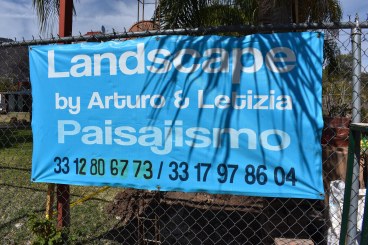
Arturo and Leti’s negocios de paisajismo in San Antonio
Both Arturo and Lete, who I assume are married, but I have yet to have confirm that, run a modest landscaping business and take the rent from the campers. They both speak English pretty well and tolerate my attempts to practice my Spanish on them. They are both very good people who clearly work very hard to run their business and keep Clavellinas open to campers who often come at all hours of the night.
Clavellinas, which, by the way, is a dianthus-like flower, is in the small Mexican village of San Antonio Tlayacapan between Ajijic and Chapala. It took me a while before I realized that San Antonio is a village separate from Ajijic, which is roughly a mile west of where we are. The perimeter of the park is completely fenced and padlocked for security purposes. When I first met Arturo the day we arrived, he gave us a key and explained to me in no uncertain terms that I was to keep the main gate chained and locked at all times.

With Rocinante unloaded, we can use the truck to run errands and explore.
There are six level concrete pads for campsites and patio space, and each site has its own functioning electrical and sewer (drenaje), but not water. Access to water was an issue. Only one site had a functioning faucet and that with very little water pressure.
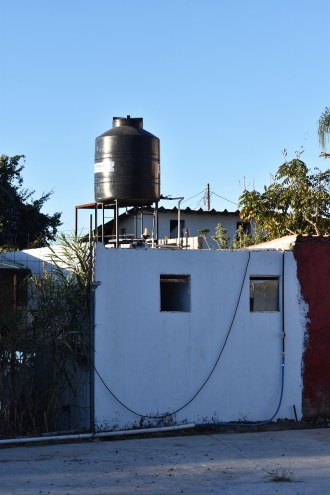
Cistern sits on top of building used by La Paceña restaurant.
Looking around, I spotted a vertical length of PVC pipe with a ball valve running up the side of a small building where it was attached to one of those ubiquitous water cisterns sitting on the roof. As soon as I opened the ball valve, I heard a pressure pump kick on (a first for any Mexican campground we’ve visited) and water under pressure started gushing out.

Vertical PVC with ball valve visible on the right side. I hooked my hose directly to the base of the pipe which, fortunately, had a threaded fitting. This was the only direct water source in the park.
I asked Arturo about it and he told me, “¡Sí, sí, señor, usalo, usalo!” To do so I had to connect two 25 ft. hoses. The pressure when the pump was going measured at 40 PSI, so I even had to use a pressure regulator, which is another first in a Mexico campground.
Emanuel y una Larga Historia
We also met a young Mexican man named Emanuel who is somehow connected with Clavellinas. He spoke no English, and was, apparently, the go-to person for all things related to the rv park and the landscaping business. After he introduced himself, he gave me his cell number and told me, “Llámame, señor, si hay problemas.” His relationship with Arturo or the owner’s son, Mauricio, was somewhat of a mystery to me, but I got the feeling he was family.
When we first arrived at Clavellinas, there was an old, beat up and faded red Toyota Hilux that I think belonged to him parked in the spot right next to us. It was sitting on four flat tires, the pickup bed full of miscellaneous construction tools, empty bags of cement, plastic buckets, and other odds and ends.
Apparently, he got the word one day that he needed to move his rig, probably to free up a camp site. So one day he and a friend showed up with an electric air compressor and a box of tools clearly intent on getting the truck started. Problem was the battery was dead and they had no jumper cables. Instead, it looked like they were going to rig something up they could us with lengths 12 gauge wire Emanuel’s friend had on hand. I watched them problem solve for a bit, trying to attach one end of the wire to the good battery and the other to the dead battery by wrapping the wire around the terminal posts.
As the situation began to unfold before me, I saw right away no good was going to come of this. Jackie said, “Why don’t you just help them out instead of watching them?” Good point. So I went out there and in my pathetically simplistic Spanish (no time for Google Translate; this was an emergency), I asked Emanuel, “¿Necesita cables de batería, señor?”
From the expression on their faces, I figured my Spanish had to be fairly spot on. So I lent them a set of jumper cables I had, and they set to work. Not more than ten minutes later, Emanuel knocked on the camper door and told me his rig was out of gas (I’m translating the gist of what he said; there was a good deal of gesticulating to help convey the message) and he was going to try to buy some gas, problematic at best since Ajijic gas stations were out of gas at the time. He wanted to know if he could keep the jumper cables. I told him sure, hang on to them until he was finished. He thanked me profusely and, as a sudden afterthought, he turned and asked me if las luces funcionando y si tiene agua suficiente agua. Then off he went with his friend, leaving the faded red Hilux behind.
A few days later, when I went out to turn on the propane tank in the morning, I noticed the Hilux was gone. Somehow while everybody was asleep, Emanuel got the truck gassed up and started and then drove off in the middle of the night. I didn’t see him again for a couple of weeks, but he finally did return the jumper cables, and again, before he left, he asked me if las luces funcionando y si tiene agua suficiente agua. ¡Todo bien, Emanuel, todo bien!
Para Terminar: Algunas Photos de San Antonio Tlayacapan
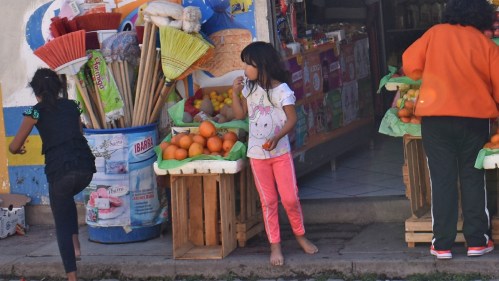
Una niña comiendo fruta in San Antonio
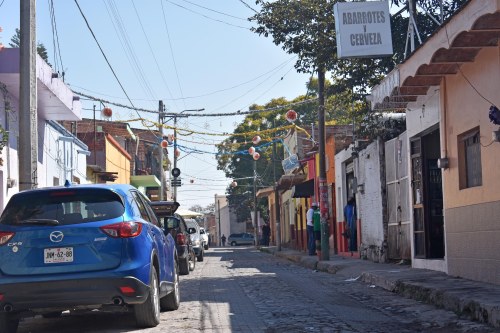
Arbarrotes y Cerveza: San Antonio street scene:
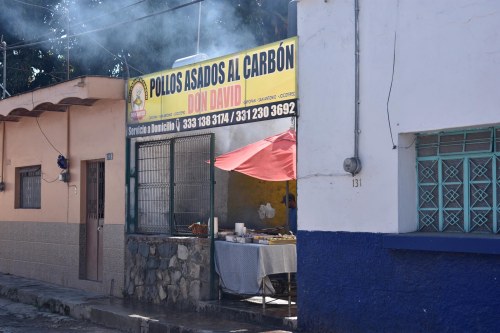
Our favorite pollo asado place; 125 pesos ($6.50) for a whole grilled chicken with tortillas, arroz y papas!

La casa limón en San Antonio

La casa naranja
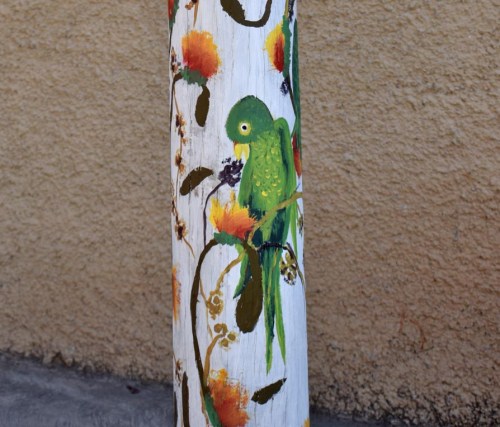
Everywhere you go in the San Antonio neighborhood we find power poles painted by children.
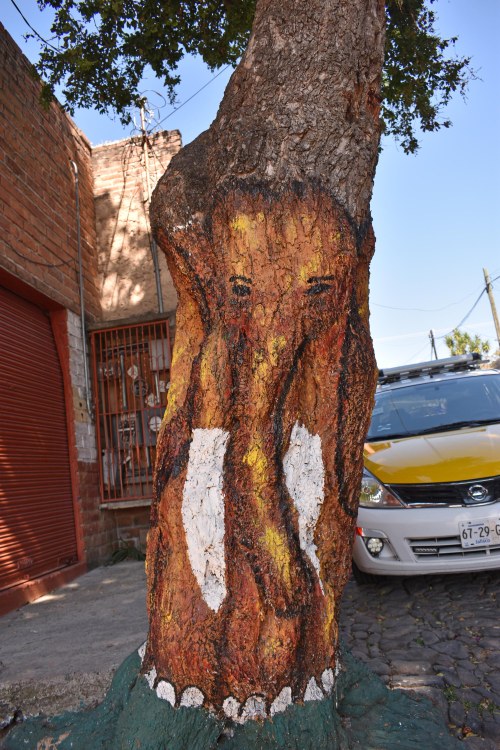
Tree “trunk” curbside in the neighborhood.
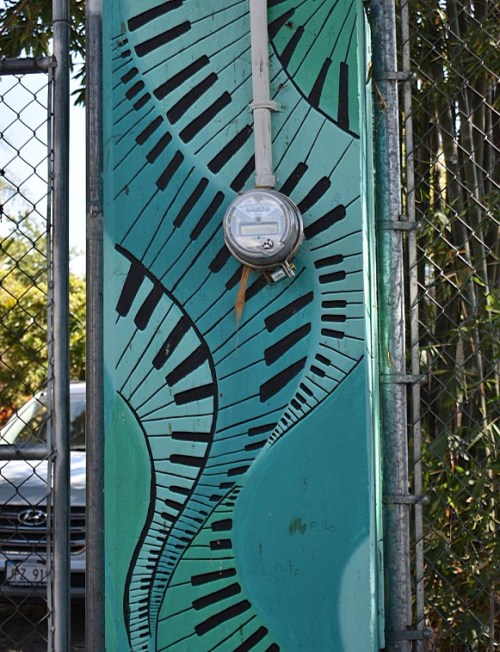
Another example of art found everywhere in San Antonio neighborhoods
 Call and Response