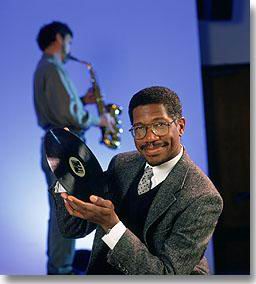
 Now that I can look back at my experiences at the NEH Jazz Institute: Teaching Jazz as American Culture from an objective distance, I can say with certainty that for me this was truly an experience of a lifetime, but not because the institute was ready made for the lifelong jazz enthusiast (which admittedly I am), and not because of the opportunity to study jazz with a variety of teachers from all over the country at one of the country’s most beautiful campuses, Washington University in St. Louis, and not because of the chance to meet and study jazz with Gerald Early (okay, maybe), but, as it turns out, for subtler, less obvious reasons.
They are less obvious because the experiences I came away with were not at all the ones I had expected. I guess you could say my original expectations were selfish and self-serving: to listen to jazz, study the lives of the jazz greats, and then become a jazz trivia expert. But the real mission of the institute did not allow for a narrow, names-and-dates jazz-enthusiast approach to the study of jazz. Instead, we were at the institute to understand how a humanities approach to our study could enrich and broaden our students’ understanding of American culture. I’ve taught high school for 22 years, and I’ve listened to jazz for most of my life, but it wasn’t until I attended the institute and listened to what the amazing variety of jazz scholars, historians, and musicians had to say about jazz and culture that I began to understand the wider implications of using jazz as a cultural learning tool in my classroom.
So then the question I came away with, the one for my students (or more aptly, one they will have for me), is a fundamental one: Why do they (or anyone for that matter) need to know anything at all about jazz? From a high school English teacher’s perspective, the answer is more problematic. Unfortunately, we have become so focused on teaching the approved literary canon or, worse, teaching to the state test, that we as English teachers have lost focus on what may be most important for our students—that is, a clearer, wider understanding of the culture that produces the very literature we want our students to examine and to have something intelligent to say about it. What the scholars and musicians at the institute have helped us to understand and recognize about the value of jazz as a cultural learning tool can best be described by Ralph Ellison, in Robert O’Meally’s introduction to Ellison’s collection of jazz writings Living with Music, as the “blues-based jazz element” that is “at the core of twentieth-century American culture.” What we want our students to realize, then, is that jazz is at the heart of their own experience. What this means for the high school classroom teacher, in any content area since many content areas were represented at the institute, is that the study of jazz can help students understand and experience the value of their own cultural heritage, and in so doing, they can begin to look outside of themselves and achieve a deeper understanding of who they are. The power of jazz, as a teaching tool, comes not from the music alone; it comes from the students’ realization, finally, that the origin of the very music they love and listen to on a regular basis has its roots in jazz. We, as teachers, must help our students to acknowledge and connect jazz with their own experiences.
What I found most productive about my experience is the fact that the institute itself became the model for a humanities approach to teaching jazz as American culture in the classroom. If I were to put myself in my students’ shoes, I would experience a variety of different ways to understand or come to terms with jazz as cultural artifact. As students at the institute, we experienced jazz in a wondrous kaleidoscope of forms: as history, examining jazz’s origins in New Orleans; as dance, watching jazz dancers, both tap and ballet; as literature in the jazz writings of James Baldwin, Langston Hughes, and Ralph Ellison; as film soundtrack, bio-pic, and musical; as art in the collages of Romare Bearden and in the jazz quilts of East St. Louis artist Edna Patterson-Petty; as a political statement during the civil rights movement; as gender studies with the all-girl swing bands of the ’40s; and as jazz in performance with Bucky Pizzarelli, Pat Martino, and OGD trio of St. Louis jazz musician Reggie Thomas. We took our experiences at the institute and as a result of our collaborative efforts translated them into a variety of useful lesson plans reflecting a variety of content areas that we can all take into our classrooms.
In a film about the artistic process of Romare Bearden, he is quoted as saying, “If you’re any kind of an artist you make a miraculous journey and you come back and make some statements in shapes and colors of where you were” (The Art of Romare Bearden, 2003). I find the quotation fitting; all of us at the institute made this “miraculous” journey; now it’s time for us to make some statements in “shapes and colors” of where we were.
(Essay was originally published in the Sept-Nov 2005 edition of Belles Lettre: A Literary Review)
 Call and Response