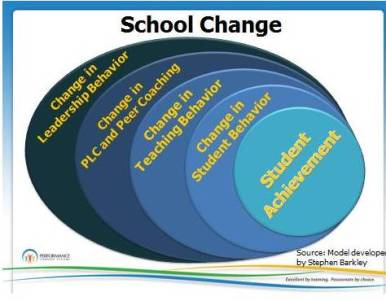
 It might be worthwhile to mention that rarely do school districts get in-services or professional development right. I’m sure I’ve participated in some that were okay, but, as I recall, many were just painful, sometimes even embarrassing. While there is much to dislike about Common Core State Standards (particularly annoying is the constant and shrill battle cry of “college and career readiness!”), the one thing educational think tank organizations seem to finally understand is that any successful professional development related to instructional improvement and student achievement has to be more than “sit-and-get,” “one-shot workshops.”
One of the more visible groups out there dedicated to influencing policy decisions is Education First. They’ve gone to great lengths to make it clear that Professional Learning (that’s the phrase they like to use instead of professional development) is a crucial piece to the successful classroom implementation of CCSS.
An interesting document that might be worth looking at—if for no other reason than to compare the ideal to the real—is their “New Essential Elements to Professional Learning.” One of the pull quotes reads, “The professional learning systems we identify and argue for in this brief move away from a top-down model where teachers work in isolation to a model emphasizing collaboration, coaching and peer accountability.”
What Education First misses is that putting such a model into practice flies directly in the face of the realities that confront far too many school districts: “collaboration” and “coaching” require funding if teachers need to be out of their classrooms; collaboration, coaching, and peer accountability require a culture that fosters a willingness to collaborate, to be coached, and to accept feedback from peers; and, finally, to acknowledge that leadership for implementing these “professional learning systems” must come from the teaching staff and not administration.
The final point here is that improvement of student achievement must be a product of genuine collaboration among all “stake holders,” including students, teachers, aids, and administrators. Believe me I know that it is much easier to make this point than it is to actually change the culture of the school enough to make this really happen.
 Call and Response