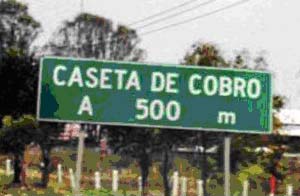
Often we’ll see Caseta de Cobro signs warning us of toll booths ahead; just as often we may see Caseta signs leading to toll booths that have long since been removed or closed. That’s Mexico!
Las Distancias de Mexico
It’s 220 miles from Celestino Gasca, Sinaloa, to Tepic, Nayarit, and then another 150 miles to Roca Azul on Lake Chapala, Jalisco, our final destination for a while. Looking at Google Maps, point-to-point distances don’t seem to be that great, but distances are relative on Mexico’s highways and deceiving on maps.
Before leaving Villa Celeste, I asked Noé, el dueño del lugar, about the drive to Tepic (Side note: I also call him el mosquito comedor because one evening while chatting, a mosquito suddenly flew into his mouth; after a momentary fit of gasping and hacking, and without missing a beat, as if this sort of thing happens all the time, he continued his conversation as if nothing happened).
He told me, “It’s no, problem, my friend. It is only a four-hour drive to Tepic. It’s not that far. So why not drive all the way to Chapala? To there only six hours, my friend. And you would be there so much sooner, which is better, no?”
Noé, eternally affable, was in the habit of always referring to me in English as “my friend” and to Jackie as “my lady.” In return I started referring to him as mi amigo—emphasis on mi amigo. He smiled at me every time I did this, amused by my Gringo sense of humor.
At least part of understanding the reality of Mexico, however, requires the Gringo Traveler to conceive of time and distances in a far different way from that which exists in Gringolandia.
Tony Cohen, Mexico travel writer, refers to this idea as Mexican Time—the difference between stated and actual time. Perception of distances in Mexico involves a similar kind of reality. Just as time in Mexico is relegated to personal interpretation, so also are distances. “I’ll be there tomorrow” has the same semantic weight and ambiguity as “it’s not that far.” Tomorrow could easily become a week; a hundred miles could easily become five hundred. Not so strangely then, the opposite is also true: “I’ll be there in a week” could mean expect them tomorrow; “It’s very far away” could also mean “It’s closer than you think.” Such is the reality of time and space in Mexico.
Add to this the unexpected challenges on Mexico highways that Guia Roji’s Mexico Tourist Road Atlas, probably the most comprehensive Mexico “paper” map, and the wildly popular Google Maps couldn’t possibly account for. Despite Noé’s calculation and Google Map’s estimation, the reality is that it took us over five and a half hours just to reach the Tepic Trailer park. As I said, such is the reality of time and space in Mexico.
The Challenges of Mexican Highways

The lines in this photo are small, however, there are multiple booths. Often there is only two booths that are actually in service, which causes long lines and waits. Pero no hay problema!
A combination of different challenges conspired to slow us down. For one, toll booth stops: we encountered eight or more stops at caseta de cobros along the way. And at each one not only the lines of cars and semi-trucks waiting in front of us to pay their tolls slow the flow of traffic down, but also the locals, hoping to make a few pesos, staking out the entrances to theses casetas, trying to sell everything from pan to coconuts, will slow traffic down as well. If I’m not 100 percent alert, there is a strong likelihood that I could run into someone.

Vehicles waiting in lines to pay their tolls make for perfect potential customers by locals who are selling just about anything to folks waiting in their cars and trucks.
Often we’ll see muchos jovenes running around, in front of, and behind cars, trying to get paid for washing your windows, whether you want them to or not. On one occasion, a young boy held up a crumpled American dollar and started waving it back and forth in front of the window for no apparent reason I could tell. Maybe he wanted to exchange dollars for pesos? Haven’t been able to find anyone who can explain that to me yet.
El Diablo está en el Tope
There are times when the cuotas or toll roads will take you through very small villages, which means encountering Mexico’s dreaded, yet very effective, topes. Drivers are immediately forced to slow down for these speed bumps or risk serious vehicular undercarriage damage (VUD).
Because the Mexico Dept. of Transportation just can’t get around to all of the topes in Mexico to install tope warning signs,the residents themselves will put up their own signs to ensure traffic slows down enough to create potential customers as is the case below:
Most often there are clearly signs that warn us of impending topes, and sometimes there are a series of topes pequeños that gradually lead to the ”big one.” As I have mentioned before here, often these topes are like phantoms—sometimes visible to the eye, sometimes not. However, sometimes you can spot them because local villagers will hang out on both sides of these topes hoping to sell you something when you slow down..
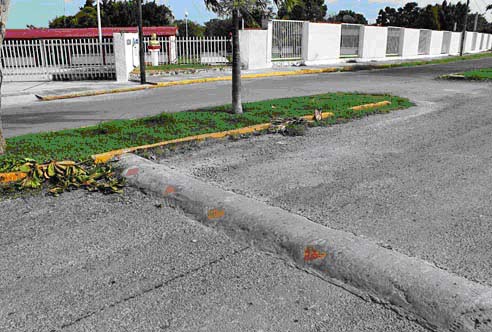
Standard size topes do not exist: they come in all shapes and sizes. All can be dangerous and destructive if not seen in time. Some are painted in yellow stripes; some are virtually invisible like this one.
Demonios de Velocidad Mexicanos
Then there are the Mexican drivers themselves who drive as fast as they possibly can with seemingly complete disregard for the safety of their fellow drivers.
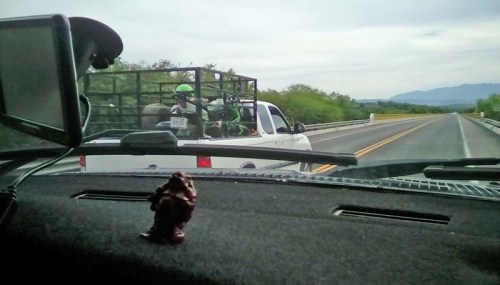
Buddha riding on the dashboard of my truck, a pickup, out of nowhere, passes me doing at least 100 mph. If I see them behind me in time, I usually pull over to the right as far as I safely can (photo by Jaxter).

Mexican truck drivers can be particularly dangerous if you aren’t prepared. As you can see from the photograph, I’m straddling the white line on the right giving the trucker as much room to pass on my left as I can. The photo shows him in the process of pulling in front of me, cutting it pretty close. But these drivers are very experienced and know these roads like the backs of their hands (photo by Jaxter).

Small truck passes me too close on the left. All too often we’ll see these small pickups going at insanely high rates of speed full of people in the back. Is this not dangerous? Yes, of course. Yet, this is the “way of the highway” in Mexico (photo by Jaxter).
 Call and Response